
A practical guide for small farm operators and hobby farmers — matching baler type, bale size, tying system, and PTO requirements to compact tractors in the 25–50 hp range without overloading the tractor or under-delivering on bale quality
The majority of the world’s farm tractors are compact machines in the 25–50 hp range. Whether a two-wheel-drive unit on a smallholding in Southeast Asia, a compact utility tractor on an orchard in southern Europe, or a garden-scale tractor on a hobby farm in North America or Australia, this is the power class that most small-scale farmers actually own — and it is the power class that most baler manufacturers’ brochures quietly underserve by leading with their largest, most impressive, highest-horsepower machines.
A farmer with a 35 hp tractor does not need to know about a baler that requires 250 hp. What they need to know is: which balers are genuinely compatible with compact tractors under 50 hp; what bale size and output those machines produce; how to avoid the most common mistake of overloading a compact tractor with a baler it cannot drive safely; and how to match the baler specification to the crops and markets available on a small farm operation.
This guide answers all of those questions with specific machine guidance, PTO requirement data, and practical decision criteria for small farm operators buying their first baler or replacing an ageing machine.
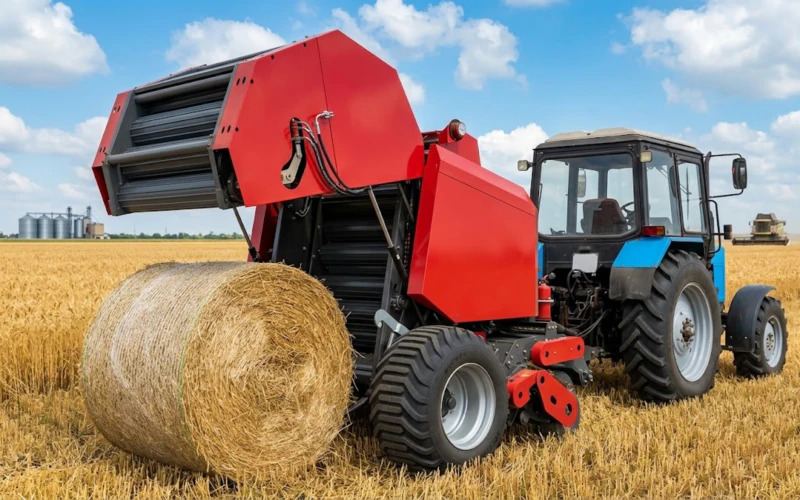
Why Tractor Power Is the First and Most Important Baler Selection Criterion
Baler power demand is not a smooth, constant load. Every baling machine — round or square — imposes peak torque spikes on the tractor’s PTO during the compression and tying cycles that can be significantly higher than the steady-state average draw. On a round baler, the peak load occurs as the bale reaches its final density and the chamber pressure rises. On a square baler, the peak load occurs during the plunger compression stroke — a sudden, high-force impact that sends a torque spike back through the PTO shaft to the tractor.
A tractor operating a baler at or near its maximum PTO power output has no reserve for those torque spikes. The result is: engine stalling during peak load events; excessive clutch slipping that wears the tractor’s PTO clutch; PTO shaft overload that causes premature universal joint and slip clutch wear; and — over time — accelerated wear on the tractor’s transmission and final drives from the repeated shock loading.
The 80% Rule for Baler-Tractor Power Matching
A baler should draw no more than 80% of the tractor’s rated PTO power at its normal steady-state operating load, leaving 20% in reserve for peak torque spikes and inclines. If a baler is rated at 30 hp PTO draw, the minimum tractor for safe operation is 30 ÷ 0.8 = 37.5 hp — call it 40 hp minimum. At 35 hp tractor PTO output, the baler would be consuming 86% of available power under steady load, with torque spikes pushing the tractor over its limit on dense swaths and uphill passes. Apply this rule to every baler you consider before purchase.
The good news for small farm operators is that there is a well-developed class of mini and compact round balers specifically engineered for the 25–50 hp tractor range. These machines are not scaled-down versions of larger balers with the same mechanical complexity — they are purpose-designed for the compact tractor market, with simplified drive systems, lower working width pickup reels, and bale chamber dimensions calibrated to the realistic throughput that a small tractor can sustain. Understanding what this machine class offers — and where its limits are — is the foundation of a good baler purchase decision for a compact tractor farm.
The Mini Round Baler: What It Is, What It Produces, and Who It Suits
The mini round baler is the correct machine class for compact tractors in the 25–50 hp range. It produces cylindrical bales in the 300–700 mm diameter range — significantly smaller and lighter than standard round bales — and is designed to operate at 540 rpm PTO with power draws in the 15–30 hp range that leave an adequate reserve on a 35–50 hp tractor.
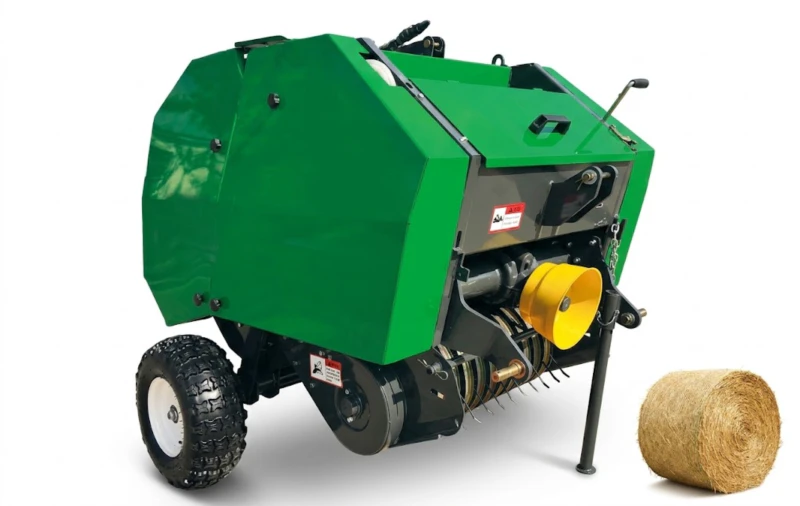
Key Specifications of the Mini Round Baler Class
| پیرامیٹر | Mini Round Baler (e.g. EP-9YK-870) | Standard Round Baler |
|---|---|---|
| Tractor PTO power | 25–50 hp | 60–120 hp |
| PTO speed | 540 rpm | 540 / 1,000 rpm |
| Bale diameter | Φ500–700 mm | Φ900–1,800 mm |
| Bale width | 500–700 mm | 900–1,250 mm |
| Typical bale weight (dry hay) | 20–80 kg | 150–500 kg |
| Pickup width | 700–900 mm | 1,500–2,200 mm |
| Tying system | Rope wrap / twine | Net wrap / twine |
| Machine weight | 350–600 kg | 1,500–4,000 kg |
| Mechanical complexity | Low — suitable for basic maintenance skills | Medium to high |
Who Benefits Most from a Mini Round Baler
Small Livestock Farms
Farms keeping sheep, goats, or a small beef herd benefit from mini bales that can be carried and placed by one person without a loader tractor. A 40–60 kg bale is manageable by hand; a 400 kg standard round bale is not.
Orchards and Vineyards
Orchard understorey grass management requires compact, manoeuvrable equipment. A mini round baler on a 35 hp tractor fits between tree rows that are inaccessible to larger machinery, converting cut grass to stored hay rather than leaving it as a fire risk or pest habitat.
Hobby Farms and Equine
Horse owners who produce their own hay prefer small bales that can be handled without machinery. A mini bale size suits the individual feeding requirements of horses without the wastage associated with large bales that cannot be fully consumed before spoilage.
Smallholdings in Developing Markets
In markets across South and Southeast Asia, sub-Saharan Africa, and Latin America, small farms with two-wheel-drive tractors of 25–40 hp represent the majority of the agricultural equipment fleet. Mini round balers are the appropriate technology for these farmers to mechanise straw and hay baling.
The PTO Shaft: Matching the Driveline to the Compact Tractor and the Baler
دی پی ٹی او شافٹ is the mechanical link between the tractor’s power take-off stub and the baler’s input gearbox. On a compact tractor operating a mini round baler, the PTO shaft must be correctly specified in three dimensions: connection type at both ends, working length range, and power rating. Getting any of these wrong results in a driveshaft that either does not physically connect, telescopes to its minimum length before the baler reaches its working position (creating a dangerous rigid shaft), or transmits the baler’s torque demand through a shaft rated for less than the load — leading to premature universal joint failure.
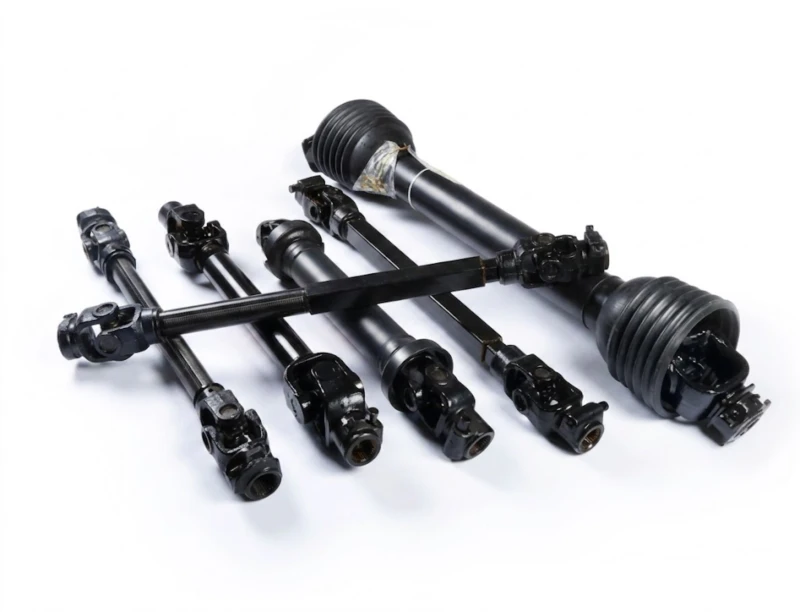
Key PTO Shaft Specifications for the 25–50 hp Baler Application
- Connection type: Almost all compact tractors in the 25–50 hp range use a 1–3/8 inch 6-spline PTO output stub (the international standard for tractors below approximately 75 hp). Confirm the baler’s input shaft spline specification matches — some European balers use metric spline patterns that require an adaptor.
- PTO speed: Compact tractors universally run the standard 540 rpm PTO. Mini round balers are designed for 540 rpm input. Do not attempt to operate a 540 rpm baler from a tractor in 1,000 rpm PTO mode — the baler’s internal drive ratios are calculated for 540 rpm input, and 1,000 rpm operation will destroy the baler’s input gearbox.
- Working length and telescoping range: Measure the distance from the tractor PTO stub to the baler input shaft with the baler at its normal working position (hitched, on flat ground). The PTO shaft must telescope freely throughout the full range of hitch movement — from minimum compressed length on raised three-point linkage to maximum extended length when driving through a dip. A shaft that is too short goes solid before the full extension required; one that is too long bottoms out at the compressed end and pushes on the tractor or baler gearbox.
- Slip clutch rating: Specify a PTO shaft with a slip clutch rated slightly above the baler’s normal operating torque demand. The slip clutch protects both the tractor PTO clutch and the baler’s input shaft from the sudden torque spike of a blockage or slug entry. On a 25–35 hp tractor, a slip clutch rated at 300–400 Nm is appropriate for most mini round baler applications.
PTO Shaft Maintenance for Baling Season
Before each baling season, inspect the PTO shaft for: play in the universal joint cross-pins (grasp the shaft and check for rotational backlash at each U-joint — more than a few degrees of play indicates a worn cross-pin bearing needing replacement); condition of the telescoping splines (clean, grease with EP grease, and confirm they slide freely through the full telescoping range without stiff spots); and integrity of the plastic safety guard (a cracked or missing guard is a serious entanglement hazard and must be replaced before operating). A replacement پی ٹی او شافٹ that is worn beyond service limits costs significantly less than the downtime and repair of a tractor PTO gearbox damaged by a shaft that failed under load mid-season.
Crop and Field Considerations for Compact Tractor Baling
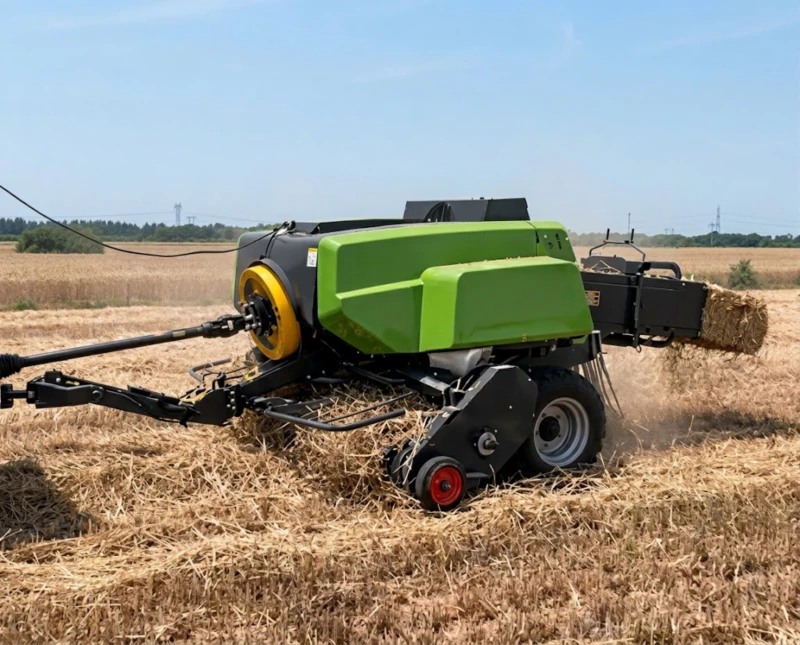
Beyond tractor power and PTO shaft specification, several crop and field factors influence whether a mini round baler will perform well on a small farm operation:
Swath Width and Volume
Mini round balers have pickup widths of 700–900 mm — narrower than the swaths left by full-size mowers on larger tractors. On fields cut with a compact mower leaving 1.2–1.5 m swaths, the operator must tedder or merge swaths to produce a windrow narrow enough for the pickup to handle cleanly. Over-wide swaths for the pickup width are the most common cause of baling blockages on mini round balers.
Moisture at Baling
For dry hay storage, the crop should be below 18% moisture content before baling. Mini round balers produce smaller bales with less internal core mass than standard round balers, which means the heat generated by the fermentation of excess moisture has a proportionally greater effect on the bale exterior. Baling at above 20% moisture significantly increases mould and heating risk in mini bales intended for barn storage.
Field Size and Slope
On slopes above approximately 12 degrees, compact tractors lose effective traction and stability at the rear-axle loading created by a full bale in the chamber at the moment of ejection. Plan baling passes across the slope rather than up and down; match forward speed to crop volume so the baler is never overfull on steep ground; and ensure the tractor’s ballast is appropriate for the rear-mounted baler weight.
Crop Type Compatibility
Mini round balers handle grass, clover, alfalfa, and cereal straw well within their design parameters. Coarse-stemmed crops — maize stover, sorghum, cotton stalks — require a specialised direct-cut baler design, not a standard mini round baler. Attempting to bale coarse-stemmed material through a mini pickup reel leads to rapid tine wear and blockage.
Pre-Purchase Decision Checklist for Small Farm Baler Buyers
Work through the following questions before committing to a baler purchase. Every question that produces an unclear answer is a specification risk worth resolving before the machine arrives.
Tractor Compatibility
- ☐ What is my tractor’s rated PTO output in hp?
- ☐ Is the baler’s rated power draw below 80% of my PTO output?
- ☐ Does the baler use 540 rpm PTO (standard for under-50 hp tractors)?
- ☐ What spline pattern does my tractor PTO stub use?
- ☐ Can my tractor’s three-point linkage lift the baler’s transport weight?
Bale Specification
- ☐ What bale size does my market or livestock feeding system require?
- ☐ Can I handle the bale weight without additional equipment?
- ☐ Do I need rope/twine wrap or net wrap for my storage conditions?
- ☐ What bale diameter suits my ring feeders or storage racks?
- ☐ If selling hay, does my buyer accept the bale format and size?
Field and Crop Fit
- ☐ Is my mower swath width compatible with the baler pickup width?
- ☐ What crop types will I bale — grass, alfalfa, straw, or other?
- ☐ Are my fields flat enough for compact tractor baling without stability risk?
- ☐ What is my seasonal baling volume (hectares and bales per year)?
- ☐ Is the baler’s throughput capacity sufficient for my harvest window?
اکثر پوچھے گئے سوالات
Can I use a 25 hp tractor to run a mini round baler?
Yes — a 25 hp tractor is at the lower end of the practical range for a mini round baler. At 25 hp PTO output, apply the 80% rule: the baler’s steady-state power draw must not exceed 20 hp (80% of 25 hp). The EP-9YK-870, for example, is rated for tractors from 25 hp upward and has been specifically designed for the lower end of this power range with a lightweight pickup reel and efficient chamber drive. On a 25 hp tractor, reduce forward speed in heavy swaths and on slopes to keep PTO load within the tractor’s capacity. In light grass and thin swaths, a 25 hp tractor will operate a mini round baler comfortably.
How many bales per hour can a mini round baler produce?
In typical small farm conditions — grass or mixed hay, moderate yield, flat to gentle slope — a mini round baler on a 35–50 hp tractor produces 15–30 bales per hour. The exact output depends on forward speed, swath volume, and the time taken for wrapping and ejection at each bale cycle. In practice, a small farm operator working alone at a comfortable pace will produce 100–200 mini bales in a full day of baling — sufficient for most small to medium smallholding hay needs in a single productive cutting day.
What happens if I run a baler that is too large for my tractor?
Running an oversized baler on an underpowered tractor causes several problems simultaneously. The tractor engine stalls or lugs down during peak bale-compression loads, causing fuel consumption to spike and exhaust temperatures to rise. The PTO slip clutch engages repeatedly as the tractor cannot maintain 540 rpm under load, wearing the clutch faces rapidly. The repeated shock loads transmitted back to the tractor through the PTO shaft accelerate wear on the tractor’s PTO gearbox and transmission. Over a season, this produces expensive tractor repairs that cost significantly more than the baler. Match the baler to the tractor — not the baler to what you wish the tractor could do.
Are mini round bales accepted by commercial hay buyers?
Mini round bales are accepted in specific market segments — primarily horse hay, small ruminant forage, and direct-to-consumer hay sales where buyers prefer a manageable bale size. They are not standard in feedlot hay supply, export markets, or dairy ration supply chains, which require the standardised large square bale format. For a small farm selling hay locally to horse owners, sheep farmers, and hobby farms, mini round bales are a perfectly marketable product. For supply into formal commercial channels, larger bale formats are required — which means either upgrading to a standard round or square baler, or contracting with a neighbouring larger operation to rebale or reformat the hay.
Conclusion: The Right Baler for a Small Farm Is the One That Matches the Tractor You Have
The single most important decision criterion for a small farm baler purchase is tractor compatibility — not bale output, not machine features, not brand reputation. A baler that is correctly matched to a 35 hp compact tractor and operated within its design parameters will outperform a more capable machine that is perpetually overloading the tractor that drives it. The mini round baler class exists precisely because the majority of farm tractors worldwide are compact machines in the 25–50 hp range — and these machines deserve equipment designed for them, not scaled-down approximations of large-farm machinery.
Once the tractor match is confirmed, align the bale size to the market — livestock feeding format for on-farm use, buyer-accepted dimensions for commercial sales — and ensure the PTO shaft is correctly specified, inspected, and maintained before each season. These three elements — tractor match, bale market fit, and PTO shaft integrity — determine 90% of whether a small farm baling investment delivers its expected return.
Mini Round Balers for Compact Tractors — Factory Direct from Balershay
We supply compact-tractor-compatible mini round balers including the EP-9YK-870 for 25–50 hp tractors, with full technical support and spare parts availability. Visit balershay.com to explore our baler range, or contact our team to confirm compatibility with your tractor and crop type.