Why cotton stalk removal demands a specialised direct-cut baling approach — machine design, disc header technology, bale density, and how to convert a post-harvest field clearing problem into a biomass, fuel, or feed resource
After cotton harvest, the field is left with a dense mat of standing stalks — typically 0.8–1.5 m tall, lignified, and interlocked at the root base — that must be cleared before the next planting season. In most of the world’s major cotton-growing regions, this residue has historically been burned. Burning is fast, cheap, and eliminates the weed and pest harbour that standing stalks provide. It is also increasingly illegal, heavily fined in many jurisdictions, and damaging to soil organic matter, soil biota, and the carbon credit position of farming operations that are moving toward sustainability certification.
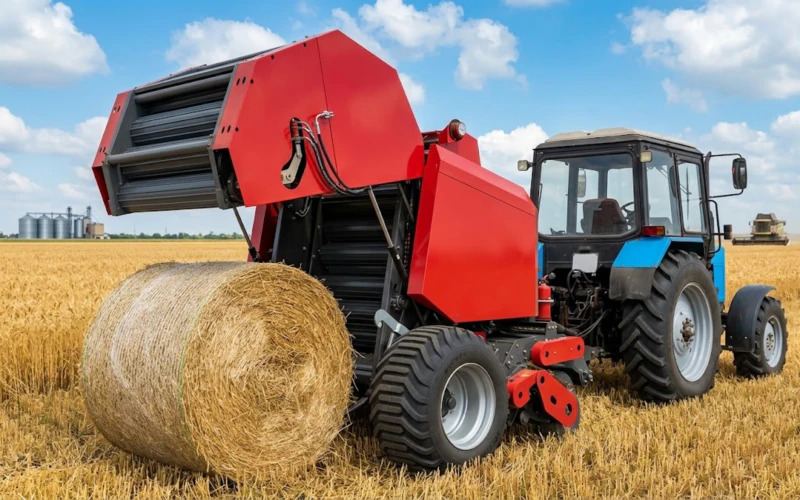
The mechanical alternative — chopping and incorporating the stalks — addresses the burning problem but requires multiple passes and powerful tillage equipment, adds fuel cost and soil compaction, and produces no economic return from the residue. A third option, increasingly adopted in cotton-growing regions from Central Asia to sub-Saharan Africa to South America, is direct-cut baling: a specialised round baler equipped with a disc cutting header that simultaneously cuts, collects, and compresses cotton stalks into round bales in a single field pass. The bales can be sold as biomass fuel, used as animal bedding, or — where cotton stalk is processed — supplied to board manufacturing, pulping, or bioenergy facilities.
This article explains why cotton stalk baling requires dedicated machine design rather than a standard forage baler, how direct-cut disc header technology works, what the EP-9YDM-1.4 cotton stalk baling system delivers in practical field conditions, and how to evaluate whether cotton stalk baling makes economic sense for a specific farming operation.
Why Standard Forage Balers Cannot Handle Cotton Stalks
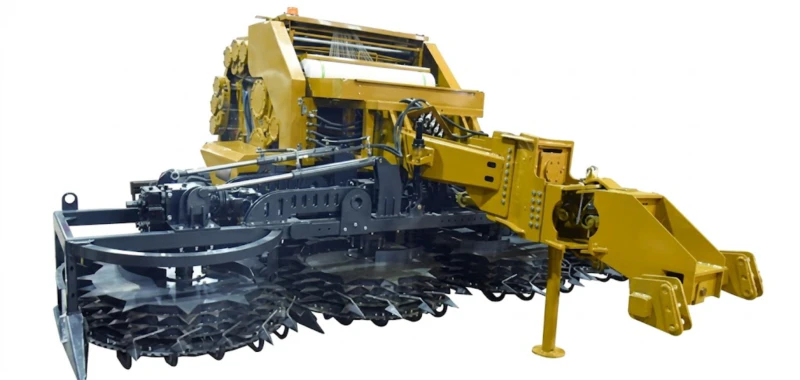
Cotton stalks are fundamentally different from the grass, alfalfa, and straw crops that standard round and square balers are designed for. Understanding these differences explains why attempting to bale cotton stalks with a forage baler results in blockages, tine failures, and mechanical damage rather than productive baling.
High Lignin Content
Cotton stalks have a lignin content of 18–24% of dry matter — three to four times higher than grass hay. Lignified stems do not compress under the belt tension of a standard forage round baler chamber; they spring back, creating a loose, poorly-formed bale that falls apart on ejection. Standard belt-chamber designs cannot generate the radial pressure required to permanently deform high-lignin material.
Standing Crop Geometry
Cotton stalks stand upright after harvest — they are not lying flat in a windrow like mown hay. A standard pickup reel designed to gather crop from a windrow cannot engage standing, root-anchored stalks. Attempting to drive a standard pickup reel into standing cotton stalks bends and breaks tines within minutes and does not achieve consistent crop intake.
Root Resistance and Cutting Requirement
Cotton plants root firmly in the soil and resist simple mechanical pulling. Effective stalk removal requires cutting at or near the soil surface — a function that a standard forage baler pickup reel does not perform. Without soil-level cutting, the stalks are torn rather than cleanly cut, producing ragged, variable-length material that does not pack uniformly in the bale chamber.
Bulk Density Mismatch
Cotton stalk bulk density in the field — 50–80 kg/m³ loose — is much lower than hay windrows. A standard baler sized for hay volume will under-fill on cotton stalks, producing poorly-formed, under-density bales that are not economically viable for biomass or fuel markets that pay by weight or energy content per bale.
The conclusion from these material properties is unambiguous: cotton stalk baling requires a machine with a cutting-and-collecting header that engages standing crop, a bale chamber design that compresses high-lignin material to useful density, and a wrapping system suited to the resulting bale characteristics. This is the design brief that the direct-cut cotton stalk baler class addresses.
Direct-Cut Disc Header Technology: How It Works and Why It Matters
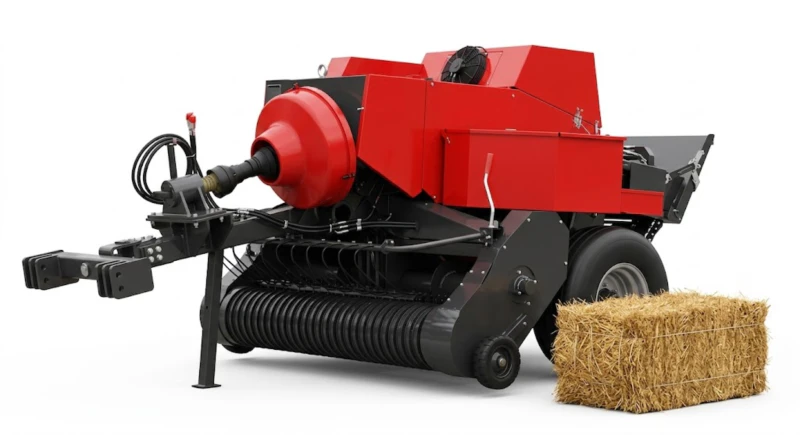
The defining feature of a cotton stalk direct-cut baler is the disc cutting header that replaces the standard pickup reel. Rather than gathering pre-cut crop from a windrow, the disc header actively cuts standing stalks at the soil surface and delivers them into the bale chamber intake in a single motion.
Disc Header Working Principle
The disc header comprises a row of horizontal cutting discs rotating at high speed above the soil surface. Each disc carries two to four hardened steel blades that cut through cotton stalks with a shearing action as the machine advances. The disc rotation speed and blade geometry are selected to produce a clean cut at the stem base rather than a tearing or crushing action — clean cuts reduce the force required per stem and minimise the generation of fine dust and debris that clogs bale chamber belts and rolls.
Behind the cutting discs, a converging auger or cross-conveyor collects the cut stalks from the full header width and feeds them centrally into the bale chamber intake. The convergence zone reduces the wide cutting swath to a narrower, dense crop flow matched to the bale chamber diameter.
The EP-9YDM-1.4 uses a 5.4 m disc cutting header — a working width that covers significantly more ground per pass than any standard forage baler pickup, reducing the total number of passes required to clear a field. At the machine’s operating speed, a single pass clears and bales the stalks from the cut width in one motion, with no separate windrowing step required.
EP-9YDM-1.4 Key Specifications
| அளவுரு | விவரக்குறிப்பு |
|---|---|
| Cutting header width | 5.4 m disc header |
| Bale dimensions | Approx. Φ800–900 mm × 700–900 mm |
| Bale weight | Approx. 200–250 kg per bale |
| Baling cycle time | 1–2 minutes per bale |
| Tractor power requirement | ≥210 hp (tractor must supply cutting + compression power) |
| Wrapping system | Net wrap |
| Operation mode | Direct-cut from standing crop — no prior windrowing |
| Applicable crops | Cotton stalks; also suitable for corn stover, sorghum, sunflower stalks |
Power and PTO Shaft Requirements for Cotton Stalk Baling
Cotton stalk direct-cut balers are among the most power-demanding baling machines produced, because the tractor must simultaneously supply power to the disc cutting header (cutting standing, lignified stalks demands significantly more power per unit width than picking up a mown windrow) and to the bale chamber compression and wrapping mechanism. The EP-9YDM-1.4 requires a minimum of 210 hp — in the same power class as a large square baler but with an additional significant cutting load that must be accounted for in tractor selection.
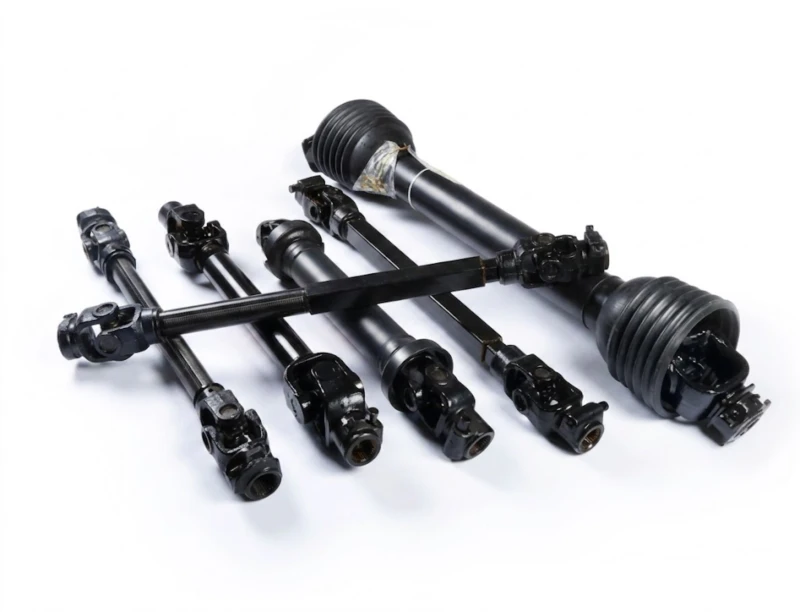
தி PTO தண்டு on a cotton stalk direct-cut baler is subject to torque loading that differs from forage balers in a critical way: the disc cutting header generates sudden high-torque spikes when the blades encounter a dense stalk cluster, a lodged root ball, or a localised increase in stalk density. These spikes are transmitted through the PTO shaft to the tractor and must be absorbed by the shaft’s slip clutch mechanism rather than passing to the tractor’s PTO gearbox. Specifying a PTO shaft with an appropriately rated friction slip clutch or shear-bolt overload protection is not optional on a cotton stalk baler — it is the primary protection against transmission damage in an application where sudden blockage events are part of normal operating conditions.
For the 210 hp tractor power class, the correct PTO connection is 1–3/4 inch 20-spline — the large-tractor standard — at 1,000 rpm PTO speed. Confirm that the PTO shaft supplied with or purchased for a cotton stalk baler is rated for:
- Peak torque rating above the maximum expected torque at the tractor PTO output under disc cutting load — not just the steady-state baling torque.
- Correct telescoping length range to accommodate the machine’s full hitch movement including ground-following header movements on uneven field surfaces.
- Friction slip clutch or shear-bolt protection rated to protect the tractor PTO at the maximum blockage torque of the disc header.
- Heavy-duty universal joint crosses suitable for the high-angle operation that can occur when the disc header follows uneven terrain independently of the bale chamber unit.
The Economic Case: Turning a Field Clearing Cost into a Revenue Stream
The economic justification for investing in a cotton stalk direct-cut baler rests on two parallel calculations: the cost saving from eliminating burning and mechanical incorporation, and the revenue potential from the baled material in available markets.
Cost Saving: Burning Eliminated
Where stalk burning is fined or prohibited, the cost of non-compliance — fines, potential loss of subsidy eligibility, and social licence risks — provides a direct economic incentive for mechanical removal. Even where burning remains legal, the soil organic matter and microbial damage from field burning represents a long-term productivity cost that baling avoids.
Cost Saving: Tillage Passes Reduced
Mechanical incorporation of uncut stalks requires multiple tillage passes — typically a heavy-duty disc pass to chop stalks, followed by a plough or subsoiler to incorporate them. Baling removes the stalks in a single pass, reducing fuel, labour, and tractor wear costs associated with post-harvest tillage.
Revenue: Biomass Fuel
Cotton stalk has a calorific value of approximately 16–18 MJ/kg dry matter — comparable to wood chips as a biomass fuel. In markets with biomass power plant or district heating infrastructure, baled cotton stalks command a market price as a feedstock. Bale logistics (round bales trucked to a reception point) suit the biomass supply chain model.
Revenue: Animal Bedding
Baled cotton stalks are used as livestock bedding in some markets — particularly for cattle, where the coarse, absorbent material performs similarly to chopped straw. Local prices vary significantly by region and season, but bedding is typically a more accessible market than biomass fuel for operations without established supply contracts.
Revenue: Board and Pulp Manufacturing
Cotton stalk cellulose fibre is used in particleboard, MDF, and paper pulp production in several countries. Processing facilities that accept agricultural residue fibres pay for baled material delivered to factory gate. This market requires consistent bale dimensions, density, and moisture specification — which the direct-cut baler system can meet with appropriate field management.
Contractor Model
For individual farms where annual baling volume is insufficient to justify owning a dedicated cotton stalk baler, the contracting model — one machine operator serving multiple cotton farms in a region — provides an attractive business case. The 5.4 m header width of the EP-9YDM-1.4 gives high per-day field coverage that supports a commercially viable contracting rate.
Field Management Practices for Effective Cotton Stalk Baling
Getting the best bale quality and machine throughput from a direct-cut cotton stalk baler requires specific field conditions and operational practices. The following points address the most common factors that reduce baling performance in real-world cotton fields.
Stalk Dry-Down Timing
Bale after sufficient field dry-down following harvest — ideally when stalk moisture is below 25%. Stalks that retain high moisture immediately post-harvest are heavier, compress poorly, and produce bales that heat during storage. In humid climates, allow 2–4 weeks post-harvest before baling. In arid regions, baling can begin sooner. A moisture meter on a sample of stalks at cutting height gives a reliable pre-baling check.
Operating Speed and Header Height
Set disc header cutting height to 50–100 mm above soil surface — low enough to capture the full stalk length but high enough to avoid soil ingestion that wears disc blades rapidly. Forward operating speed should match stalk density — in heavy stalk yield areas, reduce speed to maintain consistent bale chamber fill rate without overloading the cutting header or causing incomplete stalk cutting.
Disc Blade Inspection and Replacement
Disc blades are the highest-wear component in a cotton stalk baler. Inspect blades at each refuelling stop and replace individually when any blade shows more than 15–20 mm wear from the original cutting edge dimension. Dull blades do not cut cleanly — they push and tear stalks, increasing required power, reducing cut quality, and degrading bale uniformity. Keep a full set of replacement blades on the machine during field operations.
Stone and Root Ball Management
Cotton fields in some regions contain surface stones or compact root balls from previous seasons that can damage disc blades or cause header blockages. Walk the field boundary and identify any known stone zones before baling. In fields with a history of stone damage, reduce forward speed in those areas and increase blade inspection frequency. Some cotton stalk baler disc assemblies include spring-loaded blade mounts that deflect on stone contact rather than absorbing the full impact on the blade disc.
அடிக்கடி கேட்கப்படும் கேள்விகள்
Can I use a standard round baler to bale cotton stalks if I first chop them with a flail mower?
Pre-chopping with a flail mower reduces the stalk length and partially addresses the standing-crop geometry problem, but does not resolve the high-lignin compression problem. Chopped cotton stalk material still has 18–24% lignin content that resists the belt-tension compression of a standard forage round baler. Bale density will be low, bale shape will be irregular, and the bales will tend to fall apart during handling. Additionally, the two-pass system (flail mow then bale) doubles fuel consumption and passes over the field twice, increasing soil compaction. The direct-cut single-pass system is mechanically and economically superior for any cotton stalk baling operation above the smallest scale.
What is the typical field output in bales per day for the EP-9YDM-1.4?
In typical cotton field conditions with a stalk yield of 4–6 tonnes per hectare dry matter, the EP-9YDM-1.4 produces approximately 80–150 bales per day (based on a 10-hour working day, including refuelling, blade checks, and net wrap replenishment). Each bale weighing approximately 200–250 kg, daily output is 16–37 tonnes of baled material. Field coverage per day is approximately 20–40 hectares at the 5.4 m header width, depending on field shape, stalk density, and turning efficiency at field headlands. These figures represent conditions without significant blockage events — actual daily output varies with field conditions and operator experience.
Is a cotton stalk baler suitable for other crop residues beyond cotton?
Yes — the direct-cut disc header and high-density bale chamber design that suits cotton stalks is also effective on other coarse-stemmed standing residues including corn stover (maize stalks after combine harvest), sorghum stalks, sunflower stalks, and rapeseed stems. The same material characteristics that make these crops unsuitable for standard forage balers — high lignin content, standing geometry, variable bulk density — are what the cotton stalk baler design addresses. In regions where multiple coarse-crop residues are grown in rotation, a cotton stalk baler can be deployed on successive residue types through the post-harvest season, improving the machine utilisation rate and strengthening the business case for ownership or contracting.
How should cotton stalk bales be stored to preserve biomass fuel quality?
Cotton stalk bales should be stored under cover or on a raised, well-drained surface to prevent re-wetting from ground moisture and rainfall. Unlike hay bales that ferment at high moisture, cotton stalk bales do not ferment — but re-wetting increases the moisture content above the biomass fuel specification (typically below 20% moisture for thermal energy applications) and reduces the delivered energy value per tonne. For biomass supply chain purposes, store bales in rows on a gravel pad or concrete apron, covered with a breathable tarpaulin. Do not wrap tightly in sealed polythene, which traps condensation and can cause mould growth on the bale surface without the protective effect that net wrap provides during transport.
Conclusion: Direct-Cut Baling Converts a Field Clearing Problem into a Marketable Product
Cotton stalk removal will remain one of the most labour- and cost-intensive post-harvest operations in cotton farming until direct-cut baling is adopted at scale. The technology exists, is commercially proven in multiple major cotton-growing regions, and produces a baled product that can be sold into biomass, bedding, or industrial fibre markets to offset or exceed the cost of the field clearing operation itself.
The investment decision rests on confirming three things: that the available tractor provides the 210+ hp required to drive the disc header and bale chamber simultaneously; that a viable market for the baled material exists within economic haulage distance; and that the annual baling volume — either on a single farm or through a contracting model covering multiple farms — justifies the machine investment. Where all three conditions are met, direct-cut cotton stalk baling is one of the most commercially compelling pieces of equipment a post-harvest cotton operation can add.
Cotton Stalk Direct-Cut Balers — Factory Direct from Balershay
We supply the EP-9YDM-1.4 direct-cut cotton stalk baler with 5.4 m disc header for post-harvest field clearing and biomass baling operations — factory-direct with technical support and spare parts availability including disc blades and net wrap. Visit பாலர்ஷே.காம் to explore our full baler range, or contact our team to discuss your cotton stalk baling requirements.