
The Component Most Operators Overlook Until It Stops the Season
The gearbox is the mechanical heart of every hay baler. It converts tractor PTO rotation into the coordinated motion of the pickup reel, the feed rotor, the bale chamber rollers or belts, and the wrapping mechanism. When it fails mid-season, it does not give much warning. A seized gearbox on day two of a three-day baling window can cost more in delayed harvest than the machine itself is worth on the used market. This guide covers what baler gearboxes actually do, how to maintain them correctly across oil intervals and load cycles, how to set the overload clutch before each season, and the early warning signs that distinguish a fixable problem from an imminent catastrophic failure.
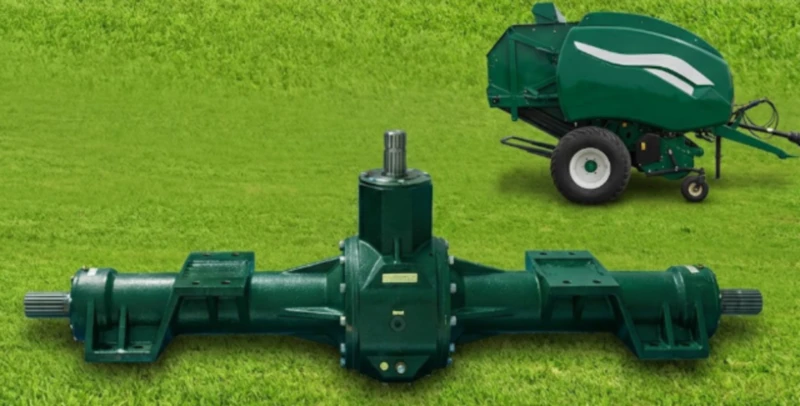
Round baler main gearbox — the central power distribution unit connecting PTO input to all baler functions
What the Baler Gearbox Actually Does: Power Flow from PTO to Bale Chamber
A round baler gearbox receives PTO input at either 540 or 1000 rpm depending on machine specification. From that single input shaft, a series of bevel gears, spur gears, and chain sprockets split the power to multiple output paths. The primary outputs typically include the pickup reel drive, the feed rotor or feed auger, the bale chamber belt or roller drive, and the net wrap or twine mechanism. On machines with hydraulic bale density control, a hydraulic pump may also be gear-driven from the same housing.
Because all these functions share a single gearbox, a bearing failure on one output shaft creates vibration and misalignment that accelerates wear on every other component in the housing. This cascade effect is why gearbox maintenance cannot be treated as an isolated task. The oil, the seals, the shaft play, and the overload clutch setting are all interconnected. A problem in any one of them accelerates degradation in the others.
Large square balers typically use a separate gearbox for the plunger drive and a second unit for the pickup and knotter mechanisms. Round balers more commonly consolidate functions into a single main gearbox with external chain drives to secondary assemblies. The principles of maintenance are the same across both configurations, but the service access points differ significantly between machine families.
Gear Oil: Specification, Volume, and Interval — Getting All Three Right
The most common gearbox maintenance failure is not skipping oil changes. It is using the wrong oil grade, under-filling after a partial drain, or extending intervals well beyond what baling conditions justify. Each of these errors accelerates wear in ways that are invisible until the damage is already done.
Most hay baler gearboxes specify SAE 80W-90 or SAE 85W-140 gear oil meeting API GL-5 or GL-4 classification. The specific grade is always stated on the gearbox housing decal or in the operators manual. Do not substitute tractor hydraulic fluid, motor oil, or universal gear oil without confirming that the viscosity index and EP additive package match the specification. Baler gearboxes operate under high shock loads during crop ingestion and high ambient temperatures during peak summer baling. A gear oil rated for automotive differentials may meet the viscosity specification but lack the thermal stability and film strength needed under these conditions.
Fill volume matters as much as grade. Every gearbox has a sight glass or fill-to overflow plug that indicates correct level. Check the level with the machine on level ground and the PTO disengaged. Overfilling causes oil to foam under high-speed rotation, which reduces lubrication film strength and accelerates seal degradation. Under-filling causes the gear faces running at the top of the housing to run partially dry during high-load operation. Both errors produce bearing wear that a visual inspection cannot detect until significant damage has occurred.
| Operating Condition | Recommended Oil Change Interval | Level Check Interval |
|---|---|---|
| New machine — first season | After first 50 operating hours | Every 10 hours |
| Standard seasonal use (under 200 hrs/yr) | Once per season (pre-season) | Every 25 hours |
| High-output use (200+ hrs/yr, contractor) | Every 150 to 200 hours | Every 10 hours |
| Heavy crop (cotton stalk, corn stover, wet silage) | Every 100 hours regardless of season | Every 8 hours |
| Post-contamination (water or crop juice ingress) | Immediate drain and refill | Daily until clear |
When draining old oil, catch it in a clean container and examine it. Fresh gear oil is amber or honey-colored and clear. Oil that has degraded shows as dark brown or black with a burnt smell. Metal particles suspended in the oil, visible as a gray shimmer or as distinct flakes on a magnet dipped into the drain pan, indicate active gear or bearing wear. Do not simply refill and continue operating. Identify the source of the metallic contamination before the next baling cycle.
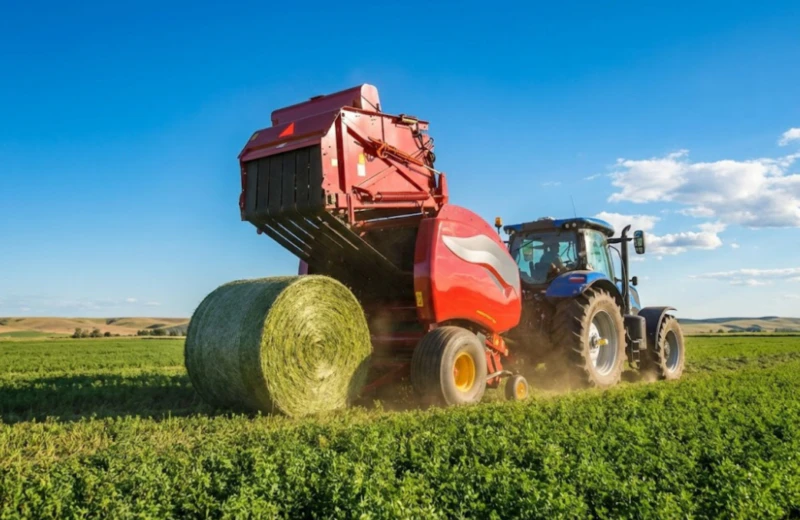
Round bale builder — the gearbox drives every active function visible on this machine simultaneously
The Overload Clutch: What It Does, Why It Slips, and How to Set It Correctly
The overload clutch sits between the PTO input shaft and the gearbox. Its job is to slip and disengage when the torque demand from the bale chamber exceeds a preset threshold, protecting the gearbox internals from shock loads caused by a crop slug, a stone, or a sudden jam in the pickup. Without it, the gearbox would absorb the full impact of these events directly, breaking gear teeth or cracking the housing.
Most round baler overload clutches are spring-loaded friction disc or cam-and-detent designs. The slip torque is set by compressing the disc stack or cam spring to a specified preload. Over time, friction disc clutches wear their disc faces and springs fatigue, both of which cause the clutch to slip at a lower torque than intended. A clutch set too light slips unnecessarily during heavy crop ingestion, interrupting bale chamber fill and reducing throughput. A clutch set too tight does not protect the gearbox adequately during a real jam event.
The correct setting procedure requires a torque wrench or the adjustment specification from the operators manual stated as a spring length or bolt torque, not as an arbitrary feel-based tightness. The general process for a spring-loaded friction clutch is as follows.
Disengage PTO and allow all rotating parts to stop completely. Confirm the tractor park brake is set and the key is removed before touching the clutch assembly.
Locate the clutch adjustment bolts or ring nut on the outer face of the clutch housing. Count the bolts — typically three or six equally spaced. Measure the current spring pack length or gap distance between the pressure plate and the housing face. Record this baseline measurement.
Compare to the specification in the operators manual. Typical spring compressed length targets range from 18 mm to 32 mm depending on machine model. Turn all bolts equally in small increments — never tighten one bolt fully before adjusting the others, as this creates uneven disc loading and premature wear on one side.
Verify adjustment by reconnecting PTO at low tractor rpm and briefly engaging baler function with the machine stationary. A correctly set clutch holds under startup torque. If it slips immediately at idle PTO speed, the setting is too light. If it never slips even when you manually block the pickup briefly, it is set too tight.
Inspect the friction disc faces. If the discs show glazing, scoring, or a surface that is shiny and hard rather than textured, replace the disc pack regardless of the current adjustment setting. A glazed disc cannot hold consistent torque values even when the spring preload is correct.
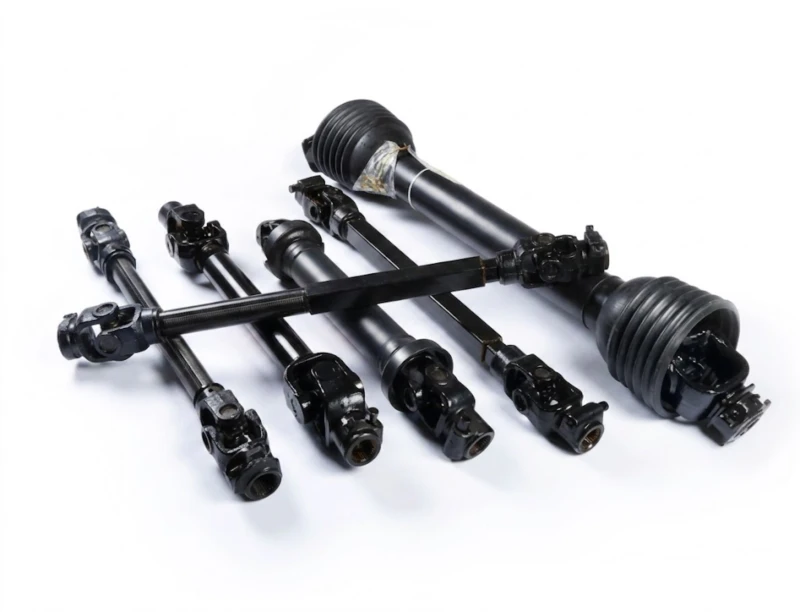
PTO shafts transmit tractor power to the baler gearbox — shaft condition directly affects gearbox loading and overload clutch performance
PTO shaft condition and gearbox load: A worn PTO shaft with excessive yoke play or a bent driveline transmits vibration directly into the gearbox input bearing. This vibration mimics the signature of internal bearing failure and causes unnecessary overload clutch slip under normal operating loads. Before adjusting the overload clutch or diagnosing gearbox noise, inspect the PTO shaft for yoke wear and driveline runout. For high-output machines, a correctly rated replacement PTO shaft for New Holland big balers eliminates input vibration as a variable before deeper gearbox diagnosis begins.
Gearbox Seal Inspection: Where Oil Leaks Start and What They Mean
Gearbox oil seals sit at every shaft exit point on the housing. They prevent oil from leaking along the rotating shaft while keeping field debris, moisture, and crop juice from entering. On a typical round baler gearbox there are four to eight shaft seals depending on the number of output drives. All of them are wear items that require inspection at each service interval.
A weeping seal produces a thin film of oil around the shaft exit that does not drip but collects dust and chaff into a dark ring around the seal lip. This is acceptable for a short period if the oil level remains stable and is corrected at the next full service. A leaking seal that produces visible drips or a trail of oil on the ground is failing and must be replaced before the next baling session. Running a gearbox low on oil because of an active seal leak is the fastest path to a catastrophic bearing failure.
Seal replacement requires removing the relevant output shaft, which typically means disassembling a chain drive sprocket or coupling. The seal itself is pressed into the housing bore and must be driven out with a seal puller or blind punch. When installing a new seal, coat the outer diameter with a thin film of gasket sealant and drive it squarely into the bore using a seal installation tool or a flat punch and a mallet. A seal installed at an angle will leak from day one. After installation, pack the seal lip cavity with grease as specified before reassembling the shaft and sprocket.
Bearing Play and Gear Noise: Reading the Warning Signs Before Failure
Gearbox bearing failure rarely happens without warning. The warning signs are present for hours or days before the bearing seizes. Recognizing them requires brief, deliberate inspection habits at the start of each baling session rather than relying on the noise becoming loud enough to hear over tractor and baler operating sounds.
| Warning Sign | Likely Cause | Action Required |
|---|---|---|
| High-pitched whine at constant PTO speed | Bearing race damage or lack of lubrication | Stop and inspect bearing play immediately |
| Rhythmic clicking or knocking at PTO speed | Broken gear tooth or worn coupling | Do not operate — open gearbox for inspection |
| Gearbox housing hot to touch after 30 min operation | Low oil level or wrong oil grade | Check level and grade, change if contaminated |
| Shaft wobble visible at output sprocket | Bearing inner race loose on shaft or worn | Replace bearing before next baling cycle |
| Oil milky or white on dipstick | Water ingress through failed seal or vent | Drain, identify leak source, refill with fresh oil |
| Gray metallic sheen in drained oil | Active gear tooth or bearing wear generating particles | Inspect all gear faces for pitting or spalling |
Shaft end play is the most reliable field check for bearing condition. With the PTO disengaged and the machine stationary, grip each output shaft at the sprocket or coupling and attempt to move it axially (in and out along the shaft axis) and radially (side to side). A correctly preloaded tapered roller bearing allows near-zero axial play and zero radial play. Movement of more than 0.3 mm in either direction indicates a bearing that has lost its preload and is approaching failure. This check takes approximately two minutes per shaft and provides earlier warning than any noise-based monitoring.
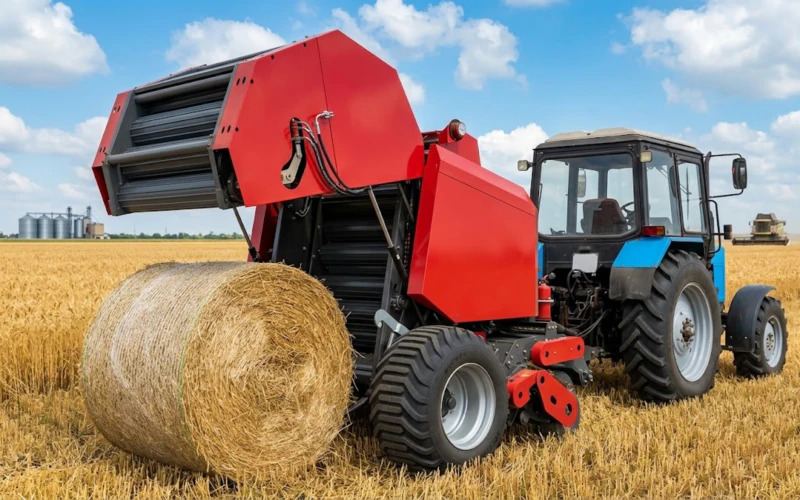
Field operation places peak cyclic load on the gearbox — pre-season maintenance prevents in-season failures at the worst possible time
Pre-Season Gearbox Service Checklist: What to Do Before the First Bale of the Year
A full pre-season gearbox service takes approximately 90 minutes on a round baler and prevents the majority of mid-season failures. The following checklist covers all gearbox-related tasks in a logical order that minimizes reassembly time.
Gearbox Pre-Season Service — Item by Item
Drain gearbox oil fully (warm the machine first if stored in cold conditions to improve oil flow). Inspect drained oil color, smell, and particle content.
Refill to correct level with specified gear oil grade and volume. Do not mix old and new oil even if the drained oil appeared clean.
Inspect all shaft seals for weeping, cracking, or hardening. Replace any seal showing visible deterioration before filling the gearbox.
Check shaft end play and radial play on all output shafts (pickup, feed, chamber drive). Record measurements and compare to prior year if data is available.
Adjust overload clutch to specified spring length or torque. Inspect friction disc faces and replace disc pack if glazed or worn below minimum thickness.
Grease all gearbox-adjacent fittings on chain drive sprockets, idler bearings, and PTO input shaft slip joint.
Inspect the gearbox breather vent. A blocked vent causes internal pressure to build and forces oil past seals. Clean or replace the vent if it is fouled with chaff or hardened oil.
Run the baler for 10 minutes under no-load PTO engagement and recheck the oil level and all seal areas for immediate leaks before moving to field operation.
Sourcing Replacement Parts: OEM vs Aftermarket for Gearbox Components
Baler gearbox bearings, seals, and overload clutch disc packs are widely available as aftermarket components. For bearings, the critical specification is the bearing designation number stamped on the outer race. Standard ISO metric bearings such as 6205, 6307, or 32210 tapered rollers are interchangeable across brands when the designation matches. Purchasing bearings from a recognized industrial bearing supplier rather than from an unbranded agricultural parts lot ensures that the steel grade and dimensional tolerance meet the load rating printed on the bearing.
Overload clutch disc packs are more brand-specific. The disc outer diameter, inner spline, and friction material thickness must match the OEM part exactly for the clutch to achieve the correct torque specification at the stated spring length. Using a disc pack with a different friction material can make a correctly adjusted clutch either slip too easily or hold too firmly. Purchase clutch disc packs from the machine manufacturer or from a specialist in your baler brand rather than substituting a generic agricultural clutch kit.
For operators running Chinese-manufactured hay balers, gearbox components are generally available directly from the factory or through authorized distributors. Providing the machine model number and the gearbox housing casting number — typically stamped on a flat pad on the housing exterior — allows the supplier to identify the exact bearing and seal specifications for your unit without guesswork.
Vanliga frågor
Conclusion: The Gearbox Rewards Attention Before the Season, Not After the Failure
Baler gearbox failures are overwhelmingly preventable. The components that fail — bearings, seals, and overload clutch discs — all give measurable warning signs well before they reach the point of catastrophic damage. The oil change interval exists because gear oil degrades under thermal and mechanical stress regardless of how clean it looks. The overload clutch adjustment matters because a setting that was correct last season may be significantly off after a year of friction disc wear and spring fatigue.
The 90-minute pre-season service described in this guide is the most cost-effective maintenance investment available to any baler operator. It costs almost nothing beyond the oil and a set of seals if worn ones are found. It prevents failures that can cost USD 2,000 to 8,000 in parts, labor, and lost baling revenue when they occur during peak season.
If you are evaluating a new round baler or sourcing spare gearbox components for your current machine, our team can assist with specifications, part numbers, and compatibility confirmation. Visit balershay.com to view our current round baler range and contact us directly for gearbox part inquiries.
Filed under: Hay Baler Maintenance | Round Baler Gearbox | Baler Service Guide