
Why Most Operators Underestimate What a Bale Actually Costs to Produce
Ask most hay producers what it costs them to bale a ton of hay and the answer will focus on diesel and twine. Those are the costs that appear as cash on the same day as the work. What they leave out — depreciation, interest on machine capital, maintenance reserves, tractor wear, and labour opportunity cost — typically adds 40 to 70 percent on top of the visible cash costs. The result is that many baling operations are priced below their true break-even, a problem that only becomes visible when a major repair arrives or when a new machine is needed and there is no capital to fund it.
This guide builds a complete baling cost model from first principles. Every cost category is explained, quantified with realistic example figures, and assembled into a per-ton and per-bale cost that reflects the actual economic reality of running a round baler or large square baler. The model works for owner-operators assessing their own operation and for custom baling contractors setting rates that generate a genuine return.
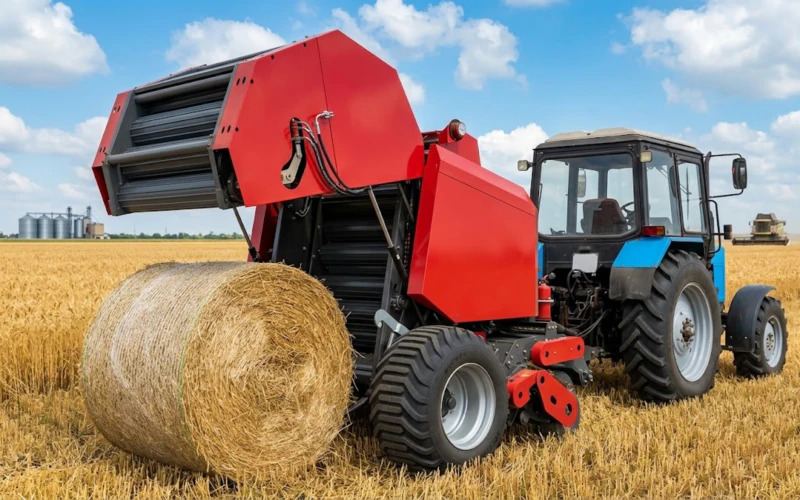
Every baling pass involves costs across at least six categories — most operators only track two of them
The Six Cost Categories in a Complete Baling Cost Model
A complete baling cost model has six distinct categories. Each must be calculated separately before the totals are combined, because each category scales differently with output volume, machine age, and operating intensity.
1. Fuel
Diesel consumed by tractor and any powered ancillary equipment. Scales directly with hours operated and tractor load factor.
2. Consumables
Twine or net wrap, plus lubricants, hydraulic oil top-ups, and any in-season minor parts such as pickup tines.
3. Repairs and maintenance
Scheduled service costs plus a reserve for unscheduled repairs. Scales with machine age and annual usage intensity.
4. Depreciation
The annual reduction in machine value. The largest single non-cash cost and the one most consistently omitted from informal cost estimates.
5. Capital cost (interest)
The cost of the capital tied up in the machine, whether borrowed at interest or owned outright as an opportunity cost.
6. Labour
Operator time valued at market rate, including setup, travel, baling, and post-work machine care time.
Category 1: Fuel Cost — Calculating Diesel Consumption Per Ton
Baling fuel consumption depends on four variables: tractor engine size, the load factor during baling, fuel price, and tonnes produced per hour. Load factor for baling is typically 55 to 75 percent of rated PTO power, reflecting the variable load between light windrows and dense crop slugs. A 100 kW tractor baling at 65 percent load factor consumes approximately 16 to 20 litres per hour.
A practical field estimate uses the tractor manufacturers fuel consumption chart at the relevant PTO load percentage, multiplied by the operating hours required to produce one tonne of baled hay. For a round baler producing 5-by-5 bales averaging 350 kg, baling 12 bales per hour at that weight gives 4.2 tonnes per hour. At 18 litres per hour diesel consumption and USD 1.20 per litre, fuel cost is USD 21.60 per hour or USD 5.14 per tonne.
Fuel Cost Formula
Fuel cost per tonne = (Litres per hour x Fuel price per litre) / Tonnes per hour
Example: (18 L/hr x USD 1.20) / 4.2 t/hr = USD 5.14 per tonne
Add tractor fuel for raking, mowing, and bale carting to get total fuel per tonne of harvested hay, but keep baling fuel as a separate line item so you can evaluate the baler component of costs independently from the overall hay production system.
Category 2: Consumables — Twine, Net Wrap, Lubricants, and Minor Parts
Consumables are the easiest cost category to track accurately because they generate receipts at the point of purchase. The discipline required is to collect those receipts and allocate them to specific machine and season rather than treating them as general farm expenses.
Net wrap and twine
Net wrap cost per bale ranges from USD 0.80 to USD 1.20 for a standard 5-by-6 round bale at 1.5 rotations. Twine cost per bale ranges from USD 0.40 to USD 0.70. To convert to per-tonne cost, divide by the average bale weight in tonnes. For a 400 kg bale at USD 1.00 net wrap cost: USD 1.00 / 0.4 t = USD 2.50 per tonne of net wrap cost.
Lubricants and grease
Grease consumption on a round baler averages 0.5 to 1.5 kg per 100 operating hours depending on the number of grease points. Gearbox oil changes cost approximately USD 40 to USD 80 per season for oil plus disposal. Spread across seasonal bale output, lubricant cost is typically USD 0.30 to USD 0.80 per tonne — small but worth tracking to confirm the maintenance schedule is being followed.
Minor parts in-season
Pickup tines, belt fasteners, and twine guide eyes are the most commonly replaced minor parts during a baling season. Budget USD 0.50 to USD 1.50 per tonne as a minor parts allowance. If actual in-season spending consistently exceeds this, it is a signal that a more fundamental component — pickup reel bearing, belt condition, or knotter setting — needs attention.
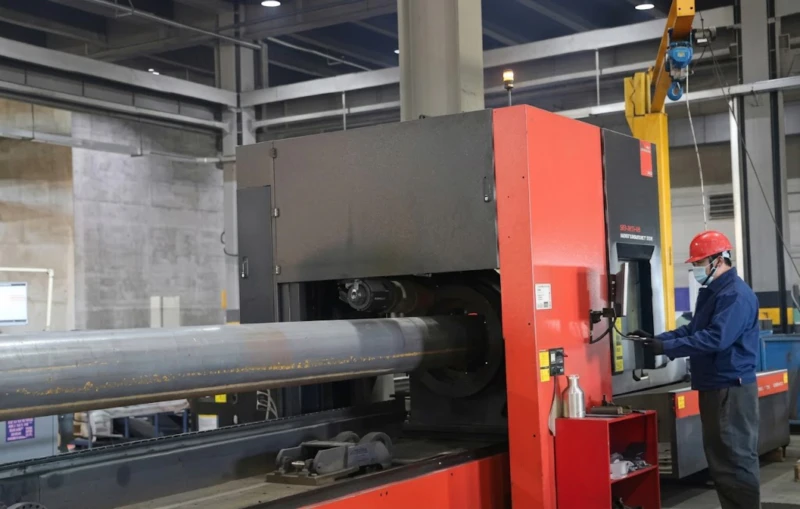
Machine purchase price and build quality directly determine depreciation rate, repair frequency, and the true cost per tonne over the machine lifetime
Category 3: Repairs and Maintenance — Building a Realistic Reserve
Repair costs are the most difficult category to predict in any single season because they are lumpy — many seasons have low repair costs, then one season brings a gearbox replacement or a belt set replacement that equals several years of routine maintenance spending. The solution is to use a long-run average based on machine type and age rather than trying to predict individual season costs.
Agricultural engineering research consistently finds that total lifetime repair and maintenance costs for a round baler average 80 to 120 percent of original purchase price over a 15-year lifespan under normal use. A baler purchased for USD 45,000 will accumulate USD 36,000 to USD 54,000 in total repair and maintenance costs over its service life, in addition to depreciation. Annual repair reserve as a percentage of current machine value typically runs:
| Machine Age | Annual Repair Reserve (% of new price) | Example: USD 45,000 machine |
|---|---|---|
| Year 1 – 3 | 2 – 3% | USD 900 – 1,350 / yr |
| Year 4 – 7 | 4 – 6% | USD 1,800 – 2,700 / yr |
| Year 8 – 12 | 6 – 9% | USD 2,700 – 4,050 / yr |
| Year 13+ | 8 – 12% | USD 3,600 – 5,400 / yr |
Divide the annual repair reserve by your annual bale output in tonnes to get the repair cost per tonne. For a machine in Year 5 producing 800 tonnes per season: USD 2,200 annual reserve / 800 t = USD 2.75 per tonne. This figure should be treated as a real cost regardless of whether any major repair occurs that season — the reserve funds the next major repair when it arrives.
Category 4: Depreciation — The Largest Cost Most Operators Ignore
Depreciation is the annual loss in machine value from use and age. It is not a cash cost that appears on a bank statement in the season it occurs, but it is a real economic cost that must be recovered through the pricing of baling services or hay sales if the operator wants to be able to replace the machine at the end of its working life without drawing on external capital.
The most practical depreciation method for baling cost analysis is straight-line over the expected machine life, using the difference between purchase price and estimated residual value at end of life.
Straight-Line Depreciation Formula
Annual depreciation = (Purchase price – Residual value) / Years of service life
Example: (USD 45,000 – USD 8,000) / 12 years = USD 3,083 per year
At 800 tonnes per year: USD 3,083 / 800 t = USD 3.85 per tonne
The residual value estimate is the key variable. A well-maintained European brand baler retains 20 to 30 percent of purchase price after 12 years. A lower-cost machine purchased at a significantly lower price may retain a similar dollar residual value, meaning its depreciation cost per tonne is proportionally lower. This is one of the concrete economic arguments for considering Chinese-manufactured round balers in cost-sensitive operations — a machine purchased at USD 18,000 with a USD 4,000 residual value over 10 years costs USD 1,400 per year in depreciation versus USD 3,083 for the example above.
High annual output reduces depreciation cost per tonne significantly. The same USD 3,083 annual depreciation applied to 1,500 tonnes per year (a contractor operation) produces USD 2.06 per tonne — 47 percent lower than the 800-tonne example. This is why custom baling contractors who maximise machine utilisation can offer lower per-tonne rates than owner-operators with modest seasonal volumes.
Category 5: Capital Cost — The Interest Charge on Machine Investment
Whether the machine was financed with a loan or purchased outright with own capital, there is an interest cost associated with the investment. For a financed machine, the cost is the actual interest paid. For an outright purchase, the cost is the opportunity cost of deploying that capital in the machine rather than in another investment — typically estimated at the current bank term deposit rate or the cost of equivalent debt.
Capital Cost Formula (average investment method)
Annual capital cost = ((Purchase price + Residual value) / 2) x Interest rate
Example: ((USD 45,000 + USD 8,000) / 2) x 6.5% = USD 1,722 per year
At 800 tonnes per year: USD 1,722 / 800 t = USD 2.15 per tonne
Many operators skip this line because it feels theoretical when the machine is fully paid off. That is precisely when it matters most — a paid-off machine has no visible cost, but the capital it represents has an opportunity cost that should be recovered in operating margins. Omitting it produces a cost model that underprices the service and does not generate the capital needed for the next machine purchase.
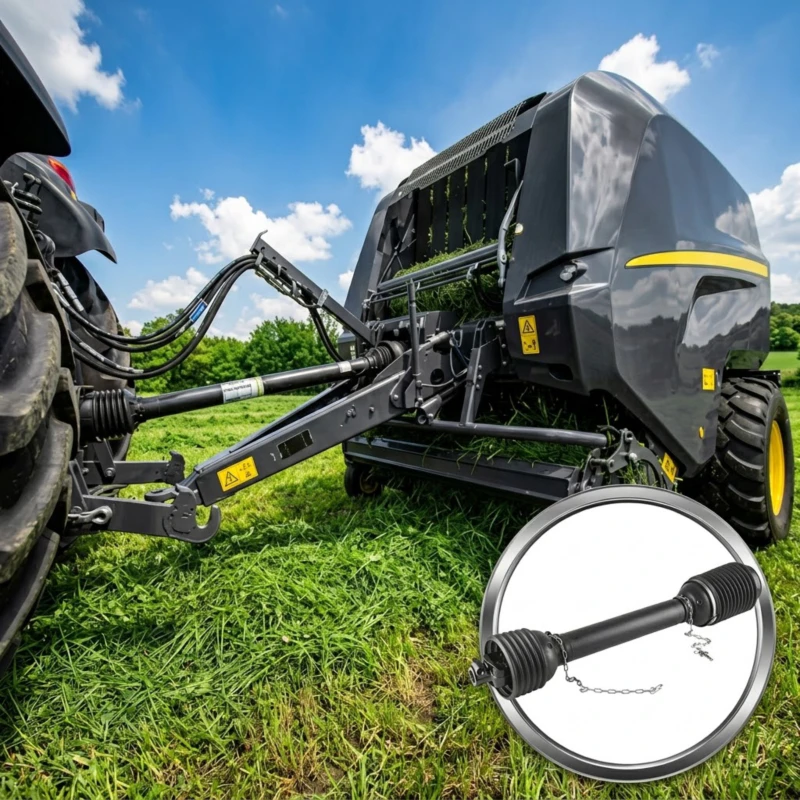
Tractor costs — fuel, depreciation, and capital — must be added to baler-only costs to produce a complete cost per tonne figure
Category 6: Labour — Valuing Operator Time at Market Rate
Labour is the cost category most systematically excluded from owner-operator cost models because the operator is the owner and does not receive a separate wage. This is an accounting convention, not an economic reality. Every hour the operator spends baling is an hour that could have been spent on another income-generating activity, or that needs to be valued in determining whether baling their own hay is more cost-effective than buying it in.
Labour cost per tonne requires two inputs: the hourly rate (use the local agricultural equipment operator market wage, typically USD 20 to USD 40 per hour depending on region) and the hours per tonne. Hours per tonne includes direct baling time, plus a 15 to 20 percent allowance for setup, travel between fields, machine checks, and end-of-day cleanup. If a baling operation produces 4 tonnes per hour and the all-in time factor adds 18 percent overhead, the effective labour time is 1 / (4 x 0.82) = 0.305 hours per tonne.
Labour Cost Formula
Labour cost per tonne = (Hourly rate x (1 + overhead factor)) / Tonnes per baling hour
Example: (USD 28 x 1.18) / 4.2 t/hr = USD 7.87 per tonne
Labour efficiency and PTO shaft reliability: Unplanned downtime from mechanical failures — including PTO shaft failures in the field — converts directly into additional labour hours at zero output. A two-hour roadside PTO shaft repair during a baling day that was producing 4.2 tonnes per hour represents 8.4 tonnes of lost output and two hours of repair labour. Replacing a worn PTO shaft before it fails at a cost of USD 200 to USD 400 eliminates a risk that can cost USD 600 to USD 1,200 in lost output and repair time on a single day.
Assembling the Full Model: Example Cost Per Tonne Calculation
The table below assembles all six categories for two representative operations: an owner-operator producing 800 tonnes per year, and a custom contractor producing 1,800 tonnes per year from the same machine.
| Cost Category | Owner-Operator (800 t/yr) | Contractor (1,800 t/yr) |
|---|---|---|
| Fuel | USD 5.14 | USD 5.14 |
| Consumables (net wrap, lube, minor parts) | USD 4.30 | USD 4.30 |
| Repairs and maintenance reserve | USD 2.75 | USD 1.22 |
| Depreciation | USD 3.85 | USD 1.71 |
| Capital cost (interest) | USD 2.15 | USD 0.96 |
| Labour | USD 7.87 | USD 7.87 |
| Total cost per tonne | USD 26.06 | USD 21.20 |
The contractor achieves USD 4.86 per tonne lower cost despite identical machine and labour rates, purely from spreading fixed costs (depreciation, capital, repair reserve) across 2.25 times more annual output. This is the fundamental economic driver behind custom baling — high utilisation amortises fixed costs that the low-volume owner-operator cannot escape.
Converting Per-Tonne Cost to Per-Bale Cost and Setting a Custom Rate
Multiply per-tonne cost by average bale weight in tonnes to get per-bale cost. For the owner-operator example at USD 26.06 per tonne and a 400 kg bale: USD 26.06 x 0.4 t = USD 10.42 per bale total cost.
Custom baling rates should be set above this total cost by a margin that reflects business risk, seasonal demand, and local market rates. A 20 to 30 percent margin above full cost is typical for established custom operators. At USD 21.20 per tonne full cost for the contractor example, a 25 percent margin produces a rate of USD 26.50 per tonne or approximately USD 10.60 per 400 kg bale. This becomes the floor below which the operation cannot sustainably operate regardless of competitive pressure.
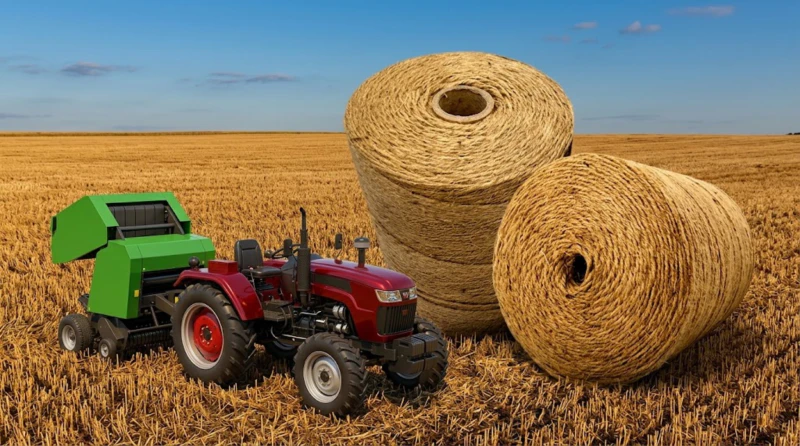
Consumable cost — net wrap or twine — is the most visible variable cost but represents only 15 to 20 percent of the complete per-tonne cost in most operations
How Machine Purchase Price Affects Long-Run Cost Per Tonne
The purchase price of the baler affects three of the six cost categories: depreciation, capital cost, and indirectly the repair reserve (because cheaper machines may have higher repair rates). This makes the purchase decision a long-run cost modelling exercise, not a simple upfront price comparison.
| Machine Type | Purchase Price (USD) | Annual Depreciation (800 t/yr) | Depreciation + Capital per tonne |
|---|---|---|---|
| European premium brand | USD 65,000 | USD 4,583 | USD 8.89 |
| Mid-range US / Asian brand | USD 45,000 | USD 3,083 | USD 6.00 |
| Chinese-manufactured quality baler | USD 18,000 | USD 1,400 | USD 2.62 |
| Used machine (8 yr old, USD 22,000) | USD 22,000 | USD 1,750 | USD 3.24 + higher repair reserve |
The cost modelling reveals that a quality Chinese-manufactured round baler purchased at USD 18,000 with comparable reliability to a mid-range brand carries USD 3.38 less depreciation and capital cost per tonne than the mid-range machine. Over 800 tonnes per year across a 10-year machine life, that difference accumulates to USD 27,040 in total cost savings — enough to purchase a replacement machine outright at the end of the service period.
Часто задаваемые вопросы
Conclusion: Build the Model Once, Use It Every Season
A complete six-category baling cost model built on real numbers from your own operation is more valuable than any industry average or rule of thumb. It tells you exactly where your costs are concentrated, which variables are worth trying to reduce, and what rate you need to charge to actually recover your full cost plus a margin. Built once in a spreadsheet with your machine purchase price, annual volume, fuel price, and labour rate, it updates automatically each season as inputs change.
The most important insight the model typically delivers is how strongly total cost per tonne responds to annual output volume. Increasing seasonal output by 20 percent reduces fixed cost per tonne by 17 percent. For operations where the machine has spare capacity, finding additional baling volume — whether from a second cutting, a neighbouring property, or custom work — is usually the highest-return action available.
If you are evaluating a new baler purchase and want to model how different machine prices affect your long-run cost per tonne, our team at balershay.com can provide specifications, purchase price ranges, and parts availability data for our round baler range to plug directly into your cost model.
Filed under: Hay Baling Economics | Baling Cost Analysis | Custom Baling | Round Baler ROI