
A practical comparison of round bale binding systems — net wrap, sisal twine, synthetic twine, and rope — covering bale shape retention, weather resistance, silage compatibility, biomass specification, cost per bale, and which system suits each crop and end market
The binding system on a round baler is the last step in bale formation and the only thing standing between a well-formed dense bale and a loosening, deforming mass of crop material. Yet binding selection is frequently an afterthought — farmers use whatever system came with the baler, or whatever the local agricultural supplier stocks, without considering whether it matches the crop, the storage conditions, the end market, or the baler’s cycle time requirements.
The choice between net wrap, sisal twine, synthetic twine, and rope binding has real consequences for bale quality, storage life, market acceptability, baler cycle time, and the environmental profile of the baling operation. A net-wrapped bale behaves differently from a twine-tied bale in outdoor storage. A biomass power plant rejects net-wrapped bales. A silage contractor specifies net wrap as the minimum standard. An export hay buyer may have views on the binding material that affect the price paid.
This guide covers every dimension of the binding choice — the mechanics of each system, its performance on different crops, its compatibility with different end uses, its cost, and the practical operational factors that determine which system works best in a given baling context. Whether you are setting up a baler for the first time or evaluating a change from your current binding method, the comparison in this article provides the framework for a well-informed decision.
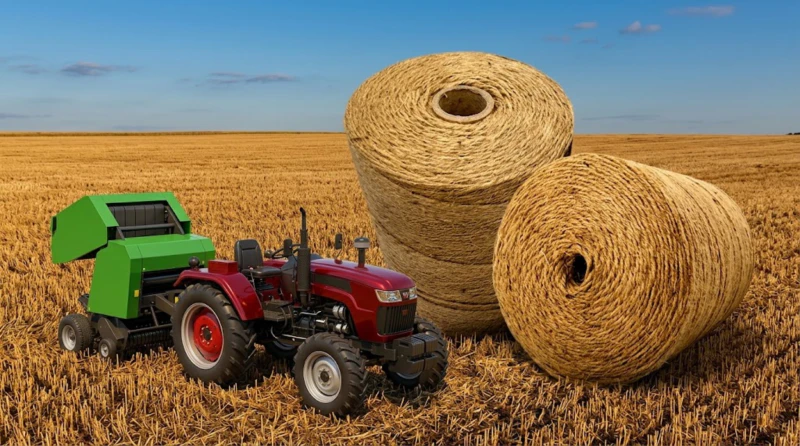
How Each Binding System Works: Mechanics, Application, and Bale Coverage
Each binding system achieves bale containment through a different physical mechanism, and those mechanical differences produce different bale shape retention, weather resistance, and handling characteristics.
Siatka do owijania
A polyethylene net is fed from a roll into the bale chamber and wrapped around the rotating bale surface. The net covers the entire bale face — both the cylindrical sides and the flat ends — in 1–3 revolutions, depending on the number of layers specified. The net interlocks with the outer crop layer as the bale rotates, holding the full bale surface in contact compression rather than at discrete band points.
Coverage: Full bale face and ends (continuous).
Sisal Twine
Natural fibre twine made from agave (sisal) fibres is tied in a set number of bands (typically 4–6) spaced along the bale width. Each band is formed by a needle system that passes the twine around the bale and ties it with a knot. Sisal twine is biodegradable, burns cleanly in biomass combustion, and decomposes in soil if not removed before incorporation. Break load: 90–130 kg depending on grade.
Coverage: 4–6 discrete bands across the bale width.
Synthetic (Polypropylene) Twine
Extruded polypropylene twine applied in the same band pattern as sisal twine. Higher break load than sisal (100–160 kg) for the same twine cross-section, and more consistent in quality because it is a manufactured rather than natural product. Does not biodegrade and burns with toxic emissions, making it incompatible with biomass combustion specifications and undesirable for soil incorporation.
Coverage: 4–6 discrete bands, same as sisal.
Rope (Sisal or Synthetic)
A heavier-gauge twisted or braided rope wound around the bale in a helical pattern as the bale rotates, rather than in discrete bands. Used primarily on mini round balers where the simpler rope-wrap mechanism reduces mechanical complexity compared with a full twine knotter system. Rope wrap provides broader contact zones than band twine but narrower coverage than net wrap. Break load: 150–300 kg depending on gauge.
Coverage: Helical spiral, typically 3–5 turns per bale.
Bale Shape Retention, Weather Resistance, and Storage Performance
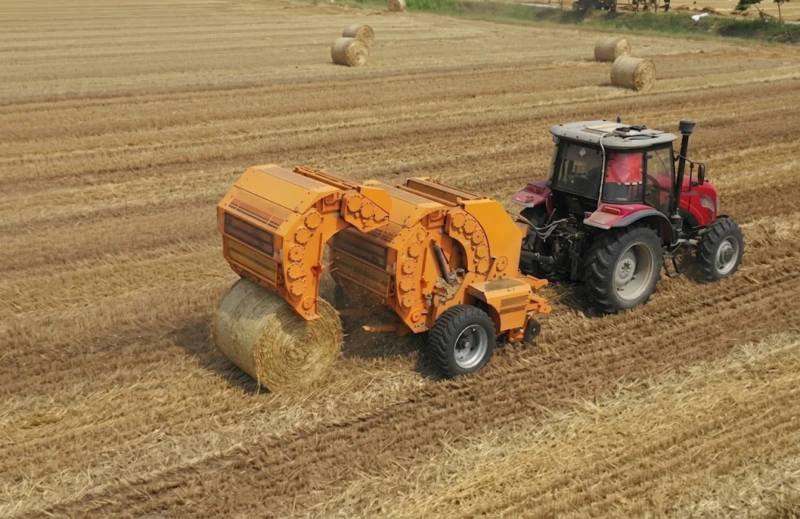
Why Bale Shape Matters
A bale that loses its cylindrical shape in storage has two problems. It no longer sheds rainfall efficiently from its curved outer surface — a flattened bale accumulates water on its upper flattened area, increasing moisture penetration into the bale interior. And it becomes structurally weaker under stacking loads — a round cross-section distributes stacking load evenly around the circumference; an oval or flat-sided bale concentrates stacking load at the flat contact points, compressing and deforming the bale at those locations.
Net Wrap: Best Shape Retention
Net wrap maintains bale shape in outdoor storage better than any twine-based system because the continuous net coverage prevents the outer crop layer from loosening between the band contact points. In a twine-tied bale, the crop surface between the bands is held only by the internal compression of the bale core — as the outer layer dries and shrinks during storage, the gaps between bands allow the outer crop to loosen and the bale to flatten. Net-wrapped bales in well-designed studies retain 90–97% of their initial cylindrical shape after 6 months of outdoor storage; twine-tied bales of the same crop and density retain 75–85%.
Twine and Rope: Adequate for Dry Hay in Good Conditions
For dry hay stored in dry climates, or for bales that will be fed out within 4–8 weeks of production, twine binding provides adequate shape retention. The bale does not need to maintain perfect cylindrical geometry for a short storage period, and the cost saving from twine versus net wrap is material for high-volume operations. In wet climates, over winter storage, or for bales that may sit in the field for 3–6 months before being collected, net wrap is the correct binding choice based on shape retention and dry matter preservation alone.
Dry Matter Losses by Binding Type
| Binding Type | DM Loss (3 months outdoor) | DM Loss (6 months outdoor) | Best Storage Scenario |
|---|---|---|---|
| Net wrap (2 layers) | 3–6% | 6–12% | Outdoor, temperate/wet climate |
| Sisal twine (6 bands) | 6–10% | 12–20% | Indoor or short-term outdoor (dry) |
| Synthetic twine (6 bands) | 6–10% | 12–20% | Indoor or short-term outdoor (dry) |
| Rope wrap (3–5 turns) | 8–14% | 15–25% | Short-term use; mini bale markets |
Crop and End-Use Compatibility: Which Binding Suits Which Application
The correct binding choice depends as much on what the bale will be used for as on the crop being baled. Different end uses impose specific binding requirements that override the generic shape-retention and cost considerations.
Silage (Wrapped Bales)
Required: Net wrap minimum. Net wrap is specified as the minimum binding standard for bales that will be wrapped in stretch film for fermentation as round bale silage. The net wrap produces a tight, smooth bale surface that the stretch film can adhere to without air pockets between film and crop. Twine-tied silage bales have channels along each twine band where the film cannot contact the crop — these channels trap air and become mould initiation sites in the fermented product. Use minimum 2 layers of net wrap for silage bales, increasing to 3 layers for bales that will sit in the field for more than 48 hours before wrapping.
Biomass (Power Plant Supply)
Required: Sisal twine only. Biomass power plants that combust straw and crop residue specify sisal twine as the only acceptable binding — synthetic twine and net wrap both contain polyethylene or polypropylene that produces toxic combustion products when burned in the power plant’s pre-heating system. Sisal twine burns cleanly as part of the straw. Do not supply net-wrapped or synthetic-twine bales to a biomass contract without explicit written confirmation from the plant operator. Net wrap rejection at the gate is common and expensive.
Export Hay (Middle East and Asia)
Preferred: Sisal or synthetic twine (large square balers). Export hay in large square bale format is typically tied with sisal or polypropylene twine — this is a square baler application covered elsewhere. For round bales entering export channels, confirm with the importer what binding is acceptable. Some Asian markets for bedding straw accept net-wrapped round bales; others specify twine only for ease of removal at the feed-out or bedding point without tools.
Cattle Feeding (Ring Feeder)
Either: Net wrap or twine acceptable. For beef cattle fed from round bale ring feeders, the binding is removed before or as the bale is placed in the feeder — either cut off or left to tear as cattle consume the outer layer. Both net wrap and twine work, but net wrap must be removed before cattle feeding because cattle will ingest net wrap material if left on the bale — a serious risk of intestinal obstruction. Always cut and remove net wrap completely before placing a net-wrapped bale in a cattle ring feeder.
Horse Hay (Direct Sale)
Preferred: Net wrap or twine (buyer preference varies). Horse hay buyers who purchase individual bales for manual handling often prefer twine-tied bales that can be cut and removed with a penknife without leaving plastic net material in the hay. Larger horse hay producers buying in pallet quantities frequently prefer net-wrapped bales for their better shape retention during transport and storage. Survey your specific buyers before standardising on a binding system for the horse hay market.
Cotton Stalk / Biomass Residue (Mini Baler)
Typical: Rope wrap (mini baler). Mini round balers designed for smallholder use typically use rope wrap — a simpler mechanism that does not require the knotter system of twine binding. Rope-wrapped bales are adequate for short-term storage and local sale as bedding or fuel. For biomass combustion specifications requiring sisal twine, a mini baler with rope wrap is not compliant — confirm the binding specification with the buyer before purchasing the machine.
Baler Cycle Time: How Binding System Affects Throughput
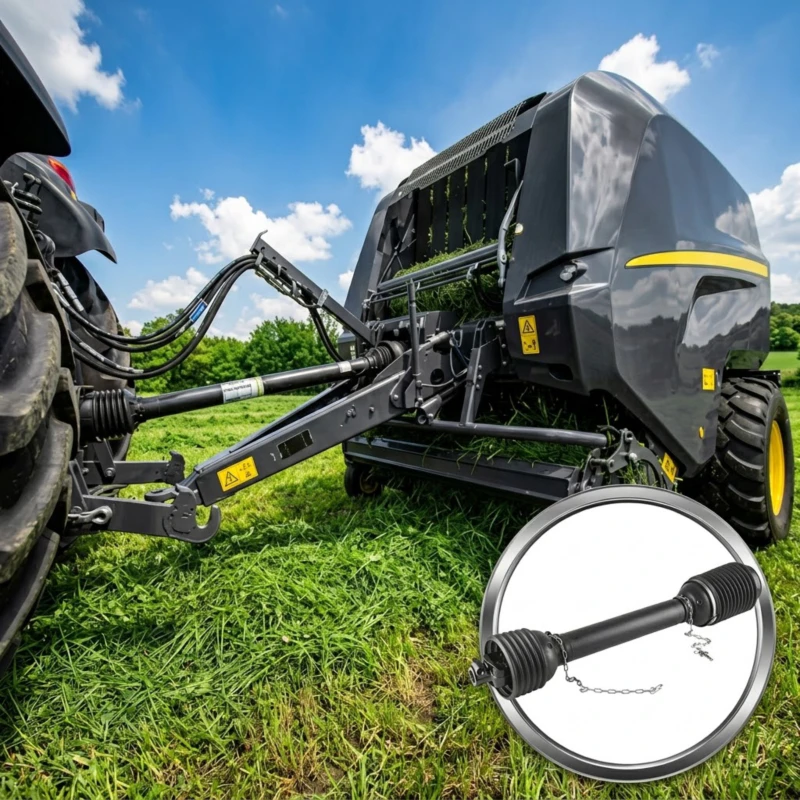
Binding system choice has a measurable effect on bale cycle time — the total time from when the bale reaches full size to when the baler is ready to start the next bale. In high-throughput operations producing hundreds of bales per day, the cumulative difference in cycle time between binding systems is commercially significant.
Net Wrap: Fastest Binding
Net wrap applies in 1–3 bale revolutions at operating speed — typically 15–25 seconds from wrap start to ejection ready. No knotter mechanism is involved; the net is simply fed and cut. This is the fastest available binding method and the primary reason commercial baling contractors prefer net wrap in high-throughput operations. At 1 bale per 6 minutes cycle, reducing binding time by 15 seconds is a 4% improvement in daily bale output — approximately 3–4 additional bales per 10-hour day.
Twine: Moderate Cycle Time
Twine binding requires 4–6 knotter cycles — each band must be fed, wrapped, knotted, and cut. Total binding time is typically 20–40 seconds depending on the number of bands, the knotter mechanism speed, and whether the baler makes multiple passes to apply all bands. On a 6-minute bale cycle, twine adds 5–25 seconds per bale versus net wrap — a 1–7% cycle time penalty that is typically acceptable for operators where twine’s cost or biomass compatibility advantage justifies the choice.
Rope: Slowest, but Simplest
Rope wrapping on mini balers takes 3–5 turns of the bale to apply — at mini baler rotation speeds, this is typically 30–60 seconds. The longer application time reflects the slower rotation speed of mini baler chambers and the need to lay multiple helical turns. However, rope-wrap mini balers are producing 20–40 kg bales at lower throughput rates than standard or large round balers, so the absolute number of rope-wrap cycles per day is lower and the total cycle-time impact is proportionally smaller.
Cost Comparison: Binding Cost per Bale and Total Season Economics
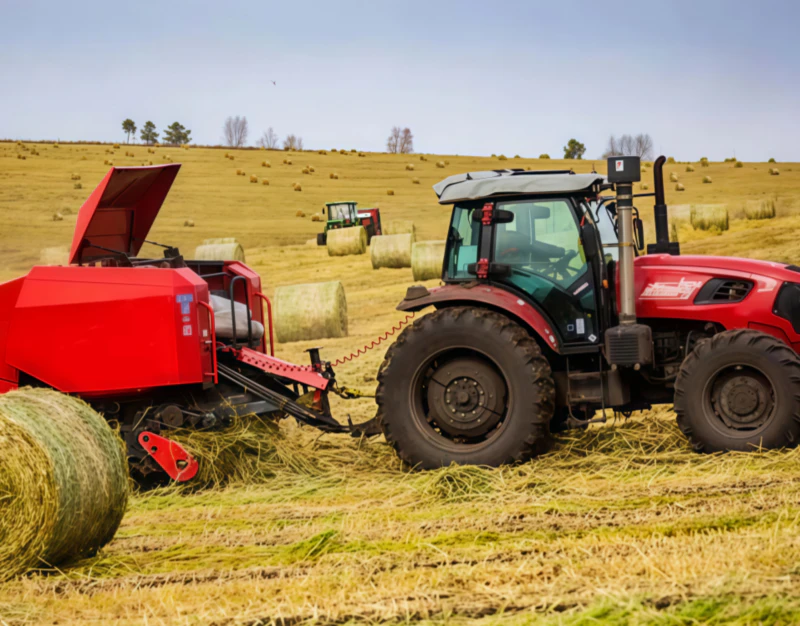
Binding cost per bale is the most commonly cited factor in the net wrap versus twine debate, but it is rarely the correct metric for the comparison. The economically relevant comparison is cost per tonne of marketable product delivered to the buyer — which incorporates binding cost, dry matter storage losses (where the binding type makes a difference), and the market price differential between well-presented net-wrapped bales and less well-presented twine-tied bales in markets where presentation matters.
Binding Cost per Bale: Typical Benchmarks
- Net wrap (2 layers, standard 1.25 m wide roll): £0.60–1.20 per bale for a standard 1.2 m diameter × 1.2 m wide round bale, depending on roll price and bale size. Net wrap rolls are sold by roll length or weight; calculate per-bale cost by dividing roll cost by the number of bales per roll at your specified layer count.
- Sisal twine (6 bands, 130 kg break load): £0.30–0.70 per bale for a standard round bale, depending on twine grade and local price. Sisal price is volatile — it is a natural fibre commodity whose price tracks agave crop conditions in Mexico and East Africa. Budget for 15–20% seasonal price variation.
- Synthetic twine (6 bands, 150 kg break load): £0.20–0.50 per bale — consistently cheaper than sisal for equivalent break load. Price is more stable than sisal because polypropylene is an oil-derivative product with more predictable supply.
- Rope (mini baler, sisal or PP): £0.10–0.30 per bale at the smaller bale sizes typical of mini round balers, because the rope quantity per bale is proportional to bale circumference and mini bales are significantly smaller than standard round bales.
Total Cost of Storage: The Correct Economic Comparison
In a wet-climate outdoor storage scenario over 6 months, a twine-tied bale loses 15–20% of its dry matter to weathering versus 6–12% for a net-wrapped bale. At a hay value of £200/tonne dry matter, the difference is £18–28 per tonne of stored hay — significantly more than the £0.30–0.50 per-bale cost difference between net wrap and twine. In this scenario, net wrap is not just the better agricultural choice: it is the cheaper total economic choice, even though its per-bale binding cost is higher. In dry-climate indoor storage where storage losses are similar regardless of binding, twine’s lower cost is the correct decision.
Quick Selection Guide: Which Binding for Which Situation
| Aplikacja | Siatka do owijania | Sisal Twine | Synthetic Twine | Rope |
|---|---|---|---|---|
| Silage (wrapped bales) | ✅ Required | ❌ | ❌ | ❌ |
| Biomass power plant | ❌ | ✅ Required | ❌ | Sisal only |
| Outdoor storage (wet climate, 6+ months) | ✅ Best | Acceptable | Acceptable | Poor |
| Indoor storage or dry climate | Good | ✅ Lowest cost | ✅ Lowest cost | Acceptable |
| Cattle ring feeder | Remove before use | ✅ Convenient | ✅ Convenient | Good |
| High-throughput contractor | ✅ Fastest | Slower | Slower | Slowest |
| Mini baler (smallholder) | Not typical | If fitted | If fitted | ✅ Standard |
Często zadawane pytania
Can I switch between net wrap and twine on the same baler without modification?
Many modern round balers are designed as combination machines — they can apply either net wrap or twine depending on which system is loaded and selected via the control panel. Switching requires loading the alternative consumable (installing a net wrap roll or loading twine into the knotter system) and selecting the correct binding mode on the baler’s control system. Some older or simpler baler models are net-wrap-only or twine-only by design — check your baler specification before assuming switchability. For a baler that is net-wrap-only, twine binding is not possible without a significant mechanical retrofit.
Is net wrap safe to leave on bales that cattle will be fed from in a ring feeder?
No — net wrap must be completely removed before placing a bale in a cattle ring feeder. Cattle will pull and consume net wrap material as they eat the outer hay layer, and polyethylene net wrap ingested by cattle accumulates in the rumen and reticulum, causing chronic digestive impairment and in serious cases fatal rumen obstruction. The risk is well documented in veterinary literature and is the most commonly cited animal welfare concern with net wrap binding. Always cut and remove net wrap completely before feeding; collect all net wrap fragments and dispose of them in a waste container rather than leaving them in the field where they can be picked up by cattle at pasture.
What is the environmental impact difference between net wrap and sisal twine?
Sisal twine is a natural fibre product that biodegrades in soil within 1–3 years and burns cleanly. Net wrap is a polyethylene product that does not biodegrade and persists in the environment for decades if not collected and disposed of correctly. From an environmental impact perspective, sisal twine has a significantly lower end-of-life burden. However, if the reduced dry matter losses from net wrap mean that fewer total bales need to be produced to supply the same amount of feed — which is the case in wet-climate outdoor storage operations — the per-tonne-of-feed environmental footprint (including the energy and emissions of baling additional bales to replace losses) may favour net wrap despite its plastic content. A full lifecycle assessment comparing the two systems in specific climatic and storage conditions is the only way to resolve this question for a particular operation.
How many bales does a roll of net wrap produce and how do I calculate the cost per bale?
Net wrap rolls are sold in standard widths (1.23 m, 1.25 m, 1.28 m depending on supplier) and lengths (typically 1,500 m, 2,500 m, or 3,000 m per roll). Each bale application uses approximately 2 × the bale circumference of net (for 2 layers) — for a 1.2 m diameter bale, circumference = π × 1.2 = 3.77 m, so a 2-layer application uses approximately 7.5 m of net per bale. A 3,000 m roll produces approximately 400 bales at 2 layers (3,000 ÷ 7.5). At a roll cost of £240, the per-bale cost is £240 ÷ 400 = £0.60 per bale. Adjusting for bale size and layer count scales these figures proportionally.
Conclusion: Match the Binding to the End Use, Not the Unit Cost
The binding choice for round bales is not a one-size-fits-all decision, and the cheapest option on a per-bale basis is not always the cheapest option on a per-tonne-of-marketable-product basis. Net wrap is the correct choice for silage production, wet-climate outdoor storage, and high-throughput contracting where cycle time matters. Sisal twine is non-negotiable for biomass power plant supply. Synthetic twine is the economically correct choice for indoor-stored or short-term outdoor hay in dry climates where storage losses are similar regardless of binding. Rope wrap is the practical solution for the mini baler market where mechanical simplicity takes priority over binding performance.
The one universal principle: always confirm the binding specification with the end buyer before committing the season’s baling to a particular consumable. A field full of net-wrapped bales destined for a biomass plant that rejects net wrap, or a string of twine-tied silage bales with mould channels under every twine band, represents a cost that no per-bale saving on the binding consumable will recover.
Round Balers for Every Binding Requirement — Factory Direct from Balershay
We supply round balers configured for net wrap, twine, and rope binding across the full tractor power range — from mini round balers for 25–50 hp smallholder tractors to commercial models for large-scale hay operations. Visit balershay.com to explore our baler range, or contact our team to confirm which binding system is standard or optional on the model that suits your application.