
A practical guide to adjusting round baler and large square baler chamber pressure, density settings, and crop-specific parameters to produce consistent, well-formed bales across grass hay, alfalfa, straw, silage, and coarse-stem residue crops
Bale density is not a fixed characteristic of a baler — it is an operator-controlled variable that interacts with the crop being baled, the moisture content of the crop, the forward speed of the tractor, and the chamber pressure setting chosen by the operator. A bale that is too loose falls apart during handling and degrades faster in storage. A bale that is too dense causes premature belt or plunger wear, risks knotter failure from over-tensioned twine, and may overload the tractor’s PTO when the baler chambers reaches maximum pressure against a difficult crop.
The challenge is that different crops behave very differently under chamber compression. Dry grass hay at 12% moisture compresses readily and holds its shape after the binding is applied. High-moisture silage grass at 55% moisture is dense, heavy, and resists the bale chamber with far greater force per unit of crop volume. Wheat straw at 8% moisture is springy and requires high chamber pressure to achieve even moderate bale density because the hollow stems want to expand back to their original geometry after every compression cycle.
This guide covers the mechanical basis of bale density control on both round and large square balers, the specific pressure settings and adjustments appropriate for each major crop type, the diagnostic signs that identify incorrect density settings, and the relationship between density, PTO load, and tractor power that determines whether a given density setting is sustainable for an extended baling session.
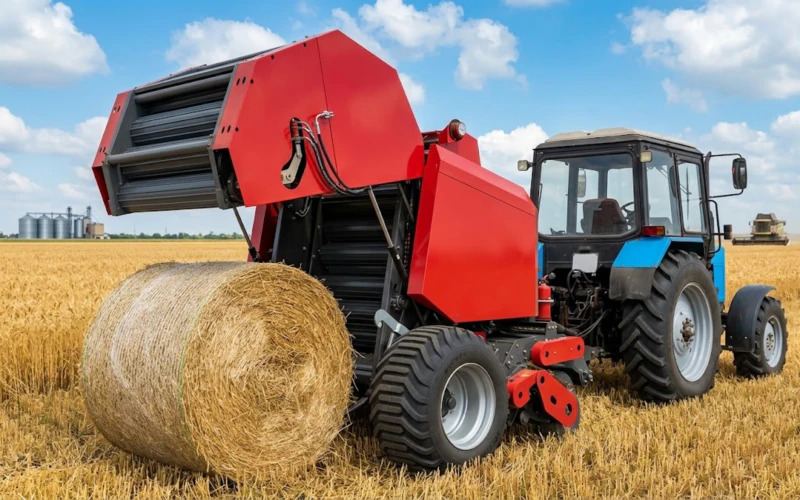
How Bale Density Control Works: Round Baler vs Large Square Baler Mechanisms
Round balers and large square balers use fundamentally different mechanisms to control bale density, and understanding how each mechanism works is the prerequisite for setting it correctly.
Round Baler: Belt Tension and Chamber Pressure
In a variable-chamber round baler (the most common design), the bale chamber is formed by a set of rubber or polyurethane belts tensioned by a pair of hydraulically actuated tension arms. As the bale grows, the tension arms spread against a hydraulic accumulator or adjustable pressure-relief valve that limits the maximum chamber pressure. The operator sets the target chamber pressure via a hydraulic pressure adjustment — either a mechanical hand screw on older machines or an electronic proportional valve on modern machines — and the hydraulic system maintains that pressure as the bale grows.
Higher chamber pressure = higher belt tension = more compressive force on the growing bale = denser bale. The relationship is not linear — the same pressure increment produces a larger density increase in a compressible crop like alfalfa than in a spring-back crop like dry straw. The operator must understand this crop-specific response to set pressure correctly rather than using a fixed pressure setting across all crops.
Fixed-chamber round balers — where the chamber walls are rigid rollers rather than tensioned belts — control density through forward speed and crop feeding rate rather than chamber pressure. The operator fills the fixed-volume chamber to a target density by controlling how much crop enters per unit of rotation. This system is simpler mechanically but provides less fine-grained density control than variable-chamber designs.
Large Square Baler: Plunger Force and Bale Chamber Resistance
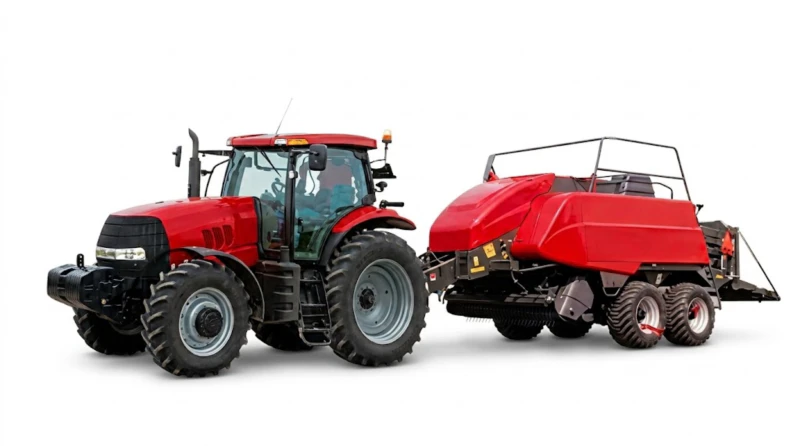
On a large square baler, bale density is controlled by the resistance the crop charges encounter as the plunger compresses each crop charge into the bale. This resistance is created by adjustable friction dogs — spring-loaded or hydraulically controlled flaps on the bale chamber walls that grip the forming bale and resist its movement through the chamber as each new charge is pushed in from behind by the plunger. Higher friction dog pressure = greater resistance to bale movement = more force required per plunger stroke = denser bale. Most modern large square balers incorporate an electronic density control system that monitors plunger force (via a shear bolt torque sensor or a load cell) and adjusts the friction dog pressure automatically to maintain a target density across variable crop conditions. The EP-9YFQ-2290XD’s NT03 touch-screen control system includes this automatic density regulation as a standard feature.
Crop-Specific Density Settings: Target Densities and Pressure Adjustments
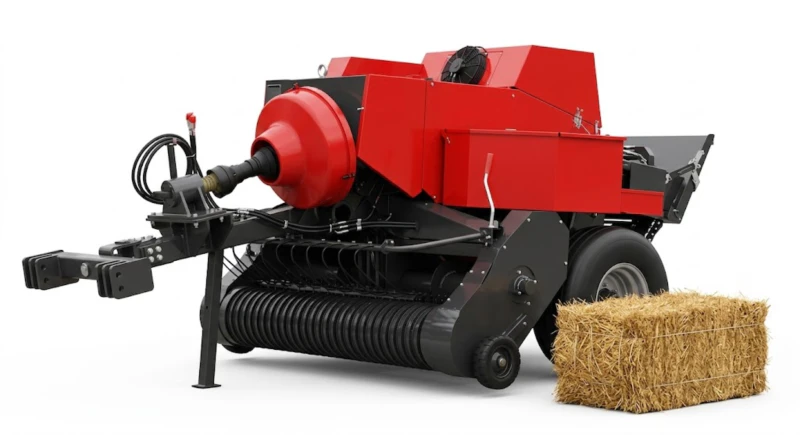
The following crop-specific guidance covers the most common baling materials. All pressure figures are indicative — the exact setting for a given baler and crop combination must be validated against actual bale weight and density measurements in the field.
Dry Grass Hay (10–18% Moisture)
Round bale: 130–160 kg/m³
Large square: 160–200 kg/m³
Round baler: medium setting (50–70% of max)
Square baler: medium friction dog pressure
Grass hay is the “baseline” crop for most baler settings. Compresses well and holds shape. Increase pressure if bales are soft or losing shape in storage.
Watch for: Bales that feel spongy when pressed — indicates pressure too low. Frequent PTO overload signal — indicates pressure too high for available tractor power. Aim for a bale that resists hand pressure firmly but does not feel rock-hard at the face.
Alfalfa (Lucerne) — Dry Hay (10–18% Moisture)
Round bale: 120–150 kg/m³
Large square: 180–220 kg/m³
Round baler: medium-low (40–60% of max)
Square baler: medium-low friction dog
Alfalfa’s high leaf content makes it brittle when dry. Excessive pressure shatters leaves, reducing nutritional value. Bale at slightly lower pressure than grass hay and accept slightly lower density to preserve leaf.
Watch for: Leaf shatter — a cloud of green dust emerging from the baler during compression indicates the crop is too dry or the pressure too high. Reduce pressure and/or increase crop moisture before baling. For export hay markets requiring maximum leaf retention, bale at the lowest pressure that still produces a commercially firm bale.
Silage Grass (40–65% Moisture)
Round bale: 180–250 kg/m³ (wet weight)
Dry matter density: 80–120 kg DM/m³
Round baler: medium-high to high (65–85% of max)
Increases PTO load significantly
High moisture = high wet density = heavy bale. The tractor must provide enough PTO power for the increased chamber resistance. High density is critical for silage — loose silage bales have more inter-stem air space, prolonging the aerobic phase and reducing fermentation quality.
Watch for: Effluent (green juice) running from the bale immediately after ejection — indicates crop is too wet (above 65–70% moisture) and the bale cannot hold the liquid under compression. Reduce moisture by additional wilting time. Also monitor PTO load carefully — silage baling at high pressure settings approaches the maximum PTO demand of the baler on most tractors.
Wheat and Cereal Straw (8–15% Moisture)
Round bale: 90–130 kg/m³
Large square (biomass): 120–160 kg/m³
Round baler: high (75–95% of max)
Square baler: high friction dog pressure
Straw is the most demanding crop for density achievement. Hollow stems spring back powerfully after each compression cycle. Maximum achievable bale density is inherently lower than for hay even at maximum pressure. Do not set pressure above the tractor’s comfortable PTO load in pursuit of hay-equivalent straw density.
Watch for: Repeated PTO slip clutch engagement — the most common sign of excessive pressure for the available tractor power when baling straw. Also watch for belt slippage on variable-chamber round balers at maximum tension — if the baler belts are slipping on the tension rollers, the pressure setting exceeds the belt system’s grip capacity and must be reduced to prevent belt damage.
Cotton Stalk and Coarse Residues (Direct-Cut Baler)
Round bale (direct-cut): 80–120 kg/m³
Higher density increases transport value
Maximum available on direct-cut baler
Crop density varies significantly by field
Cotton stalk density is set at the maximum the baler is capable of. Bale weight varies with field stalk density — accept this variation rather than reducing pressure to achieve uniformity, as density is the primary commercial value driver for biomass buyers.
Watch for: Incomplete bale formation (open or poorly closed bale face) — indicates the cutting header is not feeding a sufficient and consistent volume of material into the chamber. Adjust forward speed to maintain consistent crop flow rather than adjusting chamber pressure. Reduce forward speed in thin-stalk areas of the field rather than increasing pressure to compensate.
Electronic Density Control vs Manual Adjustment: Practical Differences
Manual Density Control: High Operator Dependency
On balers without electronic density regulation, the operator sets a fixed chamber pressure at the start of each field session and monitors bale quality visually and by feel throughout the day. This works well in uniform, consistent crop conditions — a flat field of evenly wilted grass hay where the swath density is predictable from end to end. It fails in variable conditions where swath density changes across the field or between passes: the operator either over-pressures light swath sections (risking PTO overload and belt damage) or under-pressures heavy swath sections (producing loose bales in those areas).
The practical approach to manual density control in variable conditions is to set pressure for the heaviest expected swath — the densest part of the field — and accept that lighter swaths will produce slightly lower density bales rather than risk overloading the system. Monitor the tractor’s engine speed (drooping engine speed indicates PTO overload) and the baler’s PTO load indicator (if fitted) as the primary signals for pressure adjustment.
Electronic Density Control: Consistent Output Across Variable Conditions
Electronic density control systems — standard on the EP-9YFQ-2290XD via the NT03 system, and increasingly common on large square balers in commercial use — continuously monitor the actual plunger force or belt tension and compare it against the target density setting. When the system detects that actual density is below target (light swath), it increases friction dog or belt pressure; when actual density is above target (heavy swath), it reduces pressure. This closed-loop regulation maintains consistent bale density across an entire field session without operator intervention.
The commercial benefit is most visible in the bale weight data at the end of a season: a manually-controlled baler may produce bales ranging from 250 kg to 380 kg across variable conditions; an electronically-controlled baler in the same conditions may produce bales ranging from 295 kg to 335 kg. For export hay contracts or biomass supply agreements where bale weight consistency is a quality specification, this density control advantage directly affects contract compliance and pricing.
PTO Load and Density Limits: When the Tractor Sets the Density Ceiling
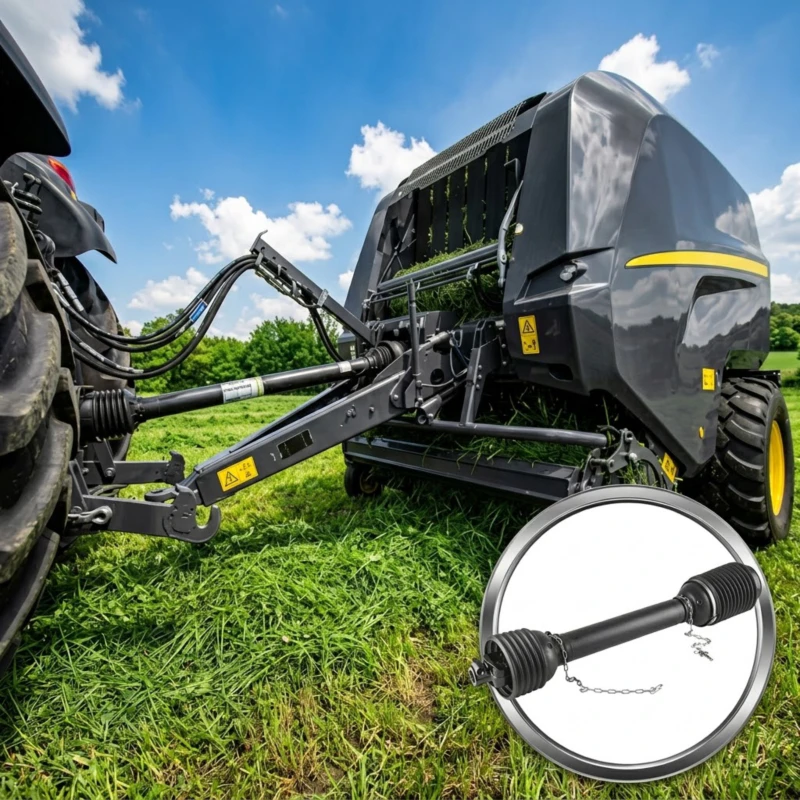
Bale density is ultimately limited by the tractor’s available PTO power. Every increase in chamber pressure increases the torque required to rotate the bale (round baler) or drive the plunger (square baler), which increases PTO load. When PTO load exceeds the tractor’s available output, one of three things happens: the engine speed droops and the baler slows down; the PTO slip clutch engages and the baler stops driving; or — if neither protection mechanism operates correctly — the tractor transmission or PTO gearbox is damaged by sustained overload.
The Density-Power-Speed Triangle
When the target density exceeds what the tractor can deliver at normal forward speed, the operator has three adjustment options that form a triangle of trade-offs:
- Reduce forward speed: A slower forward speed reduces the crop intake rate per unit of time, which reduces the baler’s instantaneous PTO demand. The same chamber pressure setting at half the forward speed loads the tractor at approximately half the rate. Trade-off: reduced throughput (fewer bales per hour).
- Reduce chamber pressure: Accepting a lower target density to keep PTO load within the tractor’s capacity. Trade-off: lower bale density, potentially below market specification or storage requirements.
- Use a more powerful tractor: The only option that does not involve a performance trade-off. If the target density consistently requires more power than the current tractor can supply, the tractor is not correctly matched to the baler for that crop and density requirement. This is the situation that confirms a tractor needs upgrading rather than a density setting needing adjustment.
PTO Shaft Considerations at High Density Settings
Operating at high density settings with a large square baler or a round baler at maximum chamber pressure places the PTO-as under sustained high-torque loading. At maximum density settings, the slip clutch on the PTO shaft may engage more frequently than at lower settings — particularly during bale completion events on a round baler or dense-slug entries on a square baler. Frequent slip clutch engagement at high-density settings accelerates wear on the clutch friction faces. Inspect slip clutch friction faces after each season of high-density baling and replace before the faces wear to the point where the clutch slips at normal operating torque rather than only at the overload event it is designed to protect against.
Bale Quality Diagnostic Guide: Reading the Bale to Adjust the Settings
The bale itself is the best feedback instrument for density setting. The following diagnostic signs identify specific setting problems and their correct adjustments.
| Observation | Likely Cause | Correct Adjustment |
|---|---|---|
| Bale feels spongy, deforms when pressed | Chamber pressure too low for crop | Increase pressure in 10% increments; recheck bale firmness |
| Bale loses shape within hours of ejection | Pressure too low OR crop too wet (especially straw) | Increase pressure; if already at max, allow additional crop dry-down |
| PTO slip clutch engaging frequently | Pressure too high for tractor power; or dense slug entry | Reduce pressure OR reduce forward speed in heavy swath sections |
| Bale weight varies widely between bales | No density control or inconsistent swath | Rake windrows to consistent width; use electronic density control if available |
| Green dust cloud from baler (alfalfa) | Pressure too high; shattering dry leaves | Reduce pressure; bale at slightly higher moisture if possible |
| Effluent dripping from bale (silage) | Crop too wet (above 65–70% moisture) | Additional wilting time before baling; reduce pressure slightly |
| Tractor engine drooping under load | Pressure too high for tractor PTO capacity | Reduce pressure OR reduce forward speed; do not continue at engine droop |
| Bale not closing (open face on round bale) | Insufficient crop volume per chamber revolution | Increase forward speed; merge thin windrows before baling |
Veelgestelde vragen
Should I use the same density setting for the entire season or adjust per crop?
Adjust per crop — different crops require significantly different settings to achieve their target density, and using a single fixed setting across all crops will either produce loose bales in some crops or overload the tractor in others. As a practical approach: set the pressure for each crop type at the start of the first field session of that crop, validate it with the first 3–5 bales (check firmness, bale weight if a scale is available, and tractor PTO load), and record the validated setting for that crop and baler combination in a field notebook. Use the recorded setting as the starting point for subsequent sessions of the same crop rather than resetting from scratch each time.
Does moisture content change the required density setting for the same crop?
Yes, significantly. Moisture content is probably the single biggest variable affecting the relationship between chamber pressure setting and the resulting bale density. Wet grass at 30% moisture requires less chamber pressure to achieve the same volumetric density as dry grass at 14% moisture, because the water adds mass without significantly changing the volume — the wet crop packs more densely under the same compressive force. Conversely, very dry straw at 8% moisture requires maximum chamber pressure because the hollow stems spring back powerfully and the material has minimal “give” under compression. As a rule: reduce chamber pressure when baling wetter-than-normal crop; increase pressure when baling drier-than-normal crop. The diagnostic test is the bale firmness check — the target is the same firm, dense bale regardless of moisture, but the pressure required to achieve it varies with moisture content.
What is the correct way to check bale density without a weighing scale in the field?
Three field tests provide a reasonable density assessment without scales. First, the hand-push test: press the flat palm firmly against the bale face — the hand should not penetrate more than 20–30 mm before feeling firm resistance. If the hand sinks in easily, the bale is too loose. If the bale surface resists immediate hand pressure, it is at or above target density. Second, the bale bounce test: drop the bale from waist height onto firm ground — a well-formed dense bale should bounce slightly and not significantly deform on impact. A loose bale deforms flat on one side and does not bounce. Third, the tape measure check: measure the bale diameter immediately after ejection and again 30 minutes later. If the diameter grows by more than 50–80 mm in 30 minutes, the bale is under-compressed and the crop is expanding back to its natural geometry after release — increase chamber pressure.
How does electronic density control on a large square baler work in practice?
The operator sets a target density value on the touch-screen control panel — typically expressed as a density class (Low / Medium / High / Maximum) or as a specific kg/m³ target if the system is calibrated. The baler’s control unit then monitors the plunger force sensor reading at every compression stroke and compares it against the target. If the measured compression force is below the target range (loose crop), the system automatically increases the friction dog pressure on the bale chamber walls to increase resistance; if the measured force is above target (dense crop), it reduces friction dog pressure. The operator observes the density indicator on the screen and can override the automatic setting if field conditions change dramatically. In practice, electronic density control reduces the operator’s workload significantly in variable conditions — instead of monitoring PTO load and adjusting pressure manually every time the swath changes, the operator focuses on maintaining consistent forward speed and windrow width, while the density control manages the chamber pressure automatically.
Conclusion: Correct Density Settings Are Set by the Crop, Not by the Baler Default
The factory default density setting on any baler is a compromise — a middle-of-the-range pressure that produces acceptable results with typical hay in average conditions. It is the right starting point for the first bale of the first field session and a reasonable baseline for operator training. It is not the correct setting for every crop, every moisture content, and every end market the baler will serve across a full season.
Developing crop-specific density settings, recording them for repeatable use, validating them against actual bale quality indicators, and adjusting them promptly when the bale quality diagnostics indicate a problem — these are the operational disciplines that separate a baling system that consistently produces market-specification bales from one that produces a mixed-quality output that buyers discount or reject. The investment is in attention and record-keeping, not in equipment, and it pays back in bale quality and market price across every season the baler works.
Balers with Precision Density Control — Factory Direct from Balershay
We supply round balers and large square balers with manual and electronic density control across the full power range — including the EP-9YFQ-2290XD with NT03 touch-screen automatic density regulation for commercial hay and export operations. Visit balershay.com to explore our range, or contact our team to discuss density control options for your specific crop and market.