
Why Baler Safety Incidents Happen to Experienced Operators, Not Just Beginners
Agricultural machinery fatality and serious injury data consistently shows that hay baler incidents are not concentrated among new or inexperienced operators. They are concentrated among operators who have used the same machine for years, who know its habits and sounds, and who have developed routines that skip steps they consider unnecessary because they have done those steps a hundred times without incident. Familiarity is the primary risk factor on a hay baler, not inexperience.
The three most serious injury categories on hay balers are PTO entanglement, bale ejection strikes, and rear-gate crush injuries. All three are preventable through guard maintenance, zone management, and pre-season inspection. None of them is prevented by operator skill alone — the physical energy in a rotating PTO shaft, a 500 kg bale in free fall, or a hydraulic rear gate under load is sufficient to cause fatal injury regardless of how experienced or careful the operator is at the moment of contact.
This guide covers the three primary hazard categories in detail, explains the mechanical and procedural controls that prevent each type of incident, and provides a complete pre-season safety inspection checklist that covers every critical system on the machine. It applies equally to round balers and large square balers, with notes where the specific hazard profile differs between the two machine types.
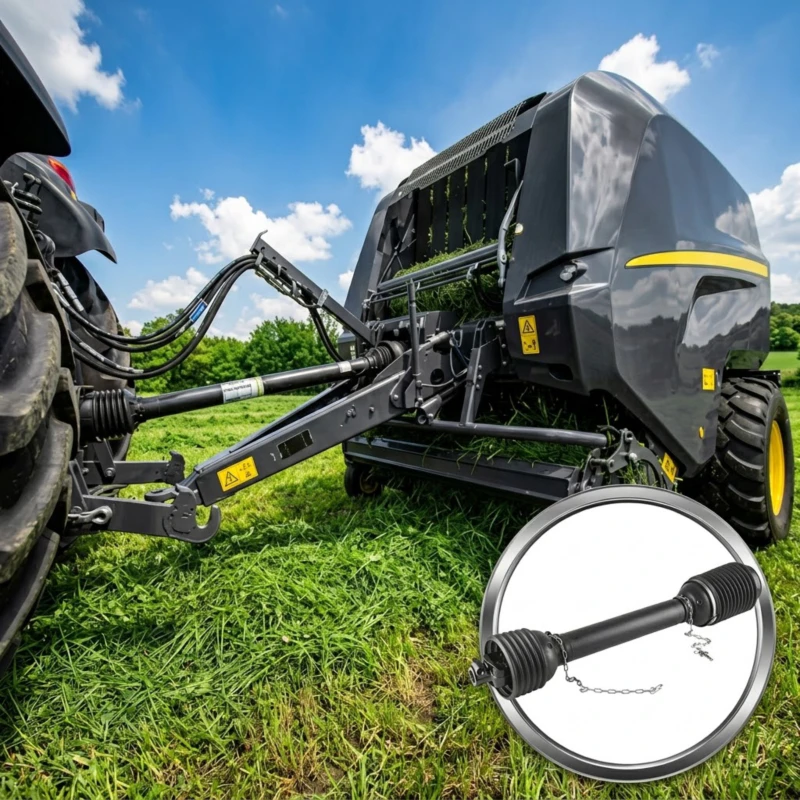
PTO connection between tractor and baler — the shaft guard, yoke guard, and bearing shield together form the complete PTO protection system that must be intact before any field operation
Hazard 1: PTO Entanglement — The Most Lethal Risk on Any Baler
A PTO shaft at 540 rpm completes nine full rotations per second. At 1000 rpm it completes 16.7 rotations per second. Any loose material — clothing, a rope end, baler twine, crop wrap — that contacts the rotating shaft is pulled in and wound around it faster than any human reflex can respond. The result is typically degloving, limb avulsion, or death depending on the point of contact and how quickly the tractor engine can be killed.
There is no safe distance from an unguarded rotating PTO shaft. The guard system — shaft tube guard, yoke guards at both ends, and the bearing shield at the tractor PTO output — exists to create a physical barrier between the rotating components and anything that might contact them. The guard cannot function when it is damaged, missing, or when someone removes it and does not replace it.
PTO Guard Requirements and Inspection Points
A complete PTO protection system consists of four components, all of which must be present and functional before operating the baler:
Shaft tube guard
The plastic or metal tube that covers the full length of the rotating shaft body between the two yoke ends. Must rotate freely on the shaft — if it has seized to the shaft and rotates with it, it provides no protection because loose material will still be wound in. Check by hand: the tube should spin freely while the shaft is stationary.
Yoke guards (both ends)
Cone-shaped or bell-shaped guards that cover the universal joint and yoke at the tractor PTO output end and the baler input end. The guard cone must extend past the joint and overlap the shaft tube guard when the shaft is at maximum operating angle. If missing at either end, the universal joint — which rotates at shaft speed — is exposed and presents the same entanglement risk as an unguarded shaft.
Guard retention chain
A short chain or strap from each yoke guard to a fixed point on the tractor or baler that prevents the guard from rotating with the shaft. If the retention chain is missing, the guard can rotate and will be ineffective. Check that both chains are attached at both ends and are not so loose that the guard can still turn significantly.
Tractor PTO output shield
The fixed shield mounted on the tractor rear axle housing that surrounds the PTO stub shaft when no implement is connected. When the baler is connected, the yoke guard overlaps this shield. If the tractor shield is missing, the area around the tractor PTO stub — including behind the connected baler shaft — remains a significant entanglement zone when the baler is parked or being disconnected.
Critical Rule: Never Approach the PTO Shaft Zone While the Engine Is Running
The PTO shaft and all baler mechanisms must be at a complete standstill before any person approaches the baler for clearing jams, checking wrapping, or adjusting any component. This means PTO disengaged AND tractor engine stopped AND key removed. A disengaged PTO that is still spinning down from 540 rpm has enough rotational energy to cause severe injury for up to 30 seconds after disengagement. Always wait for complete standstill — not just PTO disengagement.
Loose clothing is the single most common entanglement factor identified in PTO incident investigations. Untucked shirts, loose jacket sleeves, scarves, and trailing straps on personal protective equipment are regularly implicated. Wear close-fitting clothing when operating or working near any tractor-driven implement. This is not a style preference — it is a primary control measure.
Hazard 2: Bale Ejection Zone — Managing the Area Behind the Baler
When a round baler ejects a completed bale, the rear gate opens and a bale weighing 300 to 900 kg drops or rolls from a height of 600 to 1,200 mm onto the ground. On a slope, the bale can travel significant distances after ejection before stopping. On flat ground, the bale rolls a short distance but can still strike anything or anyone in the immediate area. The ejection event takes less than three seconds from gate opening to bale on the ground.
Three groups of people are at elevated risk during bale ejection: children or bystanders who have approached the baler from the rear while it was operating, second operators or helpers assisting with bale positioning who are standing in the ejection path, and the tractor operator themselves if they have left the cab for any reason while the ejection cycle is completing.
| Situation | Required Exclusion Zone | Control Measure |
|---|---|---|
| Bale forming in chamber (gate closed) | 5 m behind baler, 2 m either side | No persons in zone during baling passes |
| Gate opening / ejection cycle | 10 m behind baler, 3 m either side | Operator remains in cab; all others clear zone before ejection |
| Bale ejection on downhill slope | 30+ m downhill trajectory zone | Never eject bales toward any person, vehicle, or structure downslope |
| Children present on farm | Children must not be in the same field as an operating baler | Children remain in a designated safe area away from field operations at all times |
On hillside fields, bale ejection direction relative to slope is a critical operational decision. Always eject bales so they roll across the slope or uphill — never downhill toward a fence line, road, water feature, or working area. If field shape requires baling in a direction that would put ejected bales on a downhill trajectory toward a hazard, stop before the ejection point and position the tractor so the bale is ejected across or uphill before resuming the pass.
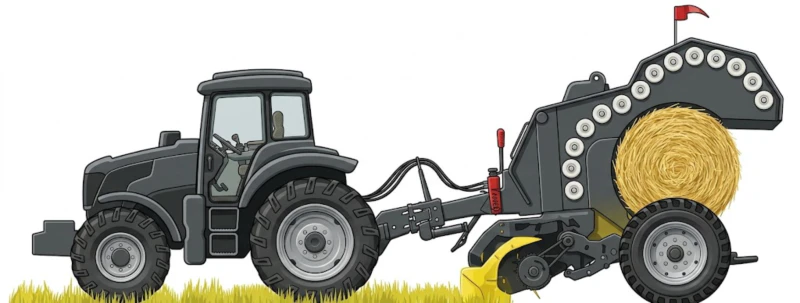
Bale chamber and rear gate mechanism — when the gate opens, the formed bale drops or rolls from 600 to 1,200 mm height; the ejection zone behind the machine must be clear before the gate cycle begins
Hazard 3: Rear Gate and Hydraulic Crush Injuries
The rear gate of a round baler is a heavy structural assembly, typically weighing 180 to 400 kg, that opens upward and rearward on a hydraulic cylinder system. When the gate is fully open, it is held in position only by the hydraulic system. If a hydraulic hose fails, a valve shifts, or pressure bleeds from the circuit, the gate can fall without warning. The closing force of a returning gate under hydraulic power is sufficient to cause fatal crush injuries.
Three specific scenarios generate most rear gate injuries:
Scenario A: Clearing a jam with the gate open
A crop jam in the bale chamber requires the operator to open the rear gate and work inside the chamber to clear the blockage. If the gate falls while the operator is inside, the result is a crush injury. The control: always install the gate prop or locking pin before entering the bale chamber zone. Never rely on the hydraulic circuit alone to hold the gate open during maintenance or jam clearing. Most balers ship with a gate prop — confirm it is present and in usable condition before every season.
Scenario B: Standing behind the baler when the gate closes during an ejection cycle
An operator standing behind the baler to check bale wrapping or net wrap application may be struck by the gate as it closes after ejection, or by the bale itself as it rolls clear. The control: complete all inspection and adjustment tasks from the tractor cab or from a position well to the side of the baler — never from a position directly behind it during or after an ejection cycle.
Scenario C: Gate drops due to hydraulic failure during hitching or unhitching
During hitching and unhitching operations, the baler is stationary and the operator is working at the rear of the machine. If the gate has been left partially open and the hydraulic circuit is not fully pressurised, the gate can descend. The control: before performing any hitching or unhitching work near the rear of the baler, confirm the gate is fully closed and latched, or if it must be open, the gate prop is installed and confirmed engaged.
Hazard 4: Pickup Reel and Feed Mechanism Injuries
The pickup reel rotates at several hundred rpm and its tines extend 100 to 150 mm beyond the reel body. Any loose material — crop wrapping string, net wrap tails, baler twine, or clothing — that contacts the tines is drawn into the mechanism within one revolution. The feed rotor or auger behind the pickup operates at similar or higher speeds and presents the same hazard from the intake zone directly above it.
The most common pickup reel injury scenario is an operator attempting to clear a blockage at the pickup while the PTO is still engaged or still spinning down. Hay that has accumulated around a tine or that is partially wrapped in the mechanism appears stationary because the reel is moving slowly or intermittently — but a slow-moving pickup reel rotating against a lodged obstruction still has sufficient torque to draw in a hand or sleeve.
The complete rule is the same as for all baler mechanisms: PTO disengaged, engine stopped, key removed, full standstill confirmed before any physical contact with the pickup, feed rotor, or bale chamber. Use a stick or tool to remove crop blockages from outside the guarded zone rather than reaching in by hand.
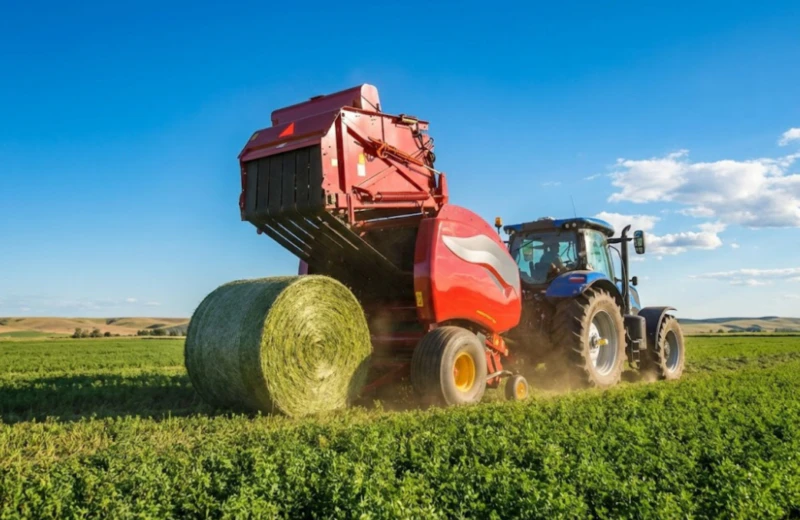
Full machine view — pickup reel, feed throat, bale chamber, rear gate, and PTO input are all active hazard zones that must be guarded and managed separately
Pre-Season Safety Inspection Checklist: 30 Points Before the First Bale
A pre-season safety inspection is distinct from a maintenance inspection. The maintenance inspection confirms the machine is mechanically ready to operate. The safety inspection confirms that all guarding, warning systems, and operator protection measures are in place and functional. Both are required. The checklist below covers safety-specific items; perform it in addition to, not instead of, the mechanical pre-season service.
A — PTO Drive System (6 points)
Shaft tube guard rotates freely on the shaft (does not spin with the shaft)
Tractor-end yoke guard present, undamaged, and overlaps shaft tube guard at full operating angle
Baler-end yoke guard present, undamaged, and overlaps shaft tube guard at full operating angle
Guard retention chains attached at both ends and short enough to prevent guard rotation
Tractor PTO stub shaft shield present and undamaged
PTO shaft length within operating range — shaft does not fully compress or extend beyond coupling limit at minimum and maximum operating angles
B — Rear Gate and Hydraulic System (7 points)
Gate prop or locking pin present on machine and in serviceable condition — can be installed and removed easily
Gate hydraulic hoses inspected for cracks, abrasion, or swelling — no leaks visible at fittings or along hose length
Gate latch and latch release mechanism operates correctly — gate latches fully closed without manual assistance and releases cleanly on command
Gate open and close functions operate from the tractor cab without the operator leaving the seat
Gate hinge pivot pins secure and retaining clips present
Bale ramp or bale guide (if fitted) secure and undamaged — no sharp edges or protruding fasteners that could cause injury during bale handling
All hydraulic system hose clamps and fitting connections tight — no loose hose clips that allow hose movement under pressure
C — Pickup Reel and Feed Throat (5 points)
Pickup reel guard / crop deflector present and correctly positioned — prevents operator from reaching tines from the front of the machine while operating
Side shields on pickup reel intact — prevents crop or binder material from being thrown laterally from the reel ends
Feed rotor cover or throat guard present and secured — no open access to the rotating feed mechanism during normal operation
No baler twine, net wrap, wire, or rope material wound around any drive shaft, sprocket, or roller in the pickup or feed zone — clear all accumulated material before the season begins
Pickup height adjustment mechanism operates correctly and locks at the set height — pickup does not drop unexpectedly during transport or field operation
D — Safety Signs, Labels, and Operator Information (5 points)
All safety warning decals on the machine are present and legible — replace any decal that is missing, peeling, or faded to the point where the symbol or text is no longer clearly visible
Operators manual is present on the farm and accessible to all operators of the machine — not stored in a location where it cannot be found when needed
Maximum PTO speed rating clearly marked on the baler input shaft housing — operator and tractor driver are aware of the rated speed
Any new or seasonal operators have been given a machine-specific safety briefing covering PTO zone, bale ejection zone, gate prop procedure, and emergency shutdown sequence before operating the baler
Emergency contact numbers and farm address are accessible in the tractor cab in case an incident requires emergency services to be called
E — General Machine Condition and Third-Party Risk (7 points)
Lighting and reflectors functional and clean if the machine will be transported on public roads — front and rear working lights for early morning or evening field operation
Slow-moving vehicle (SMV) emblem present and visible if machine will travel on public roads
Tow hitch or drawbar connection secure and appropriate pin with retaining clip installed — baler cannot become unintentionally uncoupled during field operation or road travel
Tyres inflated to specification and free of visible damage — sidewall cracks, bulges, or embedded objects require tyre replacement before field use
No children or unauthorised persons in the field during baling — field boundary access points checked and closed before baling begins
All loose items removed from the baler before operation — tools, wire, rope, or hardware left on the machine can become projectiles or entanglement hazards during baling
First aid kit present and accessible in the tractor cab — contents checked and restocked as required
PTO shaft replacement and safety compliance: A worn or damaged PTO shaft is a safety issue as much as a mechanical one. A shaft with cracked yoke guards, seized tube guard, or missing retention chains fails multiple points on the pre-season checklist above and must be replaced before the machine is operated. For machines using New Holland-compatible input configurations, a fully guarded replacement PTO shaft for big balers includes all guard components and meets the protection requirements of the Machinery Directive and equivalent national standards.
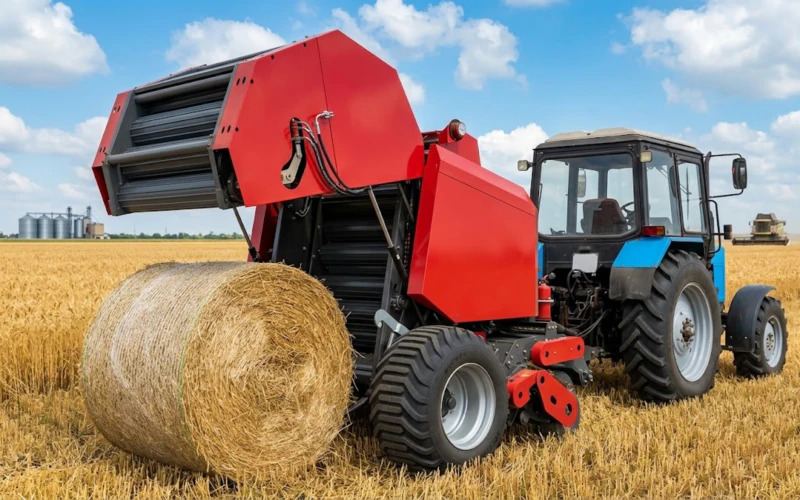
Field operation with all guards in place — safe baling depends on the combination of mechanical guarding, clear exclusion zones, and consistent operator procedures every time the machine runs
よくある質問
Conclusion: Baler Safety Is a System, Not a Single Rule
No single safety rule prevents all baler incidents. PTO guarding prevents entanglement only if the guards are present and functional. Exclusion zones prevent bale ejection strikes only if all personnel observe them consistently. The gate prop prevents crush injuries only if it is installed before anyone enters the gate zone. Each control measure is specific to one hazard — which is why the 30-point pre-season checklist covers five separate sections rather than a single general inspection.
The investment required is one inspection per season, daily visual checks on the PTO guard, and consistent application of the standstill rule every time a person approaches the machine for any reason. None of these requires specialist knowledge or expensive equipment. They require the discipline to apply them every time, including the times when experienced operators are in a hurry and the machine appears to be working fine.
If you are selecting a new round baler and want to review the safety guarding specification — PTO input guard configuration, gate prop system, pickup guard design — before purchasing, the team at balershay.com can provide detailed safety documentation and CE Declaration of Conformity for each model in our range.
Filed under: Hay Baler Safety | PTO Safety | Agricultural Machinery Safety | Pre-Season Inspection