
A practical guide to matching tractor power to baler type and working conditions — understanding the 80% rule, PTO power vs engine power, peak torque demands, and why the rated HP on your tractor badge may not be the number that matters most
Ask any baler dealer what tractor you need and the answer is simple: look up the baler’s minimum horsepower requirement and buy something bigger. But the reality of matching tractor power to baler performance involves several nuances that the specification sheet does not capture. Engine horsepower — the number on the tractor badge — is not the same as PTO horsepower, which is the power actually available at the shaft that drives the baler. Peak torque demand during the baling cycle is not the same as average PTO draw. And the power required in dense, heavy swaths on a hot afternoon is not the same as the power required in thin, dry windrows on a cool morning.
Getting the tractor-baler power match right has two failure modes. Under-powering produces stalling, clutch slipping, and mechanical stress on both the tractor and the baler during peak load events — eventually leading to component failures on both machines and a field operation that is perpetually fighting the conditions rather than working with them. Over-powering wastes capital on tractor capacity that is never needed and may produce excessive fuel consumption from running a large engine at a low load fraction. Between these extremes lies the correct match — and this article provides the framework to find it for both round baling and large square baling applications.
Whether you are buying your first baler, upgrading an existing one, or adding a baling enterprise to a farm where the tractor fleet is already established, the power-matching principles in this guide will help you make a decision that performs reliably across the full range of your baling conditions.
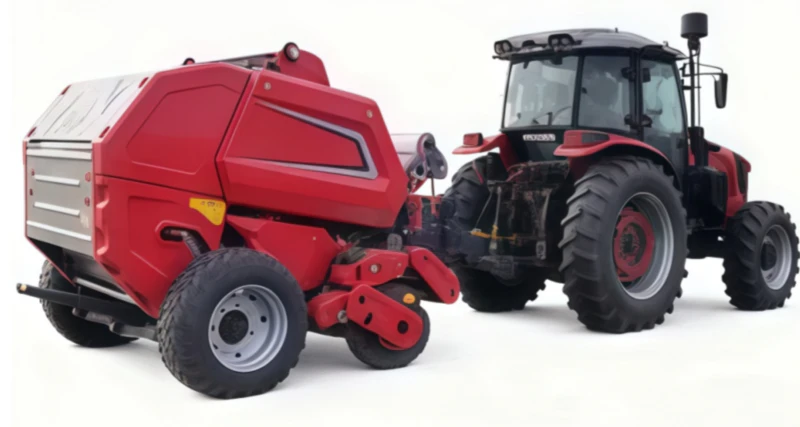
Engine HP vs PTO HP: The Number That Actually Matters
Every tractor has two horsepower figures that are relevant to baling: engine horsepower and PTO horsepower. They are different, and confusing them is the most common cause of under-powering a baler with a tractor that the specification sheet says is adequately matched.
Engine Horsepower
Engine horsepower is the gross power produced at the crankshaft under laboratory conditions — typically measured without cooling fan, air filter restriction, exhaust back-pressure, or alternator load. It is the number manufacturers use in marketing because it is the largest figure available for any given tractor. Modern agricultural tractor certification (OECD test codes 2 and 3) measures “rated engine power” under specific conditions, but even this figure is gross power at the flywheel, not at the PTO stub where it matters for a baler.
PTO Horsepower
PTO horsepower is the power actually delivered at the PTO stub shaft, measured with the tractor driving its cooling system, hydraulics, alternator, and all other parasitic loads. PTO power is typically 80–88% of rated engine power — a 100 hp engine tractor delivers approximately 82–88 hp at the PTO under field conditions. For baler power matching, PTO horsepower is the relevant figure, not engine horsepower.
The PTO Conversion Rule of Thumb
Multiply rated engine horsepower by 0.85 to estimate the PTO horsepower available under field conditions. A 50 hp engine tractor delivers approximately 42–43 hp at the PTO. A 100 hp tractor delivers approximately 85 hp at the PTO. A 250 hp tractor (as required for the EP-9YFQ-2290XD large square baler) delivers approximately 212–215 hp at the PTO — just meeting the baler’s 250 hp specification at rated engine power. This is why baler specifications listing “minimum 250 hp” should be read as “250 hp at the PTO” and the tractor must be rated above 290 hp engine power to meet the specification under real field conditions with all parasitic loads active.
Boost Power and Power Management Systems
Modern tractors with electronic engine management systems often feature boost or intellipoweramp modes that temporarily increase engine output above the rated figure during high-demand operations — typically adding 10–20% power for short periods. This boost power is real and contributes to baling performance during peak load events. However, sustained baling at boost power levels places the engine and drivetrain under continuous high-load stress; boost is not a substitute for adequate rated power but is a useful reserve for handling occasional dense slug entries without stalling.
The 80% Rule: Why Your Baler Should Use Less Than 80% of Your PTO Power at Normal Load
The 80% rule is the fundamental principle of tractor-implement power matching: under normal working conditions at a sustainable forward speed, the implement should draw no more than 80% of the tractor’s available PTO power, leaving 20% in reserve for peak load events.
The reason is not conservative engineering caution — it is the physics of how balers load the PTO. Baling is not a steady-state load. Every time the baler’s pickup reel encounters a heavy section of windrow, or the plunger on a square baler completes a compression stroke against a dense bale charge, or the round baler chamber reaches full density and the belt pressure rises, there is a sudden increase in PTO torque demand that is significantly higher than the average running load. These peak torque events are brief — fractions of a second to a few seconds — but they are real, and if the tractor has no power reserve, the only response to a peak event is engine speed droop (the engine slows under the load), clutch slip, or stalling.
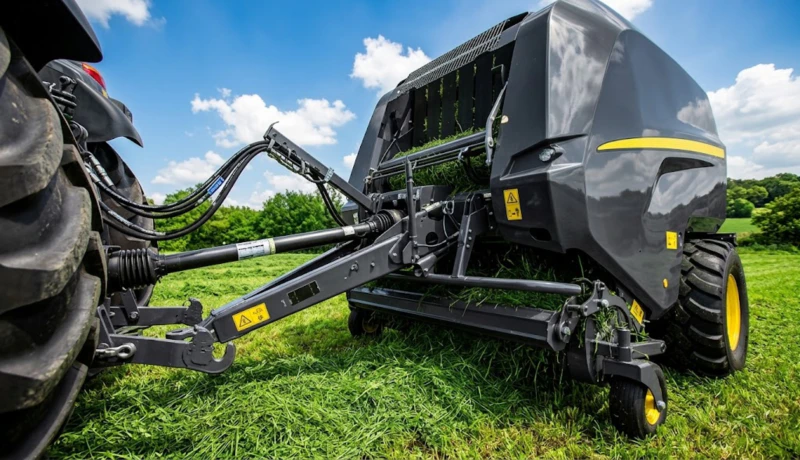
Applying the 80% Rule: Worked Examples
| Baler Type | Baler PTO Demand | Min PTO HP (80% Rule) | Min Engine HP Required | Practical Tractor Size |
|---|---|---|---|---|
| Mini round baler (EP-9YK-870) | 15–20 hp PTO | 19–25 hp PTO | 22–30 hp engine | 25–40 hp tractor |
| Standard round baler (small) | 30–45 hp PTO | 38–56 hp PTO | 45–66 hp engine | 50–75 hp tractor |
| Standard round baler (large) | 60–80 hp PTO | 75–100 hp PTO | 88–118 hp engine | 100–130 hp tractor |
| Large square baler (EP-9YFQ-2290XD) | 200–220 hp PTO | 250–275 hp PTO | 294–324 hp engine | 300–350 hp tractor |
Note that the “practical tractor size” column is consistently larger than the baler’s minimum specified requirement — this is the 80% rule in action. The EP-9YFQ-2290XD specifies 250 hp minimum tractor, which means 250 hp at the PTO, which means approximately 294 hp engine power minimum — and applying the 80% rule to that engine power means the ideal tractor is in the 300–350 hp engine range for sustained comfortable baling without regular near-limit operation.
Round Baler Power Profile: How Power Demand Changes Through the Baling Cycle
A round baler’s power demand is not constant through the bale formation cycle. Understanding the demand profile allows you to identify whether your tractor is well-matched for the full cycle, not just the average operating condition.
Phase 1: Empty Chamber Entry (Low Load)
As the bale chamber fills from empty after ejection, the pickup reel is the primary load. PTO demand is low — 15–40% of rated baler demand. The tractor runs lightly loaded. This phase is short in productive baling conditions and does not stress the tractor.
Phase 2: Mid-Bale Formation (Average Load)
The bale is forming and the chamber belts are rotating the growing bale cylinder against belt tension. PTO demand rises to 50–70% of rated baler demand — this is the average operating condition that most baler specifications reference. Most of the productive baling time is spent in this phase.
Phase 3: Bale Completion (Peak Load)
As the bale reaches full diameter and the chamber pressure rises to the target setting, PTO demand peaks at 90–110% of the average rated draw. This is the moment when an underpowered tractor stalls or the PTO slip clutch engages. The duration is 20–40 seconds per bale — brief but repeated at every bale completion.
Phase 4: Wrapping and Ejection (Low Load)
Net wrap or twine application and bale ejection are low-power operations. The tractor is stationary or moving slowly, and PTO demand drops back to pickup-only levels. Some operators disengage PTO during wrap and ejection to save fuel and reduce baler wear, which is acceptable practice.
The practical implication for tractor selection: the tractor must handle Phase 3 peak demand without stalling, not just Phase 2 average demand. A tractor that operates at 70% of its PTO capacity during Phase 2 will operate at 85–105% during Phase 3 — potentially exceeding its limit. Apply the 80% rule to the peak demand, not the average demand, for reliable baling across all conditions.
Large Square Baler Power Profile: The Plunger Torque Spike Challenge
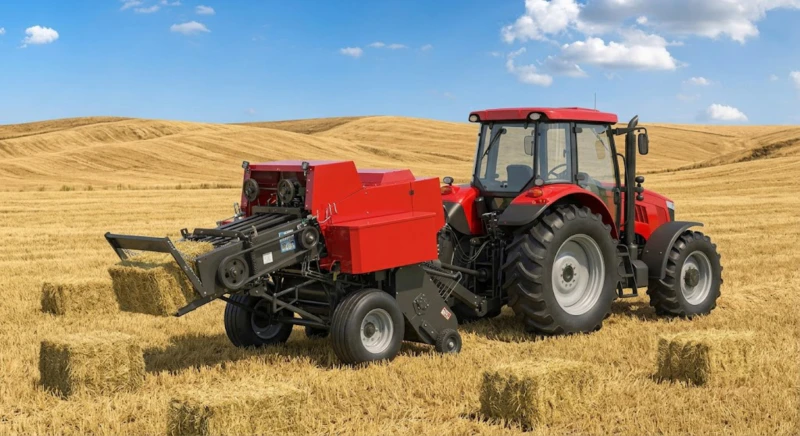
Large square balers impose a fundamentally different power demand profile on the tractor than round balers. Rather than a smoothly rising and falling chamber pressure cycle, the square baler’s plunger mechanism generates a repetitive impact load — every compression stroke applies a sudden, very high force to the crop charge in the bale chamber, then releases as the plunger retracts. This creates a cyclical torque spike at approximately 1–2 Hz (one to two compression strokes per second at operating speed) that is superimposed on the steady-state pickup and conveyor load.
The Flywheel: The Component That Manages Torque Spikes
Large square balers are equipped with a large flywheel on the plunger drive mechanism precisely to manage the torque spike problem. The flywheel stores rotational energy during the low-load retraction phase of the plunger cycle and releases it during the high-load compression phase — smoothing the peak torque experienced at the PTO shaft and allowing a smaller tractor to drive a larger baler than would be possible without flywheel energy storage.
However, the flywheel’s energy storage is finite. When the crop charge is denser than normal — a heavy swath entering the bale chamber at the same moment as a compression stroke — the flywheel cannot fully buffer the peak torque, and the excess demand reaches the PTO shaft as a torque spike. This is the event that the Poros PTO slip clutch must absorb when the tractor cannot supply sufficient power to maintain flywheel speed through the compression event.
Power Demand by Working Condition
PTO demand 60–75% of rated baler draw. Tractor lightly loaded. Comfortable operation even on a tractor at the specified minimum power. Flywheel easily maintains speed between compression strokes.
PTO demand 80–95% of rated baler draw. Tractor operating near its comfortable limit. Engine speed may droop slightly on dense slug entries. 80% rule tractor handles this condition; minimum-spec tractor struggles.
PTO demand 100–130% of rated baler draw during compression events. Minimum-spec tractor stalls or slip clutch engages repeatedly. 80% rule tractor engages slip clutch only on slug events. Significantly over-spec tractor handles the condition without protection circuit engagement.
PTO Shaft Specification: Matching the Driveline to the Power and Torque Profile
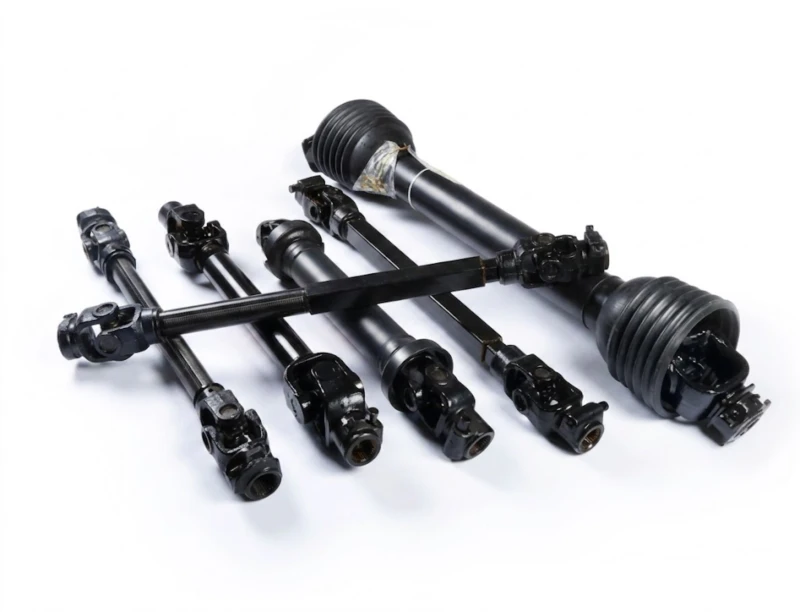
Tractor power selection and PTO shaft specification go together — the shaft must be rated for the power and torque the tractor can actually deliver to the baler, not just the baler’s average running load. The key specification parameters are PTO speed (540 rpm vs 1,000 rpm), connection spline type, and shaft torque rating.
| Aplikasi | Kecepatan PTO | Spline Type | Torque Rating | Protection |
|---|---|---|---|---|
| Mini round baler (25–50 hp) | 540 rpm | 1–3/8″ 6-spline | 300–500 Nm | Friction slip clutch |
| Standard round baler (50–130 hp) | 540 / 1,000 rpm | 1–3/8″ 6-spline | 800–1,500 Nm | Friction slip clutch |
| Large square baler (200–300 hp) | 1,000 rpm | 1–3/4″ 20-spline | 3,000–5,000 Nm peak | Friction slip + shear bolt |
The large square baler PTO shaft specification —1,000 rpm, 1–3/4 inch 20-spline, rated for 3,000–5,000 Nm peak torque — is a completely different product from the 540 rpm shaft on a mini round baler. They are not interchangeable and not up-ratable through simple adaptor fitting. If you are upgrading from a round baler to a large square baler, the PTO shaft must be replaced with a unit correctly specified for the new application, not re-used from the smaller machine.
Practical Decision Guide: What Tractor Do I Actually Need?
Use the following decision steps to determine the correct tractor specification for your baling application.
- Identify the baler’s PTO demand: Find the baler specification’s “required tractor PTO output” or “minimum PTO hp” figure. If the specification only gives engine hp, multiply by 0.85 to estimate PTO output. This is your baseline PTO demand figure.
- Apply the 80% rule: Divide the baler’s PTO demand by 0.80 to get the minimum PTO hp your tractor should deliver. Example: baler demands 30 hp PTO → tractor should provide at minimum 30 ÷ 0.80 = 37.5 hp PTO.
- Convert PTO hp to engine hp: Divide the minimum required PTO hp by 0.85 to get the minimum tractor engine hp. Example: 37.5 hp PTO ÷ 0.85 = 44 hp engine minimum. In practice, select the next standard tractor size above this: 50 hp.
- Add a working conditions factor: If you regularly bale in heavy, dense swaths; on slopes above 10 degrees; or in conditions where the crop is damp and heavier than normal dry-hay baling, add 10–15% to the calculated minimum tractor size. These conditions push the baler to its peak demand more frequently and for longer than standard conditions.
- Confirm PTO speed and connection: Verify that the tractor’s PTO stub matches the baler’s input requirement: 540 rpm for mini and standard round balers, 1,000 rpm for large square balers. Confirm spline type. Order the correct PTO shaft before the baler arrives, not after it is hitched and found to be incompatible.
Pertanyaan yang Sering Diajukan
My tractor is 10 hp below the baler’s minimum specification. Will it work if I go slowly?
Reducing forward speed reduces the rate at which crop enters the baler, which lowers the average PTO draw but does not reduce the peak torque at bale completion or during dense slug entries — those events are determined by the bale density setting and the crop material, not the forward speed. Operating 10 hp below the minimum specification means you are already at or above the 80% rule limit at average conditions, with no reserve for peak events. In practice, operating below the minimum spec produces frequent PTO slip clutch engagement, potential stalling on dense swath entries, slower-than-rated bale cycle times (waiting for the tractor to recover engine speed between compression events on a square baler), and accelerated wear on the tractor’s PTO clutch and drivetrain. It will work — but not reliably or sustainably.
Does four-wheel drive affect the required tractor horsepower for baling?
Four-wheel drive affects traction, not PTO power output. The PTO shaft draws from the engine via the PTO gearbox regardless of whether the front axle is engaged. Four-wheel drive is important for baling on slopes or soft ground — it allows the tractor to maintain forward speed under the drawbar load of the baler on difficult terrain without wheel slip, which indirectly benefits baling throughput. But on flat, firm ground, a two-wheel-drive tractor of the correct PTO hp rating will bale as effectively as a four-wheel-drive tractor of the same engine rating. Select four-wheel drive for field condition reasons, not for PTO power reasons.
If I over-power the baler significantly, does that damage the baler?
Over-powering the baler — using a significantly larger tractor than the baler requires — does not damage the baler in normal operation. The baler’s load draws what it needs from the PTO regardless of how much the tractor could supply; having excess capacity available simply means the tractor runs more lightly loaded. The risk scenario is if the PTO slip clutch is set too tightly for the larger tractor’s available torque — in a blockage event, a large tractor may be able to apply more torque than the slip clutch can absorb, potentially transferring the overload to the baler’s mechanical components rather than the clutch slipping. Ensure the slip clutch is correctly set to its rated engagement torque regardless of tractor size.
What is the difference between 540 rpm and 1,000 rpm PTO for baling, and can I use a speed adaptor?
540 rpm is the standard PTO speed for tractors below approximately 75–100 hp and for all implements designed for smaller tractors — including mini round balers. 1,000 rpm is the standard for high-power tractors and large implements — including large square balers. A speed adaptor (multiplier or reducer gearbox) can convert between PTO speeds, but with important limitations: the adaptor introduces additional mechanical losses (typically 3–5% power loss), adds weight and complexity, and does not change the available torque at the implement in the way that using a natively matched tractor does. For mini round baler operation on a 1,000 rpm PTO tractor, a speed reducer adaptor is an acceptable solution for occasional use. For continuous commercial large square baling, the tractor must have a 1,000 rpm PTO as standard — an adaptor is not an appropriate long-term substitute.
Conclusion: Match Tractor Power to Peak Demand, Not Average Demand
Tractor power matching for baling is not complicated, but it requires using the right numbers. Engine horsepower on the tractor badge overstates available PTO power by 12–18%. The 80% rule means the tractor’s PTO output should be 25% above the baler’s average demand, not equal to it. Peak demand during bale completion and dense swath events is 20–50% above average demand. And the PTO shaft must be rated for the peak torque, not the average torque.
Working through these numbers before purchase — not after the first day of baling reveals the tractor is struggling — is the difference between a baling system that performs reliably across all conditions and one that is perpetually at the edge of its capability. The tractor is the most expensive component in most baling operations; getting its specification right is worth the time the calculation requires.
Balers Matched to Every Tractor Power Class — Factory Direct from Balershay
We supply balers across the full tractor power range — from the EP-9YK-870 mini round baler for 25–50 hp tractors to the EP-9YFQ-2290XD large square baler for 250 hp commercial operations — with technical support to confirm the right machine for your tractor and baling conditions. Visit balershay.com or contact our team to discuss power matching for your operation.