
Why the Wrong Bale Size Costs Cattle Farmers More Than the Wrong Baler
Cattle operations produce more round bales than any other livestock sector in North America, Australia, and most of the developing world’s beef and dairy regions. Yet the selection of round baler, bale diameter, and complementary feeding system is more often driven by what the local dealer has in stock or what a neighbour runs than by a structured analysis of what the herd actually needs. The consequence is predictable: either bales too large for the herd to consume before spoilage begins, or bales too small to justify the handling cost per kilogram of feed delivered. Either direction costs money every winter.
This guide builds the matching framework from first principles. It starts with herd intake requirements, works through bale consumption rate and spoilage window, selects the appropriate bale size and baler configuration, and finishes with feeder rack selection and placement to minimise feed waste at the point of delivery. The numbers are practical working figures from beef and dairy production systems across temperate and semi-arid climates.
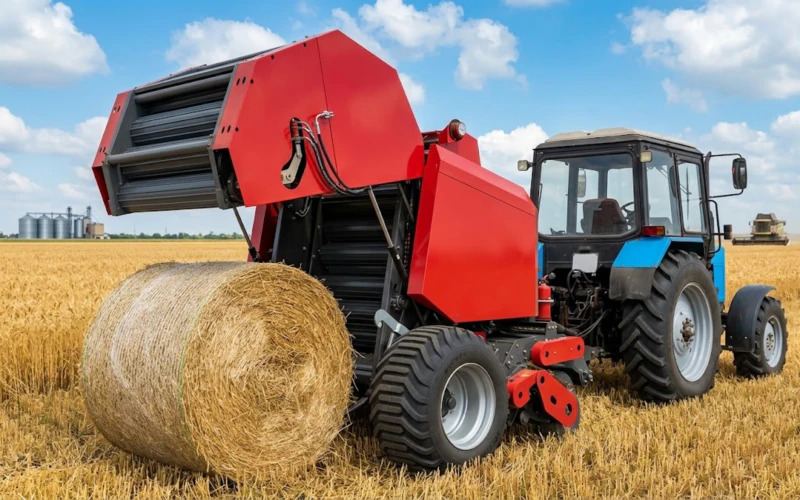
Round baler in field operation — bale size and density choices made at baling time determine feed efficiency and handling cost through the entire winter feeding period
Step 1: Calculate Your Herd’s Daily Hay Intake
The starting point for every bale size decision is a reliable estimate of how much hay the herd consumes per day. This figure drives every downstream calculation — bale consumption rate, spoilage window, number of bales needed per winter, and the appropriate feeder capacity.
Dry matter intake for beef cattle on hay during winter is typically 2.0 to 2.5 percent of body weight per day. For a mixed beef cow herd averaging 550 kg per animal, that is 11 to 14 kg of dry matter per cow per day. At typical hay dry matter content of 85 to 88 percent (12 to 15 percent moisture), this converts to 12.5 to 16.5 kg of as-fed hay per cow per day. Lactating dairy cows on hay will consume 15 to 22 kg of as-fed hay per day depending on milk production level and supplemental grain allocation.
| Animal Type | Average Weight (kg) | Daily As-Fed Hay (kg/head) | Waste-Adjusted (kg/head) |
|---|---|---|---|
| Dry beef cow | 550 | 12 – 14 | 14 – 17 |
| Cow-calf pair (winter) | 580 + calf | 14 – 18 | 17 – 22 |
| Growing steers (300 kg) | 300 | 7 – 9 | 8 – 11 |
| Lactating dairy cow | 620 | 16 – 22 | 19 – 26 |
| Bulls | 800 | 16 – 20 | 19 – 24 |
The waste-adjusted column applies a 15 to 20 percent addition to the base intake figure. Field research on round bale feeding systems consistently shows that hay waste — the material trampled, soiled with manure, or pulled from the feeder and not consumed — adds 15 to 40 percent to the hay required per animal when unconfined bale feeding is used. Feeding in ring feeders reduces waste to 3 to 8 percent. The waste adjustment should reflect your actual feeding system, not a generic assumption.
Step 2: Calculate Bale Consumption Rate and the Spoilage Window
Once daily herd intake is established, bale consumption rate — the number of days a single bale will last the herd — determines the critical constraint of the whole system. A bale that lasts longer than five to seven days in a ring feeder during mild winter conditions begins to accumulate surface spoilage from rain, dew, and manure contamination of the outer hay layer. A bale that lasts less than one day requires daily bale handling, which adds tractor time and fuel costs that quickly erode the economic advantage of larger bales.
Bale Consumption Rate Formula
Days per bale = Bale weight (kg) / (Herd size x Daily intake per head (kg) x (1 + Waste factor))
Example — 50 dry cows, 400 kg bale, ring feeder (8% waste):
400 / (50 x 13 x 1.08) = 400 / 702 = 0.57 days per bale — nearly 2 bales per day
That example illustrates a common problem on mid-sized beef operations: a herd large enough that standard 5-by-5 bales (350 to 450 kg) require daily or twice-daily feeding, while the farmer does not want to invest in a 5-by-6 or 6-by-6 baler producing bales above 600 kg. The target consumption window is two to five days per bale — long enough to reduce handling frequency to manageable levels but short enough to prevent meaningful feed spoilage in the open feeder.
| Herd Size (dry beef cows) | Target Consumption (days) | Required Bale Weight (kg) | Recommended Bale Size |
|---|---|---|---|
| 10 – 20 | 3 – 5 days | 420 – 700 | 4×5 or 5×5 round bale |
| 20 – 40 | 3 – 5 days | 840 – 1,400 | 5×6 round bale or 2x 5×5 in adjacent feeders |
| 40 – 80 | 3 – 5 days | 1,680 – 2,800 | 5×6 or 6×6 baler, multiple feeders per site |
| 80 – 150 | 2 – 4 days | 2,184 – 4,200 | Large square baler or multiple round bale feeders |
| 150+ | Daily feeding system | Depends on feeding method | TMR mixer or unrolling system — see Section 6 |
Round Baler Size Options: What 4×5, 5×5, 5×6, and 6×6 Actually Mean for Cattle Farmers
Round baler size designations describe the maximum bale produced — first number is diameter in feet, second number is width in feet. A 5×5 baler produces bales up to 1.52 m in diameter and 1.52 m wide. A 5×6 baler produces bales up to 1.52 m in diameter and 1.83 m wide. The 6×6 designation means up to 1.83 m diameter and 1.83 m wide.
Bale weight within a given size class varies significantly with crop species, moisture content at baling, and bale density setting. The table below provides working weight ranges for the most common bale sizes and crop types relevant to cattle feeding.
| Ukuran Bal | Grass Hay (kg) | Alfalfa (kg) | Straw (kg) | Tractor Requirement |
|---|---|---|---|---|
| 4×5 (small round) | 200 – 300 | 220 – 320 | 120 – 180 | 40 – 60 HP PTO |
| 5×5 (standard) | 320 – 450 | 360 – 500 | 180 – 280 | 60 – 90 HP PTO |
| 5×6 (large round) | 450 – 650 | 500 – 720 | 250 – 380 | 75 – 110 HP PTO |
| 6×6 (extra large) | 600 – 900 | 680 – 980 | 340 – 520 | 90 – 130 HP PTO |
The tractor requirement column reflects the PTO horsepower needed to run the baler at capacity in heavy crop. Matching tractor PTO output to baler requirement is as important for cattle operations as for custom contractors — an underpowered tractor in a heavy alfalfa windrow produces incomplete bales, belt slippage, and overload clutch trips that interrupt workflow. An overpowered tractor wastes fuel and accelerates wear on the baler input shaft.
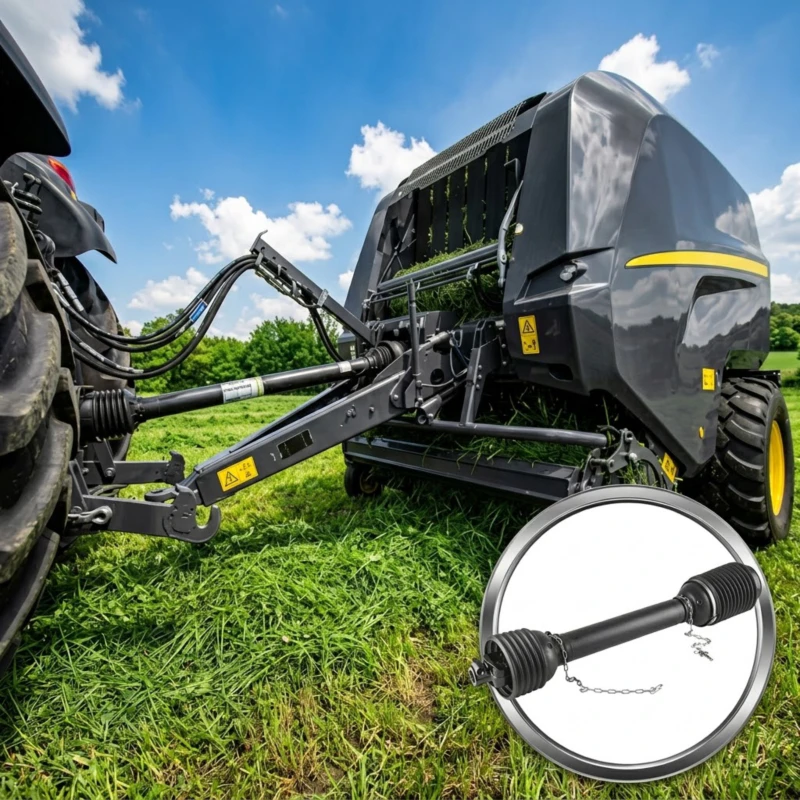
Tractor-baler PTO connection — the drive shaft must be rated for the baler input torque at the selected bale size, particularly when producing maximum-diameter bales in heavy grass or alfalfa
PTO shaft rating and bale size: Moving from a 5×5 to a 5×6 baler increases peak gearbox input torque by 25 to 40 percent as the larger bale chamber compresses more crop per cycle. A PTO shaft sized for the smaller machine may develop yoke wear or joint failure under sustained large-bale production. Before upgrading baler size, inspect the existing PTO shaft and replace if necessary. A correctly rated replacement PTO shaft for large baler applications ensures the drive system can sustain maximum-diameter bale production without unexpected field failures.
Step 3: Select the Feeder Rack System to Match Bale Size and Herd Behaviour
The feeder rack is the final link between the bale and the animal, and it is the link most directly responsible for feed waste. Research across multiple beef production environments shows that feeding method has a larger effect on the percentage of hay actually consumed versus wasted than bale quality, hay species, or storage method. A poorly designed or undersized feeder rack can waste 30 to 45 percent of a bale through trampling, soiling, and pulling material out onto the ground.
There are four main feeder rack configurations used in cattle operations, each with different waste profiles and management requirements.
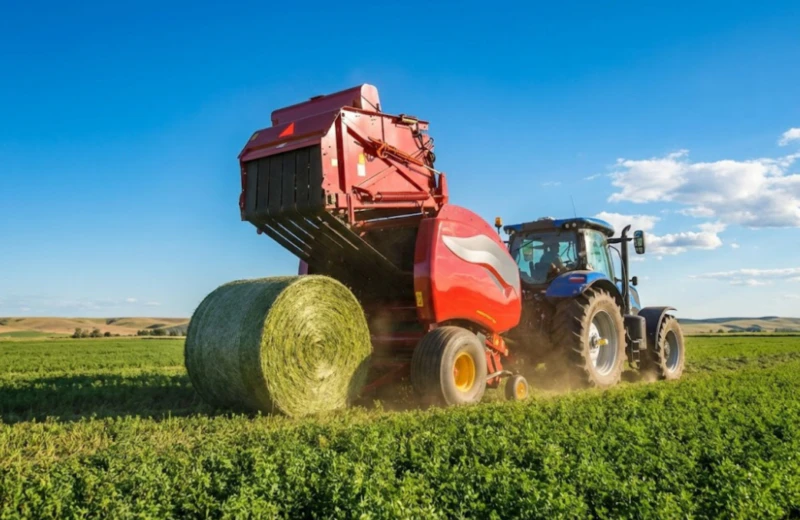
Large-diameter baler output — 5×6 and 6×6 bales require appropriately sized feeder rings; undersized rings allow excessive material to fall outside the containment perimeter
Feeder Ring Sizing: Matching Ring Diameter to Bale Diameter
A common installation error is placing a large bale inside a feeder ring sized for a smaller bale. When the bale diameter exceeds the inner diameter of the ring, the bale contacts the ring bars before settling onto the ground, leaving a gap between the bale base and the ground through which hay falls outward as the bale is consumed. The bale also sits high in the ring, making it easier for cattle to pull material upward and outward rather than inward and downward toward the animal.
The correct ring inner diameter should be 150 to 300 mm larger than the maximum bale diameter you intend to feed. This clearance allows the bale to settle fully to ground level and provides enough space for the outer layer of hay to contact the ring bars at a height accessible to cattle without excessive reach. For a 5×5 bale at 1.52 m diameter, ring inner diameter should be 1.67 to 1.82 m. For a 5×6 bale, use a ring with inner diameter of 1.72 to 1.90 m.
| Ukuran Bal | Max Bale Diameter | Recommended Ring ID | Head Spaces (cattle) |
|---|---|---|---|
| 4×5 round bale | 1.22 m | 1.37 – 1.52 m | 5 – 8 |
| 5×5 round bale | 1.52 m | 1.67 – 1.82 m | 8 – 12 |
| 5×6 round bale | 1.52 m | 1.72 – 1.90 m | 10 – 16 |
| 6×6 round bale | 1.83 m | 1.98 – 2.13 m | 14 – 20 |
Number of Feeders per Site: Avoiding Competitive Exclusion in the Herd
Social hierarchy in cattle herds means that dominant animals monopolise access to a single feeder while subordinate animals wait. In a herd where the same 20 animals compete for one 12-head ring feeder, the bottom-ranked 8 animals will consistently receive less hay than their daily requirement, leading to body condition loss through winter that reduces reproductive performance in spring. The nutritional consequence of competitive exclusion is often attributed to poor hay quality when the real cause is feeder access design.
The rule of thumb for round bale ring feeders is one feeder space per 1.0 to 1.3 cows, with a minimum of two feeders per paddock regardless of herd size. Two feeders in the same paddock allow a subordinate animal displaced from feeder one to access feeder two rather than standing away from feed entirely. Research comparing single-feeder to double-feeder systems in herds of 20 to 30 cows consistently shows that double-feeder operations maintain more uniform body condition across the herd through winter with the same total hay allowance.
Space feeders at least 15 to 20 metres apart so that a dominant animal cannot prevent access to both simultaneously by positioning itself between them. On large paddocks where cattle must walk significant distances to the feeding site, place multiple feeder clusters rather than concentrating all feeders in one location — the walk distance to feed in cold weather affects voluntary intake, particularly in cows late in pregnancy.
Bale Handling Equipment: Front Loader, Bale Spear, and Wrap Removal
Handling round bales efficiently from storage to feeder requires equipment matched to bale weight and feeder location. The most common handling attachment is a front loader bale spear — a single or double tine mounted on the tractor front linkage that impales the bale for transport and placement. Single spears handle bales up to approximately 600 kg safely on tractors with sufficient front loader capacity. Double spears distribute the load and are preferred for 5×6 and 6×6 bales above 600 kg where a single spear creates an unbalanced load that risks tipping the bale on slopes.
Front loader lift capacity is the constraint that often determines maximum practical bale size on a cattle property. A tractor with a front loader rated at 800 kg lift capacity at full extension can handle 5×6 bales safely but not 6×6 bales at maximum density. Check the loader specification at full boom height, not at low carry position — lift capacity drops significantly as the boom extends upward, and placing a bale into a feeder ring requires lifting to at least feeder ring height (typically 1.2 to 1.4 m above ground).
Wrap removal at the feeder is a welfare and safety step that must be done before or immediately after placing the bale. Net wrap left on the bale in the feeder is ingested by cattle and accumulates in the rumen, causing hardware disease, chronic bloat, and in severe cases rumen impaction that requires veterinary intervention or results in death. Establish a consistent wrap removal routine — pull net wrap entirely from the bale before placing it in the feeder, and dispose of all wrap material away from the feeding area.
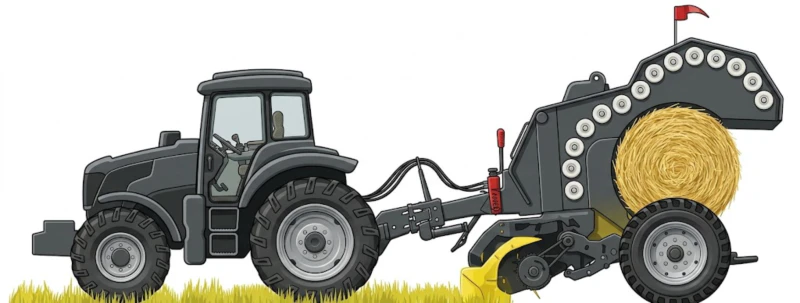
Bale density setting on the round baler determines final bale weight — a denser bale of the same diameter weighs more and lasts longer in the feeder, but requires greater front loader lift capacity for handling
Winter Hay Budget: Calculating Total Bales Required Per Season
Once daily herd intake and bale weight are established, the total winter hay budget calculation is straightforward but must include buffer stock to account for extended cold periods, late spring green-up, or unexpected herd additions.
Winter Hay Budget Formula
Total bales = (Herd size x Daily intake x Feeding days x (1 + Waste factor)) / Bale weight
Example — 50 dry cows, 13 kg/head/day, 120 feeding days, 8% feeder waste, 400 kg bales:
(50 x 13 x 120 x 1.08) / 400 = 84,240 / 400 = 211 bales required
Add 15 – 20% buffer for extended seasons: 211 x 1.18 = 249 bales to produce and store
This total bale requirement should be checked against the baler’s realistic seasonal output capacity before the hay season to confirm the operation can produce enough bales from available acreage. A 5×5 baler producing 40 bales per day in good conditions needs seven working days to produce 249 bales from one cutting. If the farm has only two reliable baling days per cutting due to weather windows, the season plan must account for multiple cuttings or additional contracted baling.
Pertanyaan yang Sering Diajukan
Conclusion: Match the System End to End, Not Just the Baler
The baler is one component in a hay production and feeding system that runs from the field through storage to the feeder ring. Selecting a baler that produces the right bale size for the herd — based on the consumption rate calculation rather than on neighbour practice or dealer recommendation — and pairing it with correctly sized feeder rings placed to minimise social exclusion, will consistently produce lower feed cost per kilogram of gain than any optimisation applied to a single component in isolation.
For most cattle operations, the 5×5 round baler is the entry-level correct choice up to approximately 40 cows. The 5×6 becomes the economically correct choice from 40 to 100 cows. Above 100 cows, large square balers or multiple 5×6 round balers become the system that minimises total cost per tonne delivered to the feeder.
If you are selecting a round baler for a cattle feeding system and want to discuss bale size options, density control configurations, and tractor PTO requirements for your specific herd size, contact the team at balershay.com for a configuration consultation matched to your operation.
Filed under: Round Baler for Cattle | Hay Feeding Systems | Beef Farm Equipment | Bale Size Selection