
How to produce export-grade large square bales that meet the bale dimensions, density, moisture, and quality standards required by dairy and livestock markets in the UAE, Saudi Arabia, Japan, South Korea, and Southeast Asia
The global trade in hay and forage is one of the most logistics-intensive agricultural commodity flows in the world. Compressed hay — primarily alfalfa, timothy, and cereal straw — moves in shipping containers from production regions in the United States, Australia, Spain, Sudan, China, and Argentina to deficit markets across the Middle East and Asia, where rapidly growing dairy and livestock industries require reliable forage imports to supplement locally produced feed. The market is large, the demand is consistent, and the price premium for quality-compliant bales over non-compliant material is significant.
But accessing export hay markets is not as simple as buying a large square baler and baling the same hay you have always produced. Export buyers in the Middle East and Asia operate to tight specifications — bale dimensions within defined ranges, minimum bale density, maximum moisture content, colour and leaf retention standards, and in some cases phytosanitary certification requirements for specific pest and weed species. A bale that fails any one of these specifications at the port of destination may be rejected, re-priced downward, or returned at the exporter’s cost. Understanding those specifications — and configuring the baling system to meet them consistently — is the fundamental commercial requirement for any hay farmer seeking export market access.
This article covers the bale specifications required by the major Middle East and Asian import markets, the large square baler configuration that produces compliant bales, the quality management practices that maintain consistency across a production season, and the logistics requirements that determine whether export-grade bales can reach their destination in commercially viable condition.
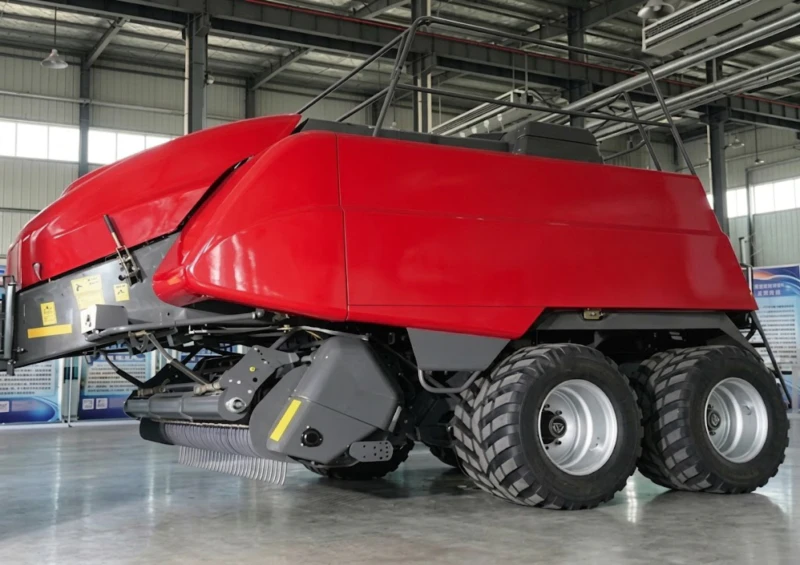
Export Bale Specifications by Destination Market
Export hay specifications vary by destination market and by end use — dairy feeding, equine, sheep and goat feeding, and feedlot applications each have different quality priorities. The following overview covers the principal specification requirements for the major import markets.
UAE and Saudi Arabia (Dairy and Feedlot)
The Gulf Cooperation Council (GCC) markets — particularly the UAE and Saudi Arabia — are the largest volume hay importers in the Middle East. Import volumes are driven by the large-scale dairy operations that produce fresh milk for domestic consumption under desert conditions where locally grown forage is essentially unavailable. Key specifications:
- Bale dimensions: Standard large square bale, 800–900 mm × 700–850 mm cross-section × 1,000–2,400 mm length. The most common accepted dimension is approximately 800×700×2,000 mm or 900×850×2,200 mm — matching the internal dimensions of a 20-foot or 40-foot shipping container with minimal void space. Bale length is the most flexible parameter; cross-section must be within tolerance for container loading.
- Minimum bale density: 180–220 kg/m³ for alfalfa; 150–180 kg/m³ for timothy. Low-density bales take more container space per tonne and increase freight cost per unit of feed, reducing the import’s commercial competitiveness.
- Maximum moisture content: Below 15% at the time of container stuffing. High-moisture bales risk heating and moulding in a sealed container during a 3–6 week sea voyage — producing a product that is commercially useless on arrival and a liability dispute between exporter and importer.
- Quality grade (alfalfa): US Hay Market grades (Supreme, Premium, Good) or equivalent visual grade standard. UAE dairy operators typically specify Premium or Good grade alfalfa — primarily stem-to-leaf ratio and colour as visual indicators. Yellowing from sun bleaching reduces grade; green colour is a key visual quality indicator for Gulf buyers.
Japan (Dairy and Equine)
Japan is the world’s largest import market for timothy hay and one of the most demanding in terms of quality specification. Japanese dairy co-operatives and equine facilities apply rigorous quality standards:
- Timothy hay colour: Japanese buyers place exceptional emphasis on green colour — bleached or yellowed timothy is discounted steeply or rejected. Baling and storing in shade or under cover immediately after drying, and minimising field exposure time, are commercial necessities for the Japanese market.
- Weed and pest content: Near-zero tolerance for listed noxious weed species. Japan’s Ministry of Agriculture, Forestry and Fisheries (MAFF) requires phytosanitary inspection certificates and imposes strict treatment or rejection for specified pest species. Any significant weed content in exported bales risks MAFF rejection at the port and return at exporter’s cost.
- Moisture content: Below 14% — tighter than Gulf markets due to Japan’s higher ambient humidity at destination storage and the longer handling chain to final users.
- Twine quality: Japanese buyers inspect twine integrity carefully. Broken twines indicate either over-dense baling that has overstressed the knotter system, or substandard twine specification. All 4–6 twines per bale must be intact and tensioned on delivery.
South Korea (Dairy and Beef)
South Korea imports primarily alfalfa and oat hay for dairy and Hanwoo beef production. Korean buyers are sophisticated importers who grade hay closely on protein content as well as visual standards:
- Crude protein (alfalfa): Minimum 17–18% CP on a dry matter basis for dairy-grade alfalfa. Alfalfa cut too late (post-full flower) or that experienced rain damage loses protein rapidly — Korean buyers send samples for laboratory analysis before payment.
- Relative feed value (RFV): Minimum RFV 150 for Supreme grade, 125 for Premium grade. This fibre-and-digestibility index is calculated from laboratory ADF and NDF analysis and is the primary objective quality metric for Korean dairy buyers beyond visual inspection.
- Bale uniformity: Consistent bale weight within a ±5% range across all bales in a shipment. Korean buyers use bale weight data for ration formulation and flag shipments with high weight variance as indicative of inconsistent baling density and therefore inconsistent feed value per bale.
Baler Configuration for Consistent Export-Grade Bale Production
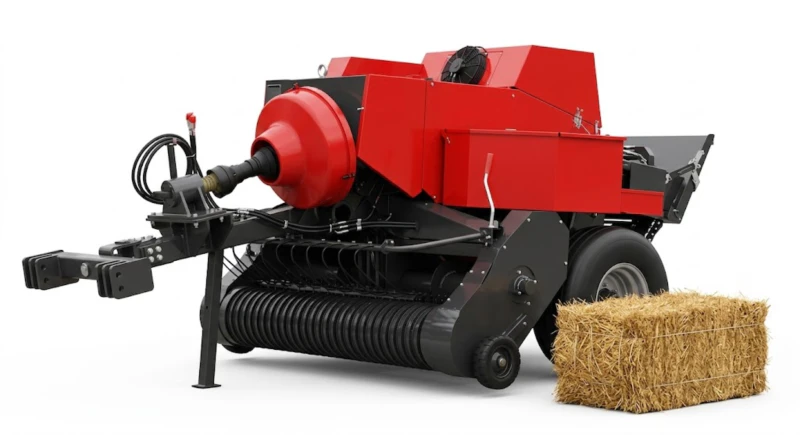
Producing export-compliant bales consistently across a full production season requires the large square baler to be correctly set up and actively monitored. The following configuration parameters directly determine bale quality compliance.
Chamber Pressure Setting
Set chamber pressure to produce bale density in the target range for the market — typically 180–220 kg/m³ for alfalfa export. Use the baler’s electronic density control (where fitted, as on the EP-9YFQ-2290XD with NT03 touch screen) to maintain consistent pressure regardless of forward speed and swath variation. Manual chamber adjustment requires constant operator attention to match pressure to crop volume.
Knotter System Maintenance
The knotter system on a large square baler is the most maintenance-intensive component and the most frequent cause of quality non-conformance in export bales. Clean knotters completely at each daily service interval. Check bill hook timing, twine disc condition, and needle timing against the manufacturer’s specification. A single failed knotter produces bales with a missing twine — which is not only a structural failure but a visible quality defect that Japanese and Korean buyers inspect for at goods receipt.
Bale Length Control
Set bale length using the star wheel or electronic counter to the target dimension for the container loading plan. For a 40-foot container loaded with bales on end, the standard bale length of 2,000–2,200 mm fits two layers of approximately 11 m × 2.3 m usable floor length. Measure actual bale length on the first 5 bales of each field session and adjust if variance exceeds ±50 mm from target.
Crop Moisture Monitoring
Use an in-bale moisture sensor (available as a factory or aftermarket fitment on most commercial large square balers) to record the moisture of every bale at production. Log the data against bale position in the field and bale number. Any bale produced above the 15% moisture maximum must be excluded from the export shipment — a moisture log allows these bales to be identified and separated rather than discovered at port inspection.
Twine Specification for Export Bales
Use high-tensile sisal or polypropylene twine rated above the baler’s maximum chamber pressure pull force. For an export baler producing 200 kg/m³ density bales, twine tensile strength should be minimum 130 kg break load. Substandard twine breaks during or after baling, producing loose bales that deform during stacking and container loading. Specify twine from a known manufacturer with consistent batch quality — and record twine batch numbers against each production session so that if a twine quality issue appears, the affected bales can be traced.
Tractor and PTO Shaft Requirements for Large Square Baler Export Operations
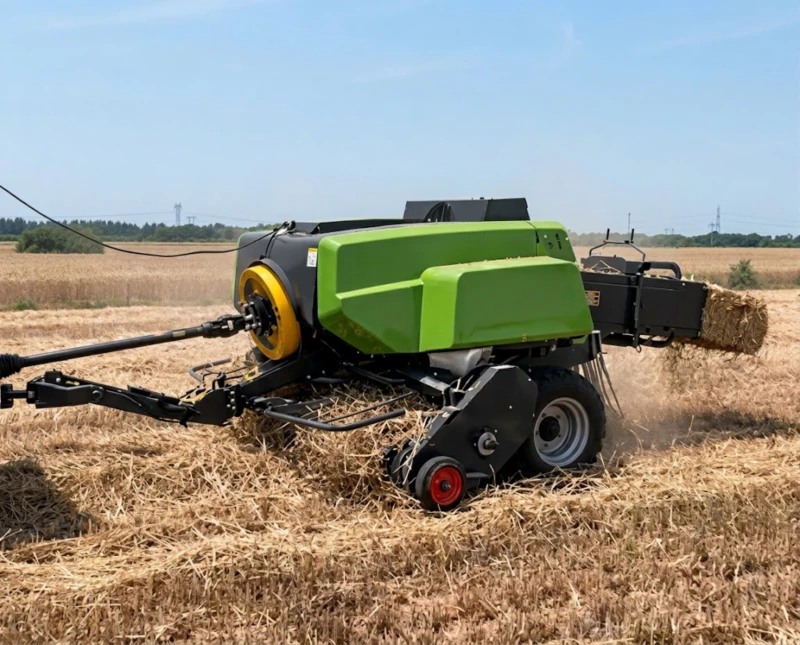
A large square baler producing export-grade high-density bales is one of the most power-demanding agricultural implements operated from a tractor PTO. The EP-9YFQ-2290XD requires 250 hp — demanding a large four-wheel-drive tractor at the upper end of the commercial agricultural power range. Beyond tractor power, the Poros PTO connecting the tractor to the baler is the component that most frequently limits production reliability in a high-throughput export baling operation.
Large square baler plunger mechanisms generate severe torque spikes at every compression stroke as the plunger drives against a dense, high-pressure crop charge. These spikes — often two to three times the steady-state running torque — must be absorbed by the PTO shaft’s slip clutch and universal joints rather than transmitted to the tractor gearbox. A PTO shaft that is undersized for these peak loads, or whose slip clutch is worn and no longer slipping at the correct torque, will either allow gearbox damage to occur or will fail mechanically at the shaft body or universal joint.
For a 250 hp large square baler, the correct PTO specification is:
- Connection: 1–3/4 inch 20-spline at the tractor end; confirm the baler input shaft spline matches (most European large square balers use 1–3/4 inch 20-spline at this power level).
- PTO speed: 1,000 rpm — the standard for tractors above approximately 100 PTO hp; large square balers are geared for 1,000 rpm input.
- Torque rating: The shaft must be rated above the peak plunger-compression torque — typically 2,500–4,000 Nm at 1,000 rpm for a high-density large square baler. Do not select a shaft rated only to the average running torque.
- Slip clutch: Friction slip clutch rated to protect the tractor PTO and baler input shaft at the blockage torque of the plunger mechanism. Set the clutch engagement torque above normal running loads but below the damage threshold of the weakest downstream component — typically the baler’s shear bolt protection circuit.
In an export hay operation where baler downtime costs not just the lost baling hours but also the farm’s contracted delivery schedule, PTO shaft inspection and replacement on a scheduled basis — not reactive replacement after failure — is a sound commercial practice. Replace universal joint cross-pins at the first sign of play or roughness, and replace the full shaft at any sign of shaft tube deformation or slip clutch slippage at below-rated torque.
Post-Baling Logistics, Storage, and Phytosanitary Requirements
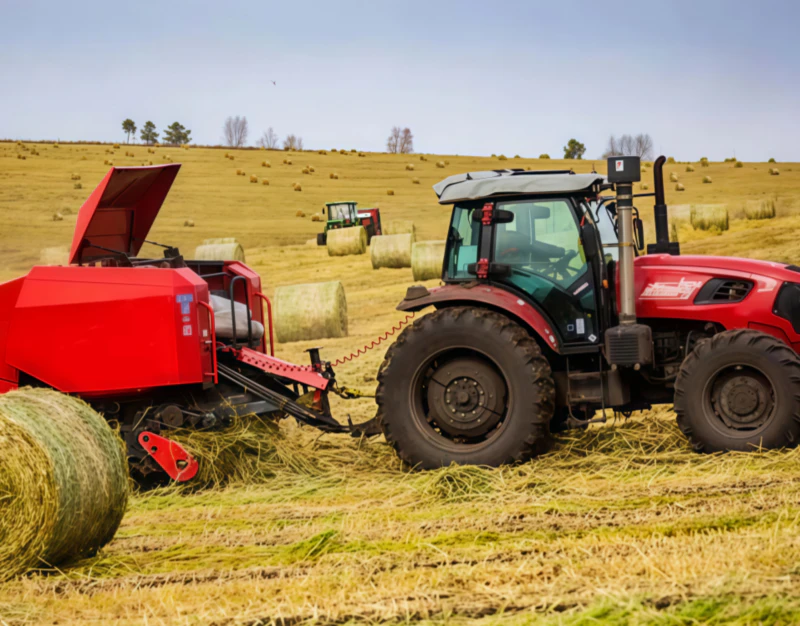
Storage Before Shipment
Export hay bales must be stored under cover — either in a closed barn or under a weatherproof tarpaulin on a raised concrete or gravel pad — from production to container loading. Any rain contact after baling can raise bale moisture above the 15% maximum in the outer layers. For the Japanese and Korean markets with even tighter moisture specifications, covered storage from the point of baling is non-negotiable regardless of weather forecast.
Allow a minimum storage period of 2–4 weeks after baling before container loading to allow the bale temperature to equalise to ambient. A freshly baled high-density hay bale retains residual heat from the hay’s own cellular respiration — this heat, trapped in a sealed container, can raise container temperature to 40–50°C in a tropical sea voyage, promoting mould growth even in bales that were within moisture specification at loading.
Container Loading and Bale Orientation
Load bales with the long axis perpendicular to the container door — cross-loaded — to maximise the number of bales per container and minimise wasted air space. For bales of 800×700×2,000 mm in a 40-foot container (internal dimensions approximately 12.0×2.35×2.39 m), the standard loading plan achieves 70–72 bales per 40-foot container. Secure the last bale row at the door with timber or airbag bracing to prevent shifting during the sea voyage — bale movement in transit causes twine failure, bale deformation, and product damage claims at destination.
Phytosanitary Certification
Most Middle East and Asian markets require a phytosanitary certificate issued by the exporting country’s national plant health authority, confirming that the hay was inspected and found free of listed pest insects, weed seeds, and plant diseases regulated by the importing country. Japan’s MAFF regulations list specific insect species (including several aphid and thrip species) and weed seeds that trigger mandatory treatment or rejection. For first-time exporters to Japan, engage a qualified plant health consultant to review the field and production history before committing to a Japan-specific export batch — discovering a regulated pest at the port of Yokohama is significantly more expensive than confirming compliance before shipment.
Export Hay Specification Quick Reference by Market
| Parameter | UAE / Saudi Arabia | Japan | South Korea | SE Asia (General) |
|---|---|---|---|---|
| Primary hay type | Alfalfa, Rhodes grass | Timothy, alfalfa | Alfalfa, oat hay | Alfalfa, bermuda |
| Max moisture | ≤15% | ≤14% | ≤15% | ≤16% |
| Min bale density | 180–220 kg/m³ | 170–200 kg/m³ | 180–220 kg/m³ | 150–180 kg/m³ |
| Colour emphasis | Medium (green preferred) | Very high (bright green) | High | Medium |
| Lab analysis required | Often | Sometimes | Standard (CP, RFV) | Sometimes |
| Phytosanitary cert | Required | Required + MAFF strict | Required | Required |
Pertanyaan yang Sering Diajukan
Can I export hay in round bales rather than large square bales to these markets?
Export of round bales to the major Middle East and Asian markets is technically possible but commercially very uncommon. Round bales pack inefficiently in standard shipping containers — the cylindrical geometry creates significant void space between bales that represents wasted freight cost. Large square bale loading achieves 70–75 bales per 40-foot container; round bales of comparable volume achieve 40–50 bales in the same space, increasing freight cost per tonne by 30–40%. Additionally, the forklift handling infrastructure at receiving ports and farms in the GCC and Japan is configured for large square bales. While round bale export contracts exist (particularly in African and some Southeast Asian markets with less developed handling infrastructure), the standard for the high-value Middle East and Japanese markets is the large square bale format.
What is the minimum field area needed to justify a large square baler investment for export?
The economic threshold for owning a large square baler depends on local hay prices, contract rates, and the number of cuttings per year. As a general guideline, a large square baler becomes economical to own — rather than use a contractor — at approximately 400–600 ha of annual cutting area across multiple cuts. Below this area, contracting a large square baler for the export-quality baling sessions and using your own round baler for on-farm feeding is often the lower-cost approach. Above this threshold, machine ownership typically pays back within 3–5 years at commercial hay prices. Many successful export hay operations begin with a contracting arrangement to prove the market and quality system before committing to baler capital.
How does sun bleaching affect export hay value and how can it be minimised?
Sun bleaching converts the green chlorophyll pigment in hay to brown or yellow pigments, reducing the visual grade from green to bleached. For the Japanese timothy market especially, bleaching is the most common cause of grade reduction that affects export pricing. Bleaching rate depends on UV intensity, field exposure time, and crop type. To minimise bleaching: cut in the early morning so the grass is in the windrow before peak UV hours; minimise wilt time to the shortest period that reaches target moisture (raking when the dew is still on the crop rather than at mid-day); bale and store under cover within 48 hours of cutting in high UV environments; and where possible orient windrows north-south so both sides receive equal (and reduced) direct sun exposure through the day.
How do I find and qualify export buyers for my large square bale production?
The most reliable route to export hay buyers for a new exporter is through established hay trading companies and commodity brokers who already have buyer relationships in the target markets. These intermediaries provide market access, handle the logistics and documentation complexity of container export, and apply their own quality inspection before accepting product for shipment — which gives the exporter a pre-shipment quality check against market standards. Direct buyer relationships with importers or end users are possible after establishing a track record, and typically deliver better net prices by removing the broker margin. Industry bodies (national agricultural commodity councils, hay and forage grower associations) maintain databases of international buyers and conduct market access programmes that connect producers with buyers in key import markets. Attending trade shows focused on livestock feed and animal nutrition in the target markets is also an effective route to direct buyer contact.
Conclusion: Export Market Access Is Earned Through Consistent Specification Compliance
The premium prices that Middle East and Asian import markets pay for quality hay reflect the cost of producing, certifying, and delivering a product that meets their specifications — not simply the cost of growing and baling grass. Every element of the production chain contributes to whether the bale that arrives at the port of Jeddah, Yokohama, or Busan meets the specification that was agreed in the sales contract. The large square baler is the machine at the centre of that chain, but its output quality is determined by the crop management decisions that precede it, the configuration settings applied during baling, the storage and logistics decisions made after baling, and the documentation that supports every quality claim made to the buyer.
An export hay operation that treats specification compliance as a systematic process — measured, recorded, and consistently maintained — builds the buyer confidence that leads to long-term supply relationships and premium pricing. One that treats export hay baling as the same activity as on-farm feeding baling, but with better packaging, will eventually encounter the rejection, downgrade, or return that erodes both the financial return and the market relationship it depends on.
Large Square Balers for Commercial Hay Export — Factory Direct from Balershay
We supply the EP-9YFQ-2290XD large square baler and the full range of commercial baling equipment for export hay operations — with NT03 electronic density control, six double-knotter system, and factory support. Visit balershay.com to explore our full range, or contact our team to discuss export baler specification for your operation.