
What Every Buyer Needs to Know Before the First Container Ships
Chinese agricultural machinery exports have grown significantly across every major hay-producing market — North America, Australia, Europe, the Middle East, and Southeast Asia. The price difference between a Chinese-manufactured round baler and a comparable European or North American machine regularly ranges from 40 to 65 percent, which on a machine priced at USD 45,000 in the West represents a saving large enough to fund two or three seasons of operating costs. That saving is real, achievable, and increasingly well-understood by progressive farm operators who have navigated the import process successfully.
What is less well-documented is the process involved in executing the import correctly — from certification verification through customs clearance to establishing a functional first-year support arrangement that protects the buyer if a warranty issue arises in a market where the manufacturer has no dealer network. This guide covers that process in full, with specific reference to the certification requirements of the European Union, the United Kingdom, Australia, and North America.
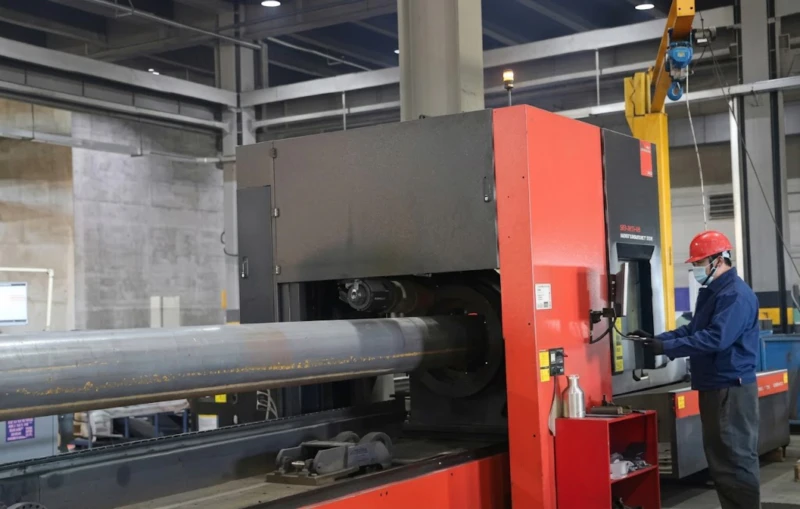
Factory production and inspection — a manufacturer with documented QMS certification and in-house testing capability is the starting point for a successful import
Why the Price Gap Between Chinese and Western Balers Is Real and Sustainable
The price difference is not primarily a quality arbitrage. It reflects structural differences in manufacturing cost: lower labour costs, lower overhead on factory space, more competitive domestic steel pricing, and in many cases a shorter supply chain to key component suppliers. Chinese baler manufacturers have been producing PTO-driven agricultural machinery for domestic and export markets for more than three decades. The engineering capability for round and square baler production is well-established in the major agricultural machinery manufacturing clusters in Henan, Shandong, and Jiangsu provinces.
The quality range within Chinese production is wide. At one end sit manufacturers supplying domestic price-sensitive markets with minimal engineering documentation and no export certification. At the other end sit manufacturers who have invested in CE certification, ISO 9001 quality management systems, export-standard documentation, and in some cases relationships with European technical inspection bodies for product compliance verification. The import buyer’s task is to identify manufacturers at the quality end of that spectrum and conduct due diligence that confirms their position before committing to a purchase order.
The cost savings are sustainable over the machine lifetime when the purchase is made from a quality manufacturer, the machine is maintained correctly, and spare parts sourcing is established before the machine arrives rather than after the first breakdown. Operators who have done all three of these things consistently report total cost of ownership competitive with — and in many cases lower than — equivalent Western brands when depreciation and capital cost are included in the comparison.
CE Certification for Agricultural Machinery: What It Covers and What to Verify
CE marking is a mandatory conformity assessment requirement for agricultural machinery sold into the European Union and the United Kingdom (which adopted equivalent UKCA marking post-Brexit for most machinery). CE marking for balers is governed primarily by the EU Machinery Directive (2006/42/EC) and the EU Outdoor Noise Directive (2000/14/EC). Compliance requires that the machine meets specific essential health and safety requirements covering guarding, PTO shielding, control system safety, noise and vibration levels, and stability.
A CE-marked machine from a Chinese manufacturer must be accompanied by a Declaration of Conformity — a document signed by the responsible person (typically the exporting manufacturer or their EU-based authorised representative) stating that the machine conforms to the applicable directives. The Declaration must list the specific directives and harmonised standards used to demonstrate conformity, include the machine model and serial number, and carry the signature of the authorised representative with their EU or UK address.
CE Documentation Checklist — Request Before Signing Any Purchase Order
EU Declaration of Conformity (DoC) — must name the specific directives (2006/42/EC minimum) and applicable harmonised EN standards used for the technical file
Authorised Representative agreement — a legal entity with a registered address in the EU or UK who holds the technical file and accepts responsibility for compliance on behalf of the manufacturer
Technical file index — evidence that a technical file exists containing risk assessment, engineering drawings, circuit diagrams, and test records. The buyer does not need to see the full file, but the manufacturer should confirm its existence and the location of the authorised representative who holds it
CE mark on the machine nameplate — the CE symbol must appear on the machine itself, alongside the model designation, serial number, rated power, year of manufacture, and manufacturer name and address
Operators manual in the buyer’s national language — the Machinery Directive requires instructions in the official language(s) of the member state where the machine is placed on the market. Verify the manual language before shipment, not after arrival
ISO 9001 certificate — confirms the manufacturer operates a documented quality management system. Not mandatory for CE marking but strongly correlated with consistent production quality and traceability of components
Certification Requirements by Market: EU, UK, Australia, and North America Compared
Certification requirements differ significantly between markets. A machine fully compliant for the EU may require additional documentation or modification for Australia or Canada. Understanding the destination market requirements before placing a purchase order avoids the costly scenario of a machine arriving at port with certification gaps that delay clearance or require physical modification.
| Market | Primary Standard | Key Requirements | Third-Party Testing Required |
|---|---|---|---|
| European Union | Machinery Directive 2006/42/EC | CE mark, DoC, EU authorised rep, manual in national language | Self-declaration for most balers; notified body required for certain safety-critical categories |
| United Kingdom | UK Machinery Regulations 2008 (UKCA) | UKCA mark, UK DoC, UK-based authorised rep from Jan 2024 | Same as EU; CE accepted until transition period ends |
| Australia | AS/NZS standards (voluntary), WHS Regulations | No mandatory pre-market certification for agricultural machinery; plant registration required in some states above threshold; safe work duty of care documentation | Not mandatory nationally; CE mark accepted as evidence of safety compliance |
| Canada | CEMA standards (voluntary), provincial WHS | No federal pre-market certification; PTO shielding must meet ASABE S331 or equivalent; safety manual required | Not mandatory; CE accepted; some provinces require electrical safety certification |
| United States | ASABE standards (voluntary), OSHA agricultural | No federal pre-market product certification for agricultural machinery; OSHA guarding standards apply to commercial operations; PTO shielding required | Not mandatory; CE mark valued by commercial buyers as quality indicator |
For Australian and North American buyers, CE certification on a Chinese baler functions as a strong proxy for design and build quality even though it is not legally required in those markets. A manufacturer who has invested in the technical file, risk assessment, and EU authorized representative arrangement required for CE certification has demonstrated an engineering discipline and documentation capacity that is directly correlated with product reliability.
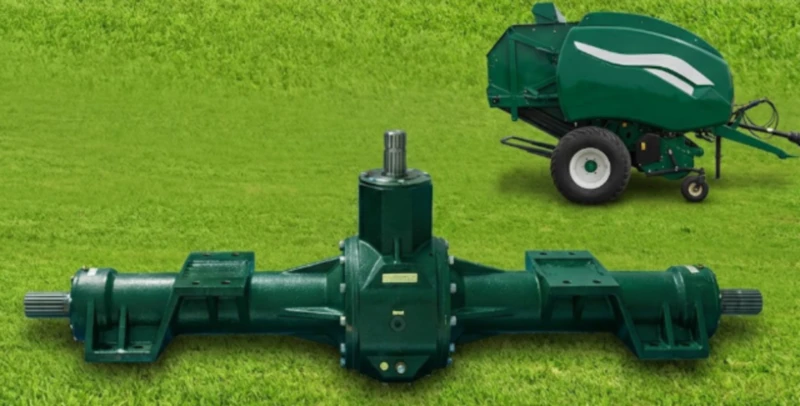
Gearbox specification and component traceability — ask the manufacturer for the gearbox supplier name and bearing specifications as part of pre-purchase due diligence
Pre-Purchase Due Diligence: Seven Questions to Ask Every Manufacturer
The due diligence process for a machinery import purchase differs from a domestic dealer transaction in one fundamental respect: the buyer cannot walk into a service centre after delivery if something is wrong. Every warranty and support arrangement must be established in writing before the container ships. The following seven questions separate manufacturers with genuine export capability from those who are simply offering a price on a machine they produce for the domestic market.
Q1: Can you provide the EU Declaration of Conformity for this model?
A manufacturer with genuine CE certification will provide this document within 24 hours of the request. A response that involves delay, redirection to a third-party agent, or a document that lacks the required elements (listed in the checklist above) should be treated as a red flag.
Q2: Who is your EU-authorised representative and what is their contact address?
Verify the named representative independently — search their name and address in the country where they are registered. A legitimate EU authorised representative will have a verifiable business registration. An agent who cannot be independently verified may be a paper entity used to create the appearance of compliance without the substance.
Q3: What are the main component suppliers for gearbox, bearings, belts, and hydraulics?
A quality manufacturer will name specific suppliers — typically domestic Chinese brands or international brands with Chinese manufacturing such as SKF (bearings), Parker (hydraulics), or named domestic gearbox manufacturers. A manufacturer who cannot name their component suppliers is either purchasing from spot-market suppliers with no traceability or is reluctant to disclose information that would allow quality assessment.
Q4: What is included in the warranty, what is the duration, and how are warranty claims processed for export customers?
The specific mechanics of warranty claims for export customers — whether the manufacturer ships replacement parts at their cost, whether the buyer must return defective components, and what documentation is required — must be in writing. A verbal assurance of a one-year warranty that has no documented claims process is operationally worthless if a gearbox fails in the first season.
Q5: What spare parts will you ship with the machine, and what is the lead time for spare parts orders?
A competent exporter will include a recommended spare parts kit with the initial shipment — typically including pickup tines, belt fasteners, key gearbox seals, and consumable items. They should also be able to quote a typical DHL or express freight lead time for spare parts orders, which for most Chinese manufacturers to Western markets is 5 to 12 business days for express shipment.
Q6: Do you have reference customers in my country or region who have purchased the same model?
A manufacturer with genuine export history to your market will have reference customers. Request contact details for two or three buyers who have operated the machine for at least one full season. Any manufacturer unwilling to provide references for an established export model should be viewed with caution regardless of how competitive the price is.
Q7: Can you provide video evidence of the machine operating under load before shipment?
Pre-shipment inspection video — showing the specific machine identified by serial number operating under PTO load, producing at least three complete bales from pickup through ejection — is increasingly standard practice among quality Chinese agricultural machinery exporters. A manufacturer who declines or delays this request without explanation is raising a significant quality assurance question.
The Import Process: From Purchase Order to Machine Operating in the Field
The logistics sequence for importing a hay baler from China follows a predictable path. Understanding the timeline and the documents required at each stage prevents the delays that commonly arise when buyers are surprised by documentation requirements at customs clearance.
Purchase Order and Deposit (Week 1)
The purchase order should specify model, serial number (or number to be assigned), bale size configuration, PTO speed (540 or 1000 rpm), wrapping system (net wrap or twine), voltage of any electrical components, language of operators manual, and all certification documents required. A deposit of 30 percent is standard for first-time orders; 20 to 25 percent for established buyers. Pay by bank transfer (T/T) or Letter of Credit — avoid informal payment methods that provide no buyer protection.
Production and Pre-Shipment Inspection (Weeks 2 – 8)
Production lead time for a standard round baler is typically 25 to 45 days from confirmed order. Request pre-shipment inspection video at the completion of production but before the machine is crated. If budget allows, commission a third-party inspection from a firm such as SGS, Bureau Veritas, or a specialist agricultural machinery inspector based in China to conduct a physical inspection before the balance payment is made. Inspection cost of USD 500 to 1,200 is worthwhile on a purchase above USD 10,000.
Shipping Documents and Balance Payment (Week 8 – 9)
The manufacturer provides a set of shipping documents before or upon vessel departure: Bill of Lading (B/L), Commercial Invoice, Packing List, Certificate of Origin (for preferential tariff rates under applicable trade agreements), CE Declaration of Conformity, and any phytosanitary or fumigation certificates required by the destination country. Verify all documents against the purchase order specifications before releasing the balance payment — errors in the invoice or B/L are much easier to correct before the vessel departs than after.
Ocean Transit (Weeks 9 – 13)
Transit time from major Chinese ports to European ports is 28 to 35 days; to East Coast Australia 22 to 28 days; to West Coast North America 18 to 22 days; to East Coast North America 28 to 35 days. A standard round baler ships in a 20-foot container. A large square baler or a machine with front hitch components may require a 40-foot container. Confirm container dimensions with the manufacturer before booking freight.
Customs Clearance and Duty (Weeks 13 – 14)
Agricultural machinery import duties vary significantly by market. EU import duty on hay balers (HS code 8433.40) is typically 3.7 to 4.0 percent of CIF value. Australia has zero or minimal import duty on most agricultural machinery from China under the ChAFTA agreement. Canada applies 0 percent MFN duty on most agricultural machinery. The US applies 25 percent additional Section 301 tariffs on Chinese agricultural machinery in addition to standard MFN duties — this is a significant cost factor for US buyers that substantially reduces the net price advantage of Chinese sourcing for that market specifically.
Delivery, Assembly, and Commissioning (Week 14 – 15)
Most round balers ship partially assembled — PTO shaft removed, pickup reel folded, net wrap arm folded, and bale ramp pinned in transit position. Reassembly typically takes two to four hours with two people following the assembly drawing in the operators manual. Before operating, check all gearbox oil levels, grease all fittings, confirm PTO shaft guard is correctly fitted, and verify belt tension and roller alignment as described in the commissioning section of the manual.
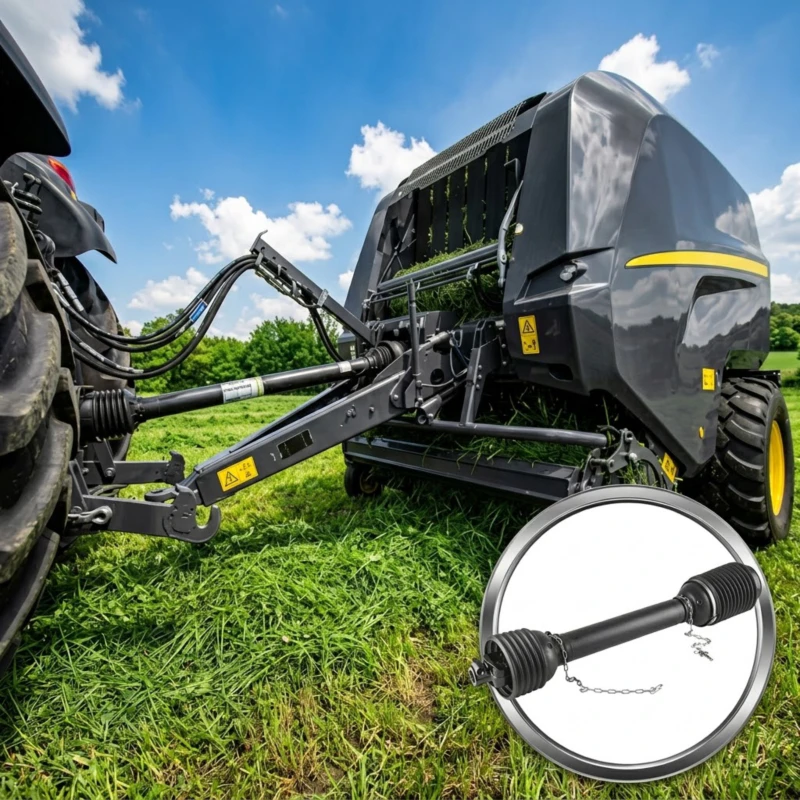
PTO connection at commissioning — verify shaft guard coverage, yoke phasing, and slip joint lubrication before the first field run
PTO shaft compatibility at commissioning: The PTO shaft shipped with a Chinese baler is specified for the tractor PTO category and output speed (540 or 1000 rpm) stated in the purchase order. Confirm the shaft length and yoke spline match your tractor before connecting. If the shaft does not fit your tractor PTO profile, a compatible replacement PTO shaft rated for the baler input torque is available from agricultural driveline suppliers and is far easier to source locally than to resolve through an international return process with the manufacturer.
First-Year Support: Building the Maintenance and Parts Network Before You Need It
The most common concern cited by buyers who have not previously imported agricultural machinery from China is what happens when something goes wrong during the warranty period — a gearbox bearing failure, a belt that needs replacement, or a hydraulic cylinder seal that begins to weep in the second season. The answer depends entirely on preparation done before the machine arrives, not after the problem occurs.
Establish a local agricultural mechanic relationship before commissioning
The mechanical systems of a Chinese round baler — gearbox, roller bearings, chain drives, PTO shaft, hydraulic cylinders — are not proprietary technologies. They use standard components available from industrial suppliers globally. A competent agricultural mechanic who services European and North American balers will be able to service a Chinese baler using the same techniques and tools. Share the operators manual with your chosen mechanic before the machine arrives, identify the service points together, and confirm that the bearing and seal specifications can be sourced through their existing suppliers.
Request a detailed spare parts list with specifications from the manufacturer
A complete spare parts list for the baler should include the ISO bearing designation (e.g. 6307-2RS), seal dimensions (inner diameter x outer diameter x width in mm), belt width and length specifications, pickup tine part numbers, and hydraulic cylinder bore and rod dimensions. With this information, every consumable and wear item can be sourced locally through industrial bearing suppliers, hydraulic seal kit suppliers, or agricultural belt distributors — without waiting for international shipping.
Agree warranty claim mechanics in writing before shipping
A written warranty agreement should specify: the duration (typically 12 months from delivery date), what is covered (manufacturing defects, not wear items or operator damage), the claim process (email notification with photos and video evidence of the defect), the manufacturer response time (typically 48 to 72 hours for diagnosis), and the remedy mechanism (replacement parts shipped at manufacturer cost via express freight, or credit applied to next purchase). Get this in writing as a separate warranty document, not as a verbal assurance in the sales negotiation.
Total Landed Cost: Calculating the True Purchase Price Including All Import Costs
The ex-factory price from the Chinese manufacturer is the starting point, not the final cost. A complete total landed cost calculation for EU buyers importing a round baler at a USD 20,000 ex-works price looks as follows.
| Cost Component | Typical Amount (USD) | Notes |
|---|---|---|
| Ex-factory machine price | 20,000 | EXW (ex-works) — baseline |
| Inland freight China (factory to port) | 300 – 600 | Varies by factory location |
| Ocean freight (20ft container to EU) | 2,000 – 4,000 | Rate varies significantly by season |
| Marine cargo insurance (1.2% CIF) | 270 – 290 | Do not ship without insurance |
| EU import duty (3.7% of CIF value) | 850 – 920 | Verify current rate with customs broker |
| VAT at destination (reclaimed if registered) | Varies by country | Reclaimable for VAT-registered farm businesses |
| Customs broker fee | 300 – 600 | Use a licensed customs broker for first import |
| Pre-shipment inspection (optional) | 500 – 1,200 | Strongly recommended for first order |
| Total landed cost (estimate) | 24,220 – 27,610 | vs USD 45,000+ for comparable Western brand |
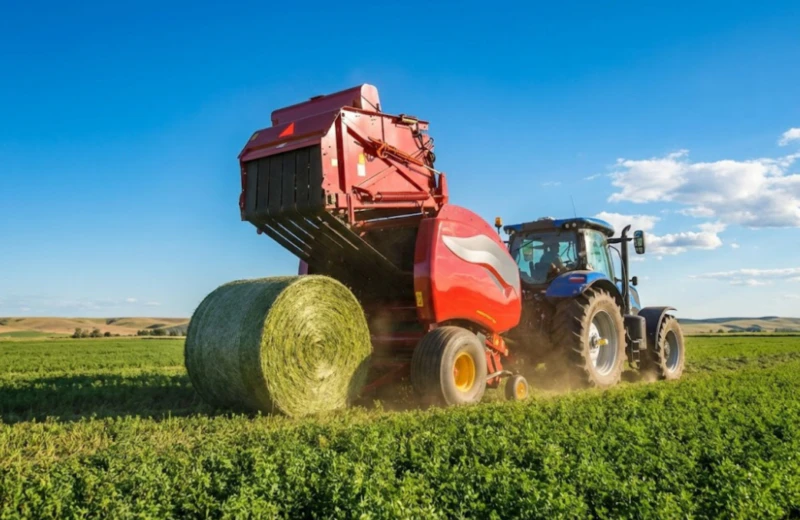
The finished machine ready for field operation — total landed cost including all import expenses typically remains 35 to 50 percent below an equivalent Western-brand machine delivered from a domestic dealer
سوالات متداول
Conclusion: The Import Process Is Manageable — and the Economics Are Compelling
Importing a hay baler from China is not a simple transaction, but it is a well-defined process with clear documentation requirements, established logistics channels, and a growing body of operator experience in every major hay-producing market. The buyers who have executed it successfully share three characteristics: they started the process four to five months before the hay season, they conducted structured due diligence on the manufacturer before signing the purchase order, and they established their local maintenance and parts network before the machine arrived rather than after.
The economics at the end of this process are compelling. A total landed cost of USD 24,000 to USD 28,000 for a machine that performs comparably to a USD 45,000 to USD 55,000 Western brand alternative — with comparable certification, comparable first-year support, and local parts sourcing established from day one — represents a capital efficiency that materially improves the long-run cost per tonne of hay produced.
To discuss specific baler models, CE documentation, export logistics, and first-year support arrangements for your market, contact the team at balershay.com — we export to more than 30 countries and can provide market-specific certification documentation, reference customers in your region, and a detailed spare parts specification list before you commit to a purchase order.
Filed under: Import Hay Baler China | CE Certification | Agricultural Machinery Import | Chinese Baler Manufacturer