
Why the Binding You Choose Affects Far More Than Purchase Price
Every round baler operator eventually faces the same decision at the supply counter: net wrap or twine? On the surface it looks like a cost question. In practice it touches bale quality, field throughput, dry matter preservation, and long-term machinery wear. This guide breaks down both consumable types across every dimension that matters to working hay producers and custom baling contractors, so you can match your choice to your actual operation rather than to a dealer recommendation.
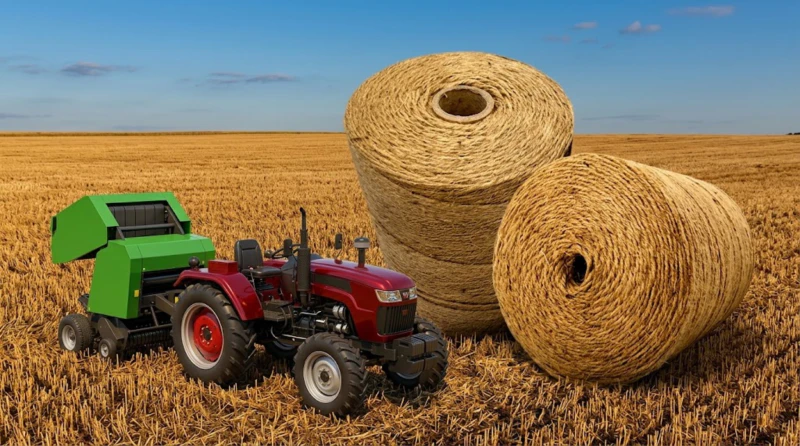
Round baler wrapping consumables: net wrap and twine side by side
What Are Net Wrap and Twine, and How Do They Differ Mechanically?
Twine has been the default round baler consumable since the earliest belt-and-roller machines of the 1970s. Two strands of polypropylene cord are fed from spools mounted on the baler frame, guided by a twine arm that sweeps across the full width of the forming bale. The arm completes multiple passes, spiraling twine from one end of the bale to the other before the tail is cut and knotted or held in tension as the door opens. Wrapping one bale typically requires six to eight twine passes and takes 20 to 30 seconds depending on bale diameter and PTO speed.
Net wrap is a woven or extruded plastic mesh fed from a roll mounted inside the baler. A net wrap system feeds the mesh across the full bale width in a single continuous sheet. As the bale rotates, the net is drawn in and layers build up over one to two rotations before the cut knife severs it. Total wrap time for a standard 5-by-6 round bale is typically 8 to 14 seconds, roughly half to one-third the time of twine.
The mechanical difference is significant. Twine systems have more moving parts: spool holders, tension springs, twine guides, and the sweep arm itself with its drive linkage. Net wrap systems have fewer moving components but are more sensitive to contamination. A small amount of hay plugging the net feed can create a misaligned wrap, leaving part of the bale exposed.
Wrapping Speed and Field Throughput: Where Net Wrap Wins Clearly
If you are custom baling and billing by the hour, wrapping time is direct revenue. Consider a field operation producing 200 bales in a day. With twine at 25 seconds per bale, wrapping alone consumes roughly 83 minutes of total cycle time. With net wrap at 11 seconds per bale, the same 200 bales require just 37 minutes of wrap time. That is 46 minutes recovered per day, enough to produce an additional 10 to 12 bales without extending the working window.
Faster wrapping also reduces the window during which the bale chamber is open. This matters most in variable weather conditions where brief rain or heavy dew can wet the outer layer of a freshly formed bale before it is ejected and the door closes. Net wrap minimizes that exposure time by roughly half.
For large-scale operations running continuous baling from early morning to late afternoon, faster wrapping accumulates into meaningful extra capacity across a season. Operators running variable-chamber balers at high PTO speeds often find that net wrap allows the baler to keep pace with fast tractor ground speeds without building a queue of incomplete-wrap bales.
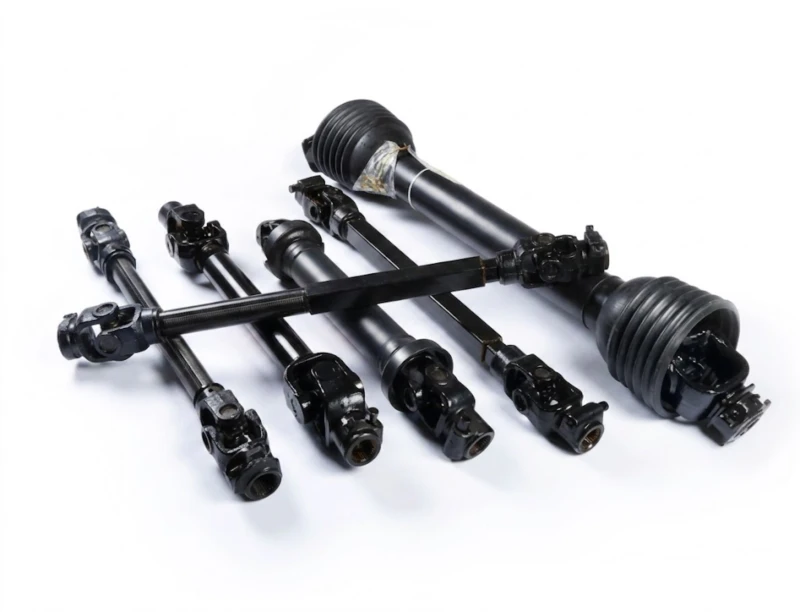
PTO drive shafts power the wrapping mechanism — a reliable shaft prevents wrap cycle interruptions
Note on PTO reliability: Both net wrap and twine systems are driven by the same PTO-powered gearbox that runs the bale chamber. A worn or undersized PTO shaft creates inconsistent rotational speed during the wrap cycle, resulting in uneven wrapping and incomplete knots on twine machines, or partial net coverage on net wrap machines. If you are upgrading from twine to net wrap, inspect your PTO shaft first. Replacement shafts rated for large square and round balers are available — for example, this replacement PTO shaft for New Holland big balers is a commonly specified upgrade when switching consumable systems on high-output machines.
Cost Per Bale: Calculating the Real Number, Not the Sticker Price
The raw purchase price comparison is misleading if you stop there. Twine rolls appear cheaper per unit, and on a spool-to-spool comparison, twine typically costs less per kilogram than net wrap mesh. But the relevant unit is cost per bale completed, not cost per kilogram of plastic consumed.
| Factor | Envoltura de red | Twine |
|---|---|---|
| Material cost per bale (5×6, USD approx.) | USD 0.80 – 1.20 | USD 0.40 – 0.70 |
| Wrap time per bale | 8 – 14 sec | 20 – 30 sec |
| Extra bales per 8-hr day (200-bale baseline) | +10 to +14 | baseline |
| Dry matter loss at 6 months outdoor storage | 3 – 6% | 8 – 15% |
| Feed-out labor (cutting binding) | Lower (mesh peels fast) | Higher (multiple cuts) |
| Mechanism complexity and failure risk | Lower | Higher (knotter, sweep arm) |
When you add together the value of time recovered from faster wrapping, reduced dry matter loss from better bale protection, and lower feed-out labor, net wrap frequently delivers a lower total cost of baling despite its higher sticker price per roll. The crossover point depends on your hay value per ton, your labor cost, and how long bales sit before feeding. Operators storing bales outdoors for four months or more almost always find net wrap pays for itself in dry matter preservation alone.
Dry Matter Loss: Why the Outer Layer of the Bale Decides Everything
Round bale dry matter loss is driven primarily by three factors: precipitation penetration into the outer layer, oxygen availability that promotes aerobic spoilage, and the surface-area-to-volume ratio of the bale. Twine wrapping leaves roughly 80 to 85 percent of the bale surface covered. The gaps between twine strands on the top and sides of the bale allow rain and condensation to wick into the outer 5 to 8 centimeters of material. In humid climates or locations with frequent overnight dew, this creates a consistently wet outer shell that supports mold growth throughout the storage period.
Net wrap covers 95 percent or more of the bale surface. The mesh is hydrophobic, sheds water, and creates a tight enough barrier to significantly reduce moisture infiltration. Research comparing outdoor storage over five to six months consistently shows twine-wrapped bales losing 8 to 15 percent of dry matter versus 3 to 6 percent for net-wrapped bales stored under identical conditions. On a 600-kg alfalfa bale at USD 200 per ton, a 10-percent dry matter loss represents USD 12 of value per bale. Over 500 bales in a season, that is USD 6,000 in lost feed value, far exceeding the cost difference of the consumables.
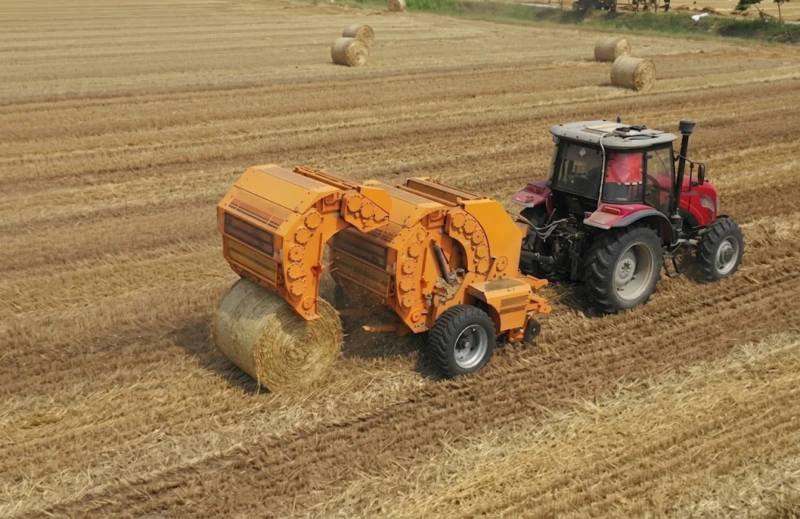
Round baler application scenarios across crop types — wrapping choice affects dry matter outcome in each setting
When Twine Still Makes Sense: Five Legitimate Use Cases
Net wrap is not universally superior. There are well-defined scenarios where twine remains the correct choice.
1. Immediate indoor barn storage
If bales move from field to covered barn within 24 to 48 hours of baling and stay there until feeding, outdoor exposure is negligible. The additional weather protection of net wrap adds cost without proportional benefit. Twine keeps the bale intact for transport and stacking. This is the correct choice for well-capitalized dairy operations with large hay sheds.
2. Biomass and bedding material
When baling wheat straw, rice straw, or cotton stalks purely for bedding or biomass energy, dry matter nutritional loss is irrelevant. The goal is density and containment for transport. Twine provides both at lower cost per bale, and removal at the biomass plant or feedlot is faster because workers cut fewer strands than they would need to unroll a net.
3. Short-season custom contractors with high bale volume
A contractor baling 5,000 bales per season across multiple clients who take immediate delivery may find that twine keeps consumable costs predictable across accounts. When the contractor does not control storage, charging customers for net wrap protection they may not need creates margin friction.
4. Older balers not equipped for net wrap
Retrofitting a twine-only baler for net wrap requires a net wrap kit including roll holder, feed roller, and knife assembly. On machines over 10 years old, the retrofit cost and mechanical risk may not be justified. Twine is the sensible operating choice until the machine is replaced.
5. High-moisture silage baling before overwrapping
When bales will be overwrapped with silage stretch film immediately after ejection, the intermediate binder just needs to hold shape during the 30 to 90 seconds between bale ejection and film wrapping. Twine is sufficient and eliminates the cost of net wrap as an intermediate layer under the film.
Net Wrap Layers: Does Two Rounds Beat One?
Most round balers offer adjustable net wrap application from one to three rotations before the cut knife fires. One rotation applies a single layer covering the bale. Two rotations create a double layer that overlaps at the seams. The practical question is whether the second layer is worth the additional material cost.
For standard dry hay intended for outdoor storage of three to six months, one and a half to two rotations provides adequate coverage. The tail end seam that forms as the net starts is the most vulnerable point, and the second pass covers it reliably. For bales stored beyond six months, or for high-value crops like alfalfa in wet-climate regions, two full rotations is the standard recommendation. The material cost increase is typically USD 0.15 to 0.25 per bale, which is easily justified against the dry matter value protected.
Three rotations is generally excessive for dry hay and consumes net material at a rate that erodes the cost advantage over twine without proportional protection improvement. Reserve three rotations for dense, high-moisture silage bales that will be film-wrapped where the net layer needs to hold significant internal pressure during fermentation.
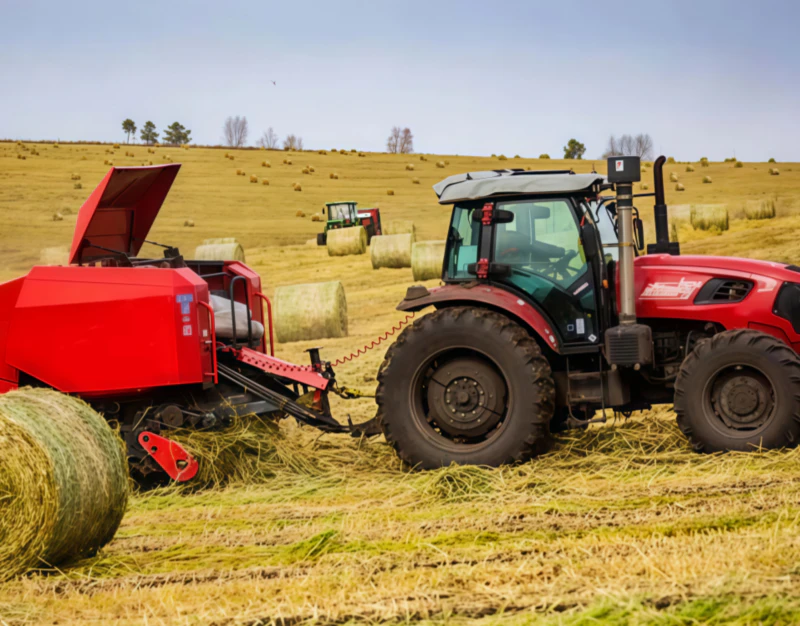
Baler control system settings — wrap rotation count and net wrap tension are configurable on modern machines
Wrapping Problems and How to Diagnose Them: Net Wrap and Twine Compared
Both systems have characteristic failure modes that experienced operators learn to recognize before they produce a full field of poorly wrapped bales.
| Symptom | Net Wrap Cause | Twine Cause |
|---|---|---|
| Bale unravels after ejection | Cut knife not firing, net tail not tucked | Knotter failure, twine tension too low |
| Wrap only covers center, not ends | Net feed misaligned, guide roller worn | Sweep arm travel too short, spring weak |
| Wrap fires too early (small bale) | Density sensor calibration off | Density sensor calibration off |
| Net tears mid-wrap | Hay stuck in net feed, roll edge damaged | N/A (twine rarely tears mid-pass) |
| Twine breaks during sweep | N/A | Worn twine spool eye, spool holder burrs |
One diagnostic advantage of net wrap is that wrap failures are immediately visible as the door opens. An incomplete net coverage is obvious before the bale hits the ground. Twine failures sometimes go undetected until a bale is moved and collapses, because a single strand may hold the bale in shape even when the knotter has failed to tie properly.
Environmental Considerations and Plastic Waste Management
Both twine and net wrap are polypropylene-based products. Neither degrades rapidly in landfill conditions, and both can cause serious problems if left in fields and ingested by livestock. Net wrap generates more plastic by volume per bale because of its mesh sheet coverage area. However, net wrap is increasingly collected through agricultural plastic recycling schemes in North America, Europe, and Australia, where it is processed into pellets for industrial reuse.
Twine is smaller in volume per bale but is often harder to collect cleanly because multiple lengths are scattered during feed-out. Mesh net from a whole bale peels in a single piece that is easier to bundle and deliver to a collection point. For operations in jurisdictions with agricultural plastic regulations, net wrap is frequently easier to document and dispose of compliantly.
Some manufacturers now produce biodegradable sisal twine as an alternative. Sisal breaks down within one growing season under field conditions. It is more expensive than synthetic twine, more vulnerable to moisture during storage, and currently not available in all markets, but it is a genuine option for operations facing strict plastic waste regulations or organic certification requirements.
Preguntas frecuentes
Conclusion: Match the Consumable to the Storage Plan, Not the Lowest Sticker Price
The net wrap versus twine decision should be driven by one primary question: how long will bales sit outdoors before feeding or sale? If the answer is more than four weeks in any climate where rainfall, dew, or high humidity is normal, net wrap will recover its higher material cost through better dry matter retention and reduced spoilage before you reach the end of the first cutting.
For operations that move bales immediately into covered storage, bale biomass material where nutritional value is irrelevant, or run older machines not equipped for net wrap, twine remains the operationally correct and economically sound choice. The right answer is specific to your field, your storage infrastructure, and your market. Understanding the mechanics, costs, and dry matter data behind each option lets you make that call on evidence rather than habit.
If you are evaluating round balers equipped with net wrap systems from the factory, or looking to upgrade your current machine, our team can provide specifications on bale chamber dimensions, net wrap roll compatibility, and PTO drive requirements for each model in our range. Contact us directly for a configuration consultation.
Filed under: Round Baler Consumables | Hay Baler Maintenance | Bale Storage