
The Measurement That Separates Premium Hay from Storage Risk
The decision to bale should never be based on how the windrow looks or how it feels when squeezed by hand. Visual and tactile estimates of hay moisture are unreliable by a margin that regularly costs operators money — either through baling too wet and losing feed quality to heating and mold, or through baling too dry and sacrificing the leaf fraction that carries most of the crop’s nutritional value. The solution is measurement, and the tools available to field operators range from a USD 80 pin-type moisture meter to a USD 8,000 in-line NIR sensor mounted on the baler pickup. This guide explains what each technology measures, how accurately it measures it, how to interpret the readings it gives, and how to build a testing protocol that makes the baling decision with consistent, defensible data.
The same principles apply whether you are baling alfalfa for a dairy premium market, grass hay for horse owners, or straw for biomass. The target moisture varies by crop and application, but the need for measurement before baling is universal.
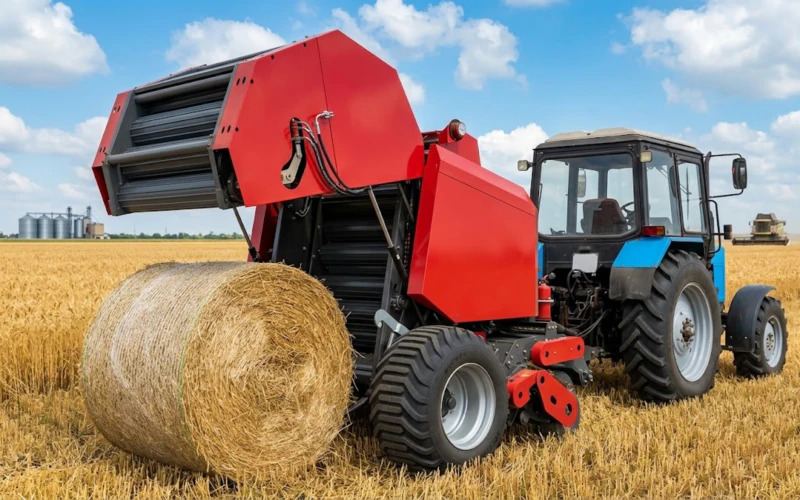
The baling decision is made in the field before the machine starts — moisture testing replaces guesswork with a number that can be acted on
Why Moisture Content Is the Primary Quality Variable Before Baling
Hay moisture content at baling is the single variable that most directly determines storage outcome, regardless of crop species, cutting date, or fertiliser history. At moisture above the safe baling threshold, the bale interior heats as aerobic microorganisms consume oxygen and oxidise organic matter. This heating phase reduces digestible dry matter, destroys vitamins, and in extreme cases produces the conditions for spontaneous combustion.
At moisture below the minimum acceptable level, leaf tissue becomes brittle and shatters during mechanical handling by the pickup, feed rotor, and bale chamber. For high-protein forages like alfalfa and clover, the leaf fraction contains 60 to 75 percent of the total crude protein in the standing plant. Losing 15 to 25 percent of the leaf fraction to shatter reduces bale crude protein by 2 to 4 percentage points — a reduction that directly affects the price premium the bale can command in a quality-differentiated market.
| Crop Moisture at Baling | Storage Consequence | Quality Impact |
|---|---|---|
| Above 25% | Severe heating, mold growth, fire risk | Significant DM loss, caramelised protein, reduced palatability |
| 20 – 25% | Moderate heating, reduced fungal counts | Acceptable only with preservative applied at baling |
| 15 – 18% (grass hay) | Minimal heating, stable storage | Optimal for most storage conditions |
| 15 – 18% (alfalfa) | Stable, leaves still pliable at upper end | Optimal window — minimum leaf loss |
| 12 – 15% | Storage safe — no heating risk | Increasing leaf shatter in legumes, 8 – 15% loss |
| Below 12% | Storage very safe — extremely dry | Severe leaf shatter in legumes, 15 – 30% DM loss at baling |
Method 1: Oven-Dry Gravimetric Testing — The Reference Standard
The gravimetric oven-dry method is the reference standard against which all other moisture measurement technologies are calibrated. It requires no electronic instrument and produces results accurate to within 0.5 percent moisture — more accurate than any field instrument currently available. Its limitation is time: a complete oven-dry test requires 24 hours at 100 to 105 degrees Celsius in a laboratory oven, which makes it impractical for same-day baling decisions.
The procedure is as follows. Collect a representative sample of approximately 200 to 300 grams from the windrow by taking handfuls from at least five locations across the field, mixing them, and subsampling from the mixed pile. Weigh the fresh sample immediately after collection and record as wet weight. Place in a tared container and dry in a forced-air oven at 103 degrees Celsius for a minimum of 16 hours, preferably 24 hours. Reweigh and calculate moisture content as:
Gravimetric Moisture Content Formula
Moisture % = ((Wet weight – Dry weight) / Wet weight) x 100
Example: (250g wet – 212g dry) / 250g wet x 100 = 15.2% moisture content
A practical adaptation for field use is a microwave oven drying method. Weigh a 100-gram sample, microwave on medium power in 2-minute intervals, reweighing after each interval until weight stabilises. This produces a result in 8 to 15 minutes accurate to within 1 to 2 percent moisture — adequate for baling decisions. Use a food-grade kitchen scale accurate to 1 gram. The microwave method is not a laboratory standard but is substantially more accurate than any pin-type field meter and requires no calibration.
Method 2: Pin-Type Electrical Resistance Meters — Practical Field Tools and Their Limits
Pin-type moisture meters are the most widely used field instruments for hay moisture measurement. They work on the principle that the electrical resistance of plant material decreases as moisture content increases. Two metal pins are pushed into the hay sample; the instrument passes a small electrical current between the pins and calculates moisture from the measured resistance using a calibration curve stored in the device.
The strengths of pin meters are speed, portability, and cost. A reading takes 5 to 10 seconds. The instrument fits in a shirt pocket. Quality pin meters suitable for hay measurement cost USD 80 to USD 300. Their limitations are significant and must be understood to use the readings correctly.
Limitation 1: Surface vs core measurement
Pin meters measure the moisture in the material immediately surrounding the pins — typically the outer 20 to 40 mm of the windrow if inserted from the top. The core of a thick windrow can be 3 to 5 percentage points wetter than the surface after a day of solar drying. Measurements taken only from the top surface consistently underestimate core moisture.
Limitation 2: Temperature sensitivity
The electrical resistance of plant material is temperature-dependent. A reading taken on a windrow surface heated to 45 degrees Celsius by direct sun will indicate higher moisture than the same material at 25 degrees Celsius, even if no moisture has changed. Quality pin meters include a temperature correction factor — use it. Take readings from shaded or mid-windrow locations where temperature is closer to ambient.
Limitation 3: Calibration by crop species
The resistance-to-moisture relationship differs between alfalfa, grass hay, clover, and straw. A meter calibrated for grass hay will read several percentage points low when inserted into alfalfa, because alfalfa stems have different tissue density and ion content. Use a meter with a species-specific calibration setting and select the correct crop before taking readings.
Limitation 4: Accuracy range
Most quality pin meters are accurate to plus or minus 1 to 2 percentage points across the 12 to 30 percent moisture range relevant to hay baling. Below 10 percent or above 35 percent, accuracy degrades significantly. Treat pin meter readings as directional — a reading of 16 percent means the true moisture is somewhere between 14 and 18 percent, not exactly 16 percent. Make baling decisions with this uncertainty band in mind.
To get the most reliable pin meter readings: take a minimum of eight readings across the field at different windrow depths (surface, mid-depth, bottom), apply temperature correction, use the correct species calibration, and average the results. Discard readings that are more than 3 percentage points above or below the average — they indicate a localised wet or dry zone that should not drive the field-wide baling decision.
Baler manufacturing quality determines how consistently the machine handles crop at different moisture levels — pickup tine geometry and feed rotor design affect how much moisture variation the machine can tolerate without bale quality loss
Method 3: Capacitance Meters — Faster Sampling with Less Insertion Required
Capacitance moisture meters measure the dielectric constant of the hay rather than its electrical resistance. The dielectric constant of water is approximately 80, compared to 2 to 5 for dry plant material, meaning that even small amounts of free moisture produce a large and measurable change in the capacitance of the material between the meter electrodes. Capacitance meters do not require metal pins to be pushed into the crop — the sensing electrode is a plate or probe that is pressed against the windrow surface or inserted shallowly.
The practical advantage is speed. A capacitance reading takes 2 to 3 seconds, enabling an operator to take 20 to 30 readings across a field in the time a pin meter user takes 8. This sampling density improvement is meaningful because field moisture is heterogeneous — high spots, low spots, north-facing windrow sections, and areas where the conditioner left thicker mat all have different drying rates. More readings produce a better field average.
The limitation of capacitance meters is their sensitivity to surface wetness from dew or light rain. Free water on the surface of crop material dominates the capacitance reading and produces falsely high moisture readings. Allow at least 30 to 60 minutes after dew has visibly evaporated from the windrow surface before using a capacitance meter. In contrast, pin meters are less affected by surface dew because the pins penetrate below the wetted surface layer.
Method 4: Near-Infrared (NIR) Sensors — Continuous Measurement at the Baler
Near-infrared spectroscopy (NIR) is the technology that allows forage laboratories to measure moisture, crude protein, ADF, NDF, and other quality parameters simultaneously from a dried and ground sample in seconds. In-line NIR sensors adapted for field use bring a version of this capability directly to the baler pickup or feed throat, providing a continuous real-time moisture reading as the crop enters the machine.
An NIR sensor emits light at specific wavelengths in the near-infrared spectrum and measures the reflected spectrum from the crop passing through the beam. Water molecules absorb NIR radiation at characteristic wavelengths — primarily around 1450 nm and 1940 nm — and the depth of absorption at these wavelengths is proportional to water content. A calibration model converts the spectral data into a moisture percentage displayed on the operator console.
| Feature | Pin-Type Meter | Capacitance Meter | In-Line NIR Sensor |
|---|---|---|---|
| Cost | USD 80 – 300 | USD 200 – 600 | USD 4,000 – 12,000 |
| Accuracy (typical) | +/- 1.5 – 2.5% | +/- 1.0 – 2.0% | +/- 0.5 – 1.0% |
| Reading speed | 5 – 10 sec per point | 2 – 3 sec per point | Continuous while baling |
| Dew sensitivity | Low (pins penetrate below) | High | Moderate (surface and bulk) |
| Field sampling coverage | 8 – 15 points practical | 20 – 30 points practical | Every bale continuously |
| Best application | Pre-baling field check | Pre-baling field check | In-season continuous monitoring, variable-rate preservative |
The key operational advantage of in-line NIR is that it enables automatic preservative application rate adjustment based on real-time crop moisture. As the baler passes through a field with variable moisture — common on fields with slope, shade variation, or uneven windrow drying — the NIR sensor detects moisture changes and adjusts the preservative pump output continuously. This eliminates the risk of under-application in wetter zones and reduces preservative waste in zones that are already at safe moisture levels.
Interpreting Moisture Readings: What the Number Tells You and What It Does Not
A moisture reading from any instrument tells you the moisture content of the material the instrument sampled at the moment of measurement. It does not tell you whether the rest of the field is at the same moisture, whether the moisture is evenly distributed between stems and leaves, or whether the reading will still be valid in two hours as drying continues. Understanding these limitations prevents incorrect baling decisions based on a technically accurate reading applied to a situation it does not represent.
Stem vs leaf moisture differential
Pin and capacitance meters measure the bulk moisture of the material they contact, which in a mixed stem-and-leaf sample reflects a weighted average of stem and leaf moisture content. In alfalfa at a bulk reading of 17 percent, stems may be at 19 percent and leaves at 13 percent — a 6-percentage-point differential within the same reading. For storage safety, the stem moisture matters most (stems dominate heating risk). For leaf retention, leaf moisture matters most (leaves below 13 percent shatter). A single bulk reading does not distinguish between these, which is why experienced alfalfa operators supplement instrument readings with the rub-test: pull a stem and a leaf cluster separately, rub each between fingers, and assess flexibility independently.
Field moisture gradient
Moisture varies across a field based on slope aspect (north-facing areas dry slower), windrow thickness variation (thick areas dry slower), shadow from trees or buildings, and proximity to irrigation edges. A single reading from a convenient location near the field entrance may read 15 percent while the back corner of the same field reads 22 percent. Take readings from the slowest-drying areas — north-facing slopes, thick windrow sections, areas in partial shade — because these are the locations that will determine whether baling is safe, not the fastest-drying areas.
Interpreting a range of readings
When readings across a field span a wide range — say 13 to 22 percent — the baling decision should be based on the highest reading in the slowest-drying zone, not the average. Averaging a 13 percent reading from a dry hilltop with a 22 percent reading from a shaded flat gives a misleading 17.5 percent average that implies safety while the shaded flat will produce dangerously wet bales. Apply the preservative rate appropriate for the highest moisture zone if you choose to bale the field in one pass, or wait for the wet zones to dry down before beginning.
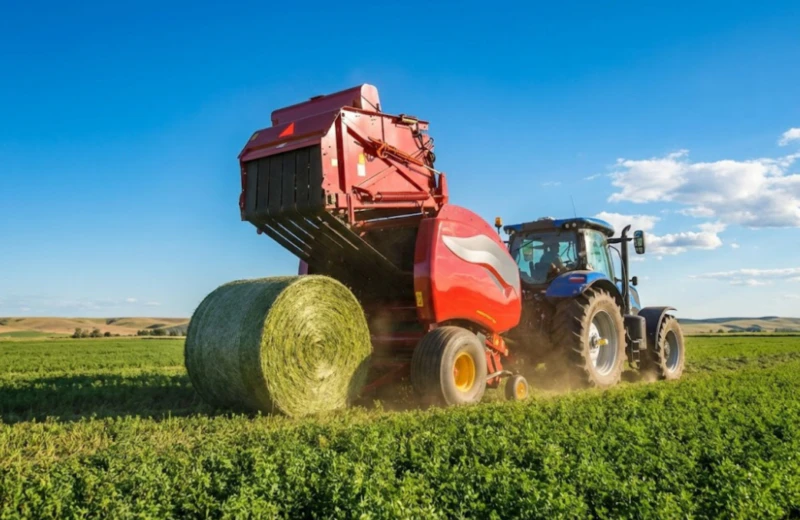
Bale density and shape consistency are directly affected by crop moisture — machines set for dry hay conditions underperform on wetter crop, producing loose or misshapen bales
Crop-Specific Moisture Targets: A Reference Table for Common Baled Crops
Safe baling moisture varies by crop species because leaf-to-stem ratio, stem diameter, tissue density, and sugar content all affect both the heating risk and the leaf shatter risk at a given moisture level. The table below provides working targets for the most commonly baled crops.
| Crop | Safe Baling Range (no preservative) | With Preservative Upper Limit | Key Risk |
|---|---|---|---|
| Alfalfa (lucerne) | 15 – 18% | 22 – 25% | Leaf shatter below 15%, heating above 18% |
| Mixed grass hay | 15 – 20% | 25% | Heating above 20% in large round bales |
| Clover (red or white) | 15 – 18% | 22% | High sugar content accelerates heating; leaf shatter at low moisture |
| Ryegrass (perennial) | 16 – 20% | 25% | High sugar — rapid heating above 20% |
| Oat hay | 14 – 18% | 22% | Stem thickness slows drying — check core moisture |
| Wheat straw | 12 – 16% | 18% | Low sugar — heating risk low but mold above 18% |
| Corn stover | 14 – 20% | 25% | Thick stems — core moisture consistently higher than surface |
Building a Field Testing Protocol: From First Reading to Baling Decision
A field testing protocol converts individual instrument readings into a consistent, defensible baling decision. The following six-step process works with any of the instruments described above and produces a baling decision based on field-representative data rather than a single convenient measurement.
Identify the slowest-drying zone in each field before measuring. Walk the field perimeter and locate north-facing slopes, thick windrow sections, areas near tree lines, or any zones where the crop appears visibly greener or more flexible than the average. These are your first measurement locations.
Take a minimum of 10 readings distributed across the field: three in the identified slow-drying zone, three in a mid-field representative area, two at the fast-drying end, and two at mid-windrow depth in different locations. Record all readings.
Calculate the 90th percentile reading — the value that 90 percent of readings fall below. In a set of 10 readings, this is the second-highest value. This is the moisture level the slowest 10 percent of the field is at, which is the number that governs storage safety. Do not use the arithmetic mean for this decision.
Apply the crop-specific threshold from the reference table above. If the 90th percentile reading is below the safe baling upper limit for your crop, you can bale without preservative. If it is above the limit but below the preservative-assisted upper limit, apply preservative at the rate appropriate for the measured moisture level. If it exceeds the preservative-assisted limit, delay baling and re-test in two hours.
Re-test if environmental conditions change during baling. A cloud cover period that lasts more than 30 minutes, a wind drop, or an unexpected temperature fall can all slow further drying significantly. If any of these occur, stop baling and re-test before continuing.
Record all readings and decisions in a field log. Date, time, instrument used, readings taken, 90th percentile value, decision made, and preservative rate applied. This record supports quality claims if bales are sold and provides year-over-year data on how quickly each field dries under different weather conditions.
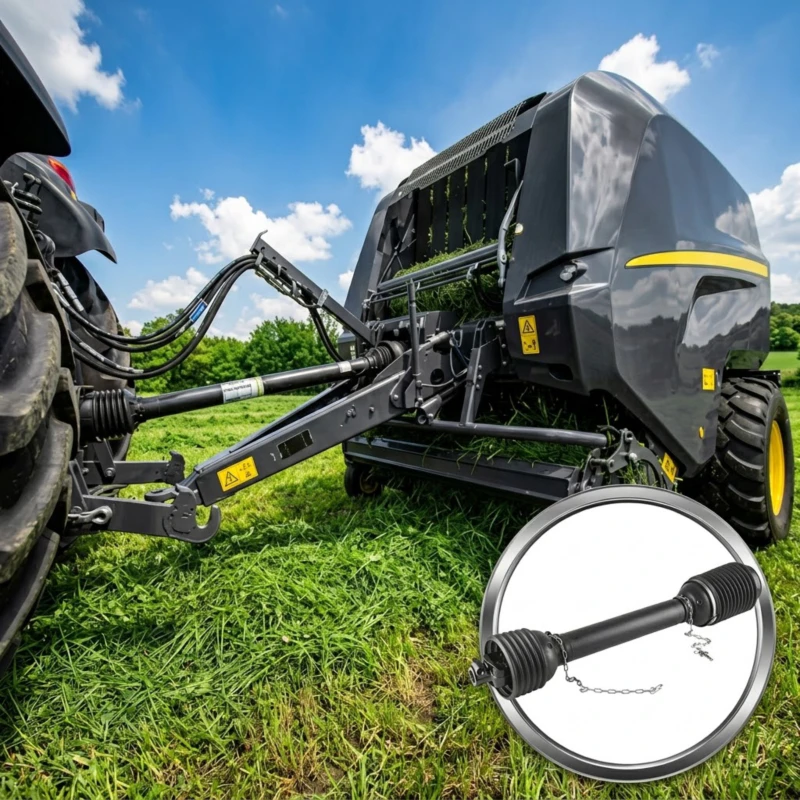
Once the moisture test confirms baling conditions are correct, machine readiness — including PTO shaft condition — determines whether that window is used efficiently
Machine readiness and the moisture window: The morning moisture window for alfalfa is typically two to four hours. A baler that requires field repairs — including PTO shaft issues — during that window can lose the entire day’s baling opportunity. Pre-season inspection of the PTO shaft for yoke wear and joint play is part of ensuring the machine can operate continuously when conditions are right. For machines using New Holland-compatible drive systems, a replacement PTO shaft installed before the season eliminates one of the most common reasons for unexpected field stoppages during the moisture window.
Preguntas frecuentes
Conclusion: A USD 150 Meter Used Correctly Outperforms a USD 5,000 Meter Used Incorrectly
The instrument matters less than the protocol. A quality pin meter used with the six-step field testing process described in this guide — sampling the slowest-drying zones, taking enough readings, using the 90th percentile rather than the mean, and applying the correct crop-specific threshold — will make better baling decisions than an NIR sensor whose output is interpreted from a single reading at the field entrance.
Moisture measurement is not a bureaucratic step in the harvest process. It is the information that converts all the agronomic and mechanical investment of growing, cutting, and raking the crop into a bale that stores safely and feeds well. An operation that measures consistently, records results, and uses those records to refine the timing of future cuttings will progressively improve the average quality of bales it produces without changing anything about the field, the crop, or the baler.
If you are selecting a empacadora redonda for operations where hay quality is a commercial priority, our team can advise on models with pickup and feed configurations optimised for moisture-sensitive crops such as alfalfa and clover, and on compatibility with aftermarket NIR sensor systems.
Filed under: Hay Quality | Moisture Testing | Baling Management | Forage Science