
How to select the right baler, match machine capacity to harvest windows, manage field logistics, and meet biomass power plant delivery specifications when baling cereal straw as an energy crop
Wheat and rice straw are among the largest agricultural biomass resources in the world. Global wheat production generates approximately 600–700 million tonnes of straw per year; rice production adds another 600–800 million tonnes. Historically, the majority of this material has been burned in the field — an increasingly regulated practice — or incorporated into the soil at a fraction of its potential energy value. The alternative: baling and delivering straw to biomass power plants, combined heat and power (CHP) facilities, and pelletising operations, which convert the straw’s 14–16 MJ/kg calorific value into electricity, heat, or densified fuel.
Straw biomass baling is not simply hay baling in a cereal field. The material characteristics of straw — low bulk density, high silica content, fragile stem structure, and the narrow post-harvest window in which baling must occur before rain wets or combines the straw back into the stubble — impose specific requirements on machine selection, field organisation, and logistics that differ meaningfully from forage baling. A system that produces the correct bale format, density, moisture content, and field-to-gate logistics within a constrained harvest window is a commercially viable biomass supply operation; one that does not is simply expensive field clearing with additional fuel and labour costs.
This article covers the material characteristics of cereal straw as a biomass feedstock, baler selection criteria for straw biomass operations, field logistics organisation, biomass plant delivery specifications, and the PTO shaft and tractor requirements that determine whether the baling system can sustain commercial throughput rates.
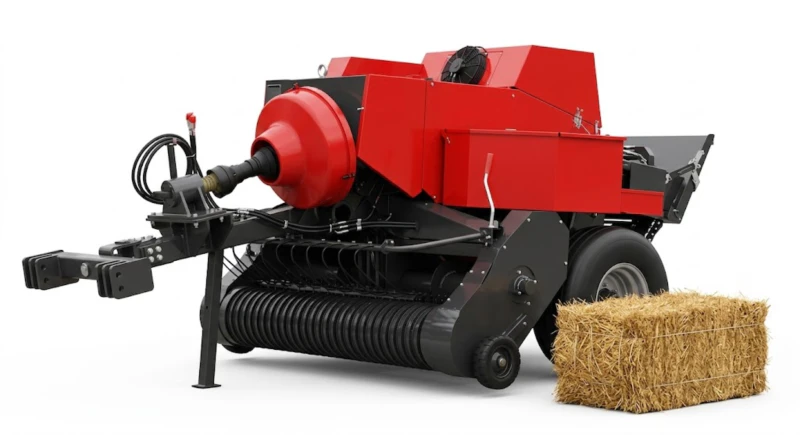
Wheat and Rice Straw as Biomass: Material Characteristics That Drive Machine Selection
Understanding the physical and chemical characteristics of cereal straw is the starting point for selecting the right baling system. Straw differs from hay in ways that affect bale density, combustion behaviour, and supply chain requirements.
Calorific Value
Wheat straw: 14.5–16.0 MJ/kg dry matter. Rice straw: 13.5–15.5 MJ/kg dry matter (slightly lower due to higher silica content). Both are comparable to wood chip as biomass fuels. Moisture content directly affects delivered calorific value — a bale at 20% moisture delivers 20% less energy per tonne than the same bale at 10% moisture. Power plant contracts typically specify a reference moisture and adjust payment accordingly.
Bulk Density (Loose)
Loose wheat straw bulk density is 35–60 kg/m³ — approximately half the loose bulk density of grass hay. This very low density means straw requires more aggressive chamber compression than hay to achieve the target bale density of 120–180 kg/m³ for large square biomass bales. Bale chamber pressure must be set higher than for hay baling with the same baler, and plunger force demand is increased accordingly.
Silica and Ash Content
Rice straw contains 10–20% silica (SiO₂) in the ash fraction — significantly higher than wheat straw (5–8%) and wood chips (0.5–1%). High silica forms low-melting-point eutectics with potassium and chlorine during combustion, producing ash slagging and fouling in boiler combustion chambers. Some power plants impose a maximum ash content specification; confirm this with the offtaker before committing rice straw to a contract.
Fragility and Dust
Dry cereal straw is brittle — the stems fracture under the aggressive intake action of a high-speed pickup reel. Stem fracture produces fine dust and short-fibre losses at the baler intake that reduce baling efficiency. Baling slightly damp straw (10–15% moisture rather than bone-dry below 10%) significantly reduces fragility losses and improves bale density by allowing the stems to flex rather than fracture during compression.
Harvest Window
The post-combine straw baling window is narrow — typically 3–7 days in temperate climates before the risk of rain re-wetting the straw becomes significant. In drier continental climates the window is wider; in maritime climates it may be 2–3 days. The baling system’s capacity to clear the field within the weather window is a primary machine selection criterion — under-capacity means straw left in a wet field, spoiled or incorporated rather than baled.
Straw Yield per Hectare
Wheat straw yield: 2–5 tonnes/ha dry matter depending on variety and climate. Rice straw yield: 3–6 tonnes/ha. At 150 kg/m³ bale density, a 5 tonne/ha straw yield produces approximately 33 large square bales of 0.8×0.7×2.0 m per hectare. Multiply by the total field area to determine the baling capacity (bales/day) required to clear the area within the harvest window.
Machine Selection: Round Baler vs Large Square Baler for Straw Biomass
Both round balers and large square balers are used in straw biomass supply chains, but they serve different market structures and logistics models. The choice depends on the scale of the operation, the power plant’s reception system, and the available transport infrastructure.
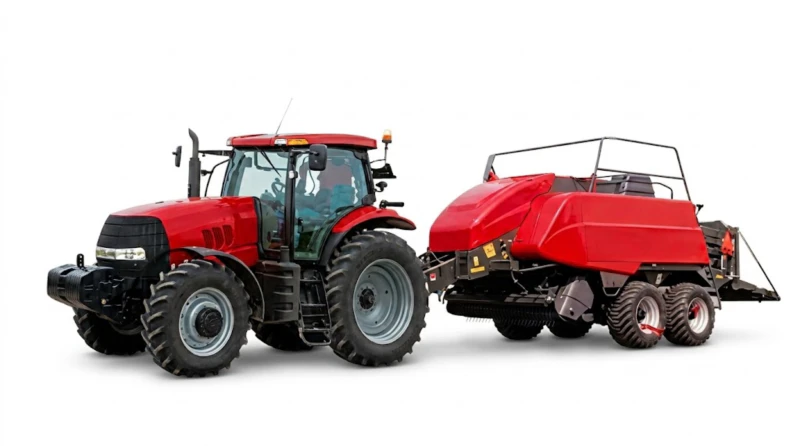
Large square baler producing straw biomass bales — the rectangular format loads and transports at significantly higher bulk density than round bales and feeds power plant reception systems designed for standardised bale dimensions
Large Square Baler: The Commercial Biomass Standard
For most commercial straw biomass supply contracts — particularly those supplying dedicated biomass power plants and CHP facilities — the large square baler is the industry standard. The reasons are logistical and economic:
- Transport density: Large square bales of straw at 150–180 kg/m³ load onto a flatbed truck at 25–30 tonnes per load. Round bales of the same straw at 80–100 kg/m³ (typical for straw round bales) load at 12–15 tonnes per load — requiring twice as many truck movements per tonne delivered and approximately doubling the farm-gate-to-plant transport cost per GJ of energy delivered.
- Power plant reception: Most dedicated straw biomass power plants have reception systems — bale grabbers, conveyor systems, shredders — configured for large square bale dimensions. Round bales require a different reception configuration and are not universally accepted at plants designed for square bales.
- Storage density: Large square bales stack vertically to 3–4 layers by forklift, achieving storage density of 400–600 kg/m³ of floor area. Round bales can only be stacked 2 layers reliably, halving the effective use of covered storage space which may be limited at both farm and plant sites.
Round Baler: Appropriate for Small-Scale and Local Biomass Markets
Round balers remain appropriate for straw biomass where the supply chain is short — farm-to-local-farm for animal bedding, small-scale heating systems, or pelletising operations that receive material by tractor trailer rather than articulated truck. The lower capital cost and tractor power requirement of a round baler also makes it accessible to smaller farm operations that cannot justify the investment in a large square baler for occasional straw clearing. For the high-volume commercial power plant supply chain, however, the large square baler’s logistical efficiency is the standard on any analysis of cost per GJ delivered.
Tractor Power and PTO Shaft Specification for Straw Biomass Baling
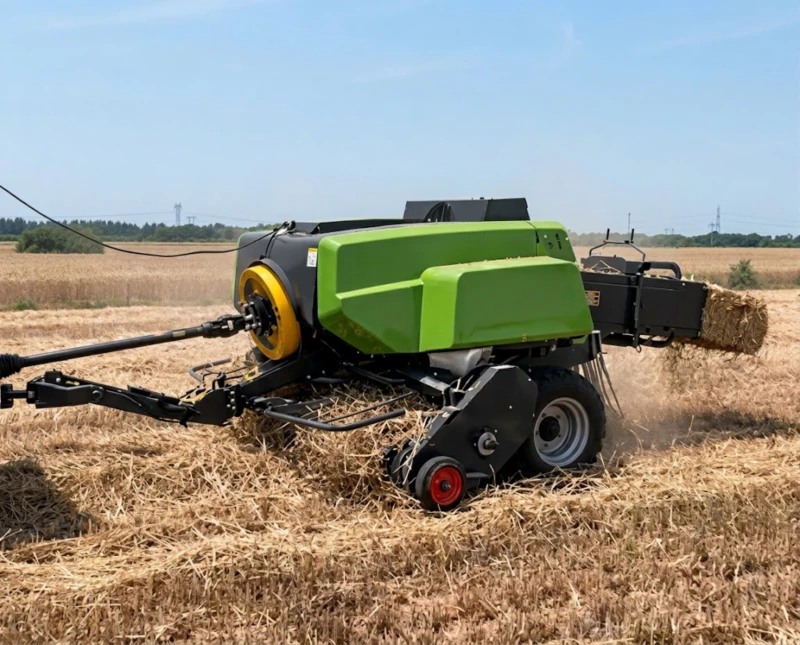
Straw baling at biomass-grade density (150–180 kg/m³) places higher sustained loads on the baler’s plunger mechanism than hay baling, because straw’s lower initial bulk density requires the plunger to travel further into the bale charge before resistance builds — and then to compress that charge to higher final pressure to achieve target density. This longer compression stroke at higher final pressure translates to greater energy per compression cycle and greater peak torque at the plunger mechanism, which is transmitted back through the drive train to the Zapfwelle and tractor.
For commercial straw biomass baling with a large square baler:
- Tractor power: The EP-9YFQ-2290XD requires 250 hp. For straw baling at maximum density settings, operate the tractor at no more than 80% of rated engine load in steady state, preserving 20% reserve for the peak torque cycles of heavy straw charges. In very dense straw swaths, reducing forward speed is preferable to reducing chamber pressure — the bale density must be maintained to meet the supply contract specification.
- PTO shaft specification: 1–3/4 inch 20-spline connection at 1,000 rpm. Shaft torque rating must exceed the peak plunger compression torque at maximum density setting — for a 250 hp class baler this is typically 3,000–4,500 Nm peak. Specify the shaft to the peak torque, not the average running torque.
- Slip clutch setting: Set the slip clutch torque limit above the normal maximum running torque but below the tractor PTO gearbox damage threshold. For straw baling where slug feeding (a sudden large mass of straw entering the pickup at once) is more common than in hay baling, the slip clutch engages more frequently — inspect the clutch friction faces every 50 operating hours and replace when wear reduces the face thickness below the service limit.
- Pre-season shaft inspection: Before the straw harvest season, disassemble the PTO shaft completely — inspect all universal joint cross-pins for play (maximum 2–3 degrees of rotational backlash before replacement), lubricate all grease points, inspect the telescoping spline for wear and corrosion, and confirm the safety guard rotates freely and is not cracked. A PTO shaft failure during straw harvest cannot be resolved within the harvest window in most cases — the downtime cost is measured in missed baling days, not just repair cost.
Field Logistics: Organising the Baling and Removal Operation for Maximum Throughput
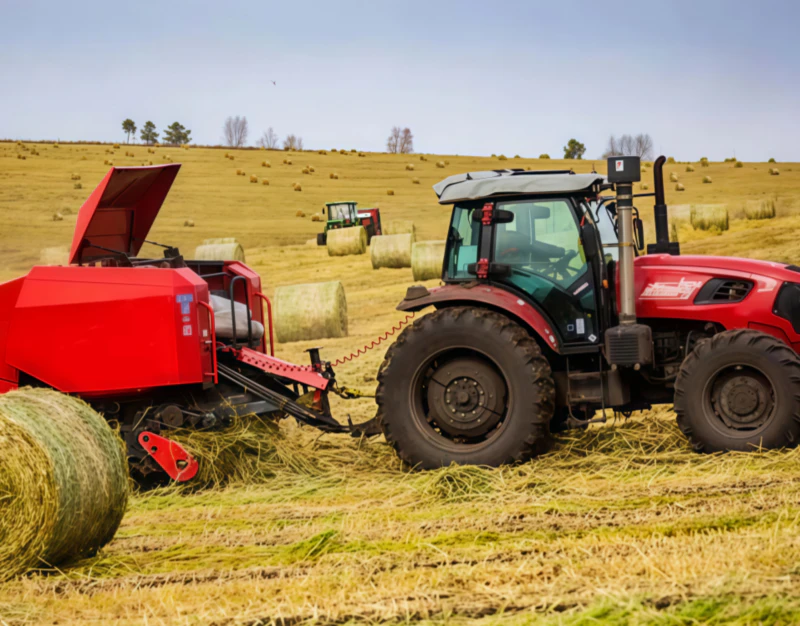
Capacity Planning: Bales Per Day vs Field Area
Before harvest, calculate the baling capacity required to clear the available area within the weather window. A large square baler in straw conditions at commercial forward speed produces 60–100 bales per day (10-hour working day, including turning, refuelling, and knotter checks). At 5 tonnes/ha straw yield and 150 kg/m³ bale density with 0.8×0.7×2.0 m bale dimensions (≈168 kg per bale), that is approximately 30 bales per hectare. A 100 bale/day baler can clear approximately 3.3 ha/day. To clear 100 ha within a 5-day window, you need 100 ha ÷ (3.3 ha/day × 5 days) = approximately 6 balers, or one high-throughput baler and a longer weather window. Plan realistically for your climate’s typical post-harvest window, not the best-case scenario.
Straw Rowing and Swath Management
Combines leave straw in a swath or spread across the full cutting width. For large square baler operation, straw must be in a windrow — collected into a narrow, consistent row that matches the baler pickup width. If the combine is set to spread (which improves straw-soil contact for incorporation), the straw must be rowed before baling. If the combine is set to windrow (rear discharge through a swath board), the swath width should be set to match or be slightly narrower than the baler pickup width. Combining with a narrow swath setting and baling directly behind the combine is the lowest-cost logistics option in flat, dry-climate areas where the combine and baler can work the same field at the same time.
Bale Collection and Field Exit Logistics
In a large-scale straw biomass operation, bale collection and field exit is often the bottleneck — not the baling capacity itself. A large square baler producing 80 bales/day deposits 80 bales scattered across the field. Each bale must be collected by a bale handler (telehandler or front-end loader with bale fork) and loaded onto a flatbed trailer or truck for transport to the farm store or direct to the plant gate.
Plan the baler’s field pattern to deposit bales at the field headland where possible — working in circuits with the bale ejected at the end of each pass rather than mid-field. This concentrates the bale collection point at the headland where collection equipment can work without driving over the remaining windrows.
Direct delivery to the power plant from the field — truck loading at the headland and driving straight to the plant — is the most cost-efficient model for farms within 30–50 km of the plant. For farms at greater distance, intermediate farm-side storage is necessary, which adds a double-handling cost but allows the baling to proceed at the field’s natural rate without being constrained by truck availability at the plant reception gate.
Biomass Plant Delivery Specifications: What the Offtaker Requires
Before committing to a straw biomass supply contract, confirm the following specification parameters with the offtaker. Each parameter must be achievable within your baling and logistics system before the contract is signed.
| Parameter | Typical Biomass Plant Requirement | Baling System Implication |
|---|---|---|
| Bale format | Large square bale | Large square baler required; round bales not accepted at most plants |
| Bale dimensions | 800×700 mm – 1,200×875 mm cross-section | Set baler cross-section to plant specification; confirm before purchase |
| Minimum density | 120–160 kg/m³ (wheat straw) | Chamber pressure must maintain density through the full day’s baling |
| Maximum moisture | ≤20% (often ≤15% for payment at full rate) | Do not bale after rain; use in-bale moisture sensor to log compliance |
| Twine/net wrap | Twine only; no net wrap | Net wrap melts in combustion pre-heaters; twine is the only accepted binding |
| Soil contamination | Max 1–2% ash above straw base | Set pickup height 50–75 mm above soil; avoid baling after prolonged rain |
| Delivery window | Year-round contracted volumes | Farm-side covered storage required to supply through non-harvest months |
Häufig gestellte Fragen
Why do biomass power plants specify twine only — why is net wrap not accepted?
Plastic net wrap is made from polyethylene or polypropylene, which melts and burns at temperatures reached in the pre-heating and drying stages of most biomass combustion systems — temperatures well below the full combustion chamber temperature. Melted plastic contaminates the combustion system, blocks conveyors, and produces toxic flue gas components (dioxins, furans) that require additional treatment in the exhaust gas cleaning system. Sisal twine burns cleanly as part of the straw combustion. Synthetic twine (polypropylene) is also unacceptable for the same reason as net wrap — specify sisal or biopolymer twine for straw destined for biomass plant consumption, and confirm the twine specification with the plant before purchase.
How much straw should I leave in the field for soil health after baling?
The consensus from soil science research is that removing more than approximately 50% of cereal straw reduces soil organic matter over time, particularly on lighter soils with already-low organic matter levels. The recommended practice is to remove straw from fields with a medium-to-heavy soil and reasonable organic matter baseline (above 3% soil organic carbon), while leaving straw on lighter, lower-organic-matter soils where the decomposing residue plays a more significant role in organic matter maintenance. Adjust the combine straw-spreading setting to leave the cut stubble (the bottom 150–200 mm of stems below the combine header) in the field as a partial residue return, while collecting only the upper stem and head material in the combine swath for baling. This partial retention approach typically allows 40–60% straw removal without long-term soil organic matter decline on most soil types.
Can the same large square baler be used for both hay and straw biomass operations?
Yes — a large square baler is not crop-specific and can bale both hay and straw in the same season. The main operational difference is chamber pressure setting (higher for straw to achieve target density), pickup reel speed (may need reducing for very dry, brittle straw to reduce fragility losses), and twine specification (sisal required for biomass supply, polypropylene or sisal both acceptable for hay). The baler is not mechanically changed between crops — simply adjust the operating parameters. This dual-use capability is commercially valuable for operations that harvest both hay in summer and straw post-cereal-harvest, allowing the high-capital baler investment to be spread across two revenue streams per season.
What is the typical biomass supply contract structure for straw and how is pricing agreed?
Straw biomass supply contracts are typically structured as annual or multi-year agreements specifying a total volume per year (in tonnes dry matter or in GJ energy content), a delivery schedule, a reference moisture content for payment calculation, and a base price per tonne or per GJ at the plant gate. The price is usually indexed to an energy price benchmark or negotiated annually. Some contracts include a quality premium/penalty structure — straw below the maximum moisture specification is paid at the full rate; straw above it is discounted proportionally to its reduced energy content. Transport cost is either included in the plant gate price (farmer delivers) or netted out if the plant arranges collection. For a first contract, request a minimum one-year term with clear quality rejection and dispute resolution procedures — the investment in baling equipment and storage should not be made on a handshake supply agreement without documented quality and payment terms.
Conclusion: Straw Biomass Baling Is a Logistics and Capacity Challenge as Much as a Machine Choice
The decision to enter a straw biomass supply contract is primarily a logistics and capacity planning decision, with the machine selection as the tool that implements the plan. The baler must have the capacity to clear the contracted field area within the post-harvest weather window; the tractor must match the baler’s power demand with adequate reserve; the PTO shaft must be specified and maintained for the sustained high-torque demands of straw compression; and the bale collection, storage, and delivery logistics must be in place before the combine starts.
Farms that approach straw biomass baling with this systems perspective — capacity calculated, equipment specified, logistics pre-planned — consistently deliver on their supply contracts and benefit from the additional revenue stream that converts a historically burned or incorporated residue into a commercially valuable energy feedstock.
Large Square Balers for Straw Biomass Operations — Factory Direct from Balershay
We supply large square balers including the EP-9YFQ-2290XD for commercial straw biomass baling — with six double-knotter system, electronic density control, and 250 hp tractor compatibility. Visit balershay.com to explore our full baler range, or contact our team to discuss straw biomass machine selection for your operation.