
Why the Film Around Your Silage Bale Decides Whether You Have Feed or Waste
Silage fermentation is a biological process that requires one condition above all others: the complete exclusion of oxygen. The stretch film wrapped around a round bale is the only barrier between the crop and the air. When that barrier holds, the anaerobic bacteria present in the crop convert soluble sugars into lactic acid, dropping pH to 4.0 or below within 21 days and preserving the feed value of the forage for months or years. When the barrier fails — through insufficient layers, inadequate stretch, puncture, or UV degradation — oxygen penetrates, aerobic molds and yeasts take over, and the fermentation profile shifts from preservation to spoilage.
This guide covers the technical and practical dimensions of silage bale wrap film: how the material is engineered, why layer count and stretch ratio determine seal quality, what causes the most common fermentation failures, and how to operate a bale wrapper to consistently produce wrapped bales that ferment correctly. It applies equally to round bale silage (baleage) and to large square bale wrapping.
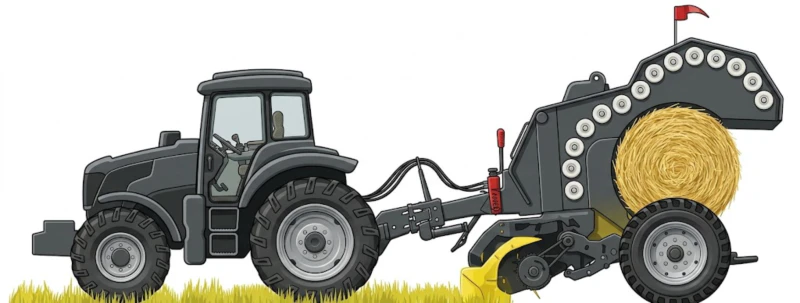
The round bale is the substrate — its density, shape, and surface moisture at ejection all affect how well stretch film seals and how evenly fermentation proceeds
Silage Wrap Film Construction: What the Layers Actually Do
Agricultural silage stretch film is a co-extruded multi-layer polyethylene product, typically five to seven layers in construction despite being delivered from a roll that looks like a simple sheet. Each layer in the co-extrusion serves a specific function. Understanding this structure explains why cheap single-layer or two-layer alternatives fail, and why the marketed specification of a film — stretch ratio, oxygen transmission rate, UV stabilisation level — directly determines its performance in the field.
Outer layers
The outermost layer on each face of the film is a linear low-density polyethylene (LLDPE) compound optimised for puncture resistance and UV stabilisation. This layer takes the mechanical contact with the crop surface, the ground when bales are moved, and solar radiation during outdoor storage. UV stabilisers — typically HALS compounds at concentrations specified by the film manufacturer — slow the photo-oxidation of the polyethylene chains that would otherwise cause the film to become brittle and crack within one growing season. Films specified for 12-month outdoor storage require substantially higher HALS loading than films rated for six months.
Core barrier layer
The central layers of a quality silage film contain an oxygen barrier component — typically EVOH (ethylene vinyl alcohol copolymer) or a metallocene-enhanced LLDPE blend with low oxygen transmission rate. This layer is the primary determinant of the film’s ability to maintain anaerobic conditions inside the bale over months of storage. Oxygen transmission rate (OTR) for quality silage films is typically below 150 cc/m²/day at ambient temperature at the pre-stretch thickness. Films with OTR above 300 cc/m²/day at the applied thickness may allow sufficient oxygen ingress to support aerobic spoilage even with correct layer count.
Tack layer
At least one inner layer contains a self-adhesive tack compound — typically polyisobutylene (PIB) — that causes successive film layers to bond to each other on contact without requiring heat or adhesive application. This interlayer bonding is what converts multiple individual film wraps into a monolithic barrier. Without it, adjacent film layers remain as discrete sheets with air pockets between them, dramatically reducing the effective barrier thickness and allowing oxygen channels to form at the overlap seams.
Stretch Ratio: The Most Misunderstood Specification in Silage Film
Stretch ratio is the percentage by which the film is elongated from its roll width during application. A film applied at 55 percent stretch has been pulled to 155 percent of its original length before contacting the bale. This stretching serves three functions: it reduces film thickness (increasing coverage area per roll), activates the cling properties of the tack compound by orienting the polymer chains, and creates the elastic tension that pulls the film tightly against the bale surface and subsequent layers.
Most quality silage films are engineered for a target application stretch of 55 to 70 percent. This is the range at which the film achieves its optimal combination of thinness, barrier integrity, tack activation, and mechanical strength. Stretching below this range leaves the film thicker than necessary, consumes more film per bale, and under-activates the tack layer — successive wraps do not bond as strongly. Stretching above the film’s rated maximum elongation — which for most films is 70 to 80 percent — progressively damages the barrier layer, creating micro-tears in the EVOH or metallocene film that are invisible to the naked eye but allow oxygen transmission far above the film’s rated specification.
| Application Stretch | Effect on Film Performance | Fermentation Risk |
|---|---|---|
| Below 45% | Film too thick, tack under-activated, poor layer bonding | Moderate — air pockets between layers |
| 45 – 54% | Below optimal — acceptable but less efficient | Low if layer count is increased to compensate |
| 55 – 70% | Optimal — tack fully activated, barrier intact, coverage maximised | Minimal at correct layer count |
| 70 – 80% | Approaching film limit — barrier layer micro-stress | Moderate — monitor wrapper pre-stretch setting |
| Above 80% | Barrier layer micro-tears, tack over-stretched, film may neck or break | High — oxygen ingress through barrier damage |
The pre-stretch setting on the bale wrapper controls the stretch ratio delivered to the film. This setting must be calibrated to the specific film brand and roll width being used — different films have different stretch limits and different optimal targets. Check the film manufacturer specification sheet before adjusting the wrapper pre-stretch rollers, and measure actual applied stretch using a strip of tape marked on the film before and after the pre-stretch rollers to confirm the setting matches the specification.
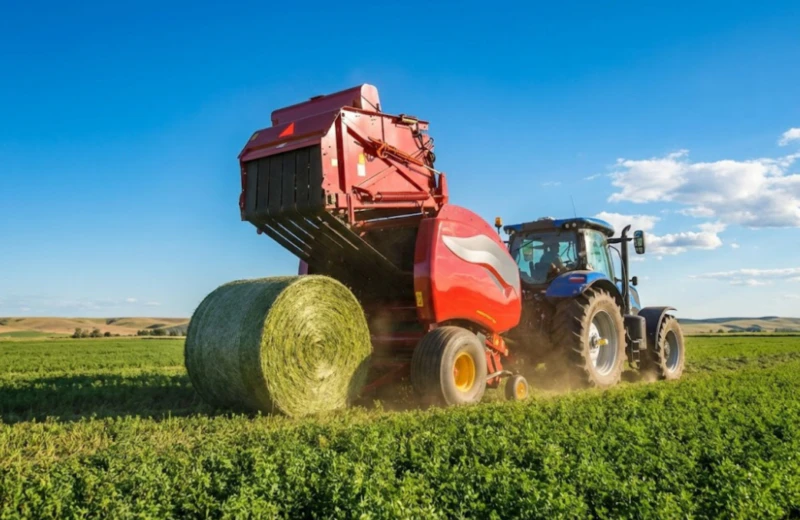
A well-formed, dense bale with a smooth surface profile provides the most consistent wrap film contact — loose or irregular bales create air pockets under the film
Layer Count: How Many Wraps Does a Silage Bale Actually Need?
The universally cited minimum for round bale silage is four layers of stretch film. This figure comes from European research in the 1990s showing that four correctly applied layers of 25-micron film pre-stretched to 55 to 70 percent produce a total effective barrier thickness sufficient to exclude oxygen during a standard fermentation and storage period of up to 12 months in temperate climates.
The practical question is whether four is always enough, or whether specific conditions justify more.
| Storage Condition | Recommended Layers | Reason |
|---|---|---|
| Flat ground, temperate climate, under 6 months | 4 | Standard condition — four layers are sufficient |
| Outdoor storage 6 – 12 months | 6 | Extended UV exposure and seasonal temperature cycling |
| Rocky or rough ground, bale movement during storage | 6 | Higher puncture risk — additional layers provide redundancy |
| High bird or rodent pressure | 6 – 8 | Additional thickness resists beak and claw puncture |
| High-DM crop (above 45% DM, sharp stems) | 6 | Stiff stems puncture film from inside during contraction |
| Tropical or high-UV climate, year-round | 8 | Accelerated UV degradation — use UV-stabilised film and add layers |
Adding layers beyond the minimum increases film cost per bale by approximately 25 to 40 percent per additional two-layer increment. On a crop valued at USD 150 to 250 per tonne, the insurance value of two extra layers — preventing a spoilage event that can destroy 20 to 50 percent of a bale’s feed value — is almost always positive. The exception is short-term storage under cover, where the minimum four layers is consistently sufficient and additional layers provide no measurable benefit.
The Seven Most Common Fermentation Failure Causes and How to Prevent Them
Silage bale fermentation failure manifests as black or brown discoloured feed with a sharp, acetone, or putrid smell at feed-out, or as visible mold growth on the surface layer of the opened bale. Identifying the cause is necessary to prevent repetition. The seven failure modes below cover the overwhelming majority of field cases.
1. Insufficient layer count
Symptom: Uniform surface spoilage across the whole bale, not localised.
Prevention: Confirm wrapper layer count setting before each session. Count film passes manually on the first bale of each day by marking a reference point on the bale with chalk before wrapping begins.
2. Excess crop moisture at baling
Symptom: Effluent (brown liquid) seeping from the bottom of the wrapped bale within days of wrapping. Clostridial fermentation producing butyric acid and ammonia rather than lactic acid.
Prevention: Target 30 to 45 percent DM (55 to 70 percent moisture) for round bale silage. Below 25 percent DM, effluent loss and clostridial risk increase sharply. Use a DM meter or oven-dry sampling before baling.
3. Delayed wrapping after baling
Symptom: Spoilage localised to the outer 5 to 10 cm of the bale — the layer exposed to aerobic conditions before wrapping.
Prevention: Wrap within 2 hours of baling. Aerobic deterioration of the outer layer begins immediately after baling. Every hour of delay between ejection and wrapping consumes water-soluble carbohydrates that the lactic acid bacteria need for fermentation.
4. Puncture during or after wrapping
Symptom: Localised mold or spoilage at one point on the bale surface, often with a visible hole or entry mark.
Prevention: Walk all bales within 48 hours of wrapping and repair any puncture immediately with silage repair tape. Remove sharp debris from the storage area. Fence birds away from the storage site. Consider increasing layer count in high-risk environments.
5. Film applied at excessive stretch
Symptom: Film appears very thin and semi-transparent after wrapping. Bale may show early surface discoloration within weeks despite correct layer count.
Prevention: Verify pre-stretch roller setting against film manufacturer specification. Reduce stretch setting in 5 percent increments and re-measure if OTR symptoms appear.
6. UV film degradation in storage
Symptom: Film becomes chalky, brittle, or cracks across the bale surface after 3 to 4 months of outdoor storage, particularly on the top surface most exposed to sun.
Prevention: Use film rated for the actual storage period. Do not use 6-month film for 12-month storage. In high-UV climates, use only films with enhanced HALS UV stabilisation and verify the rated storage period with the supplier.
7. Soil contact and ground moisture ingress
Symptom: Spoilage localised to the bottom contact zone of the bale, with soil or moisture visible at the base when bale is moved.
Prevention: Store bales on well-drained ground or a gravel pad. Avoid storing on wet, soft soil where the bale sinks and film is abraded by soil particles. Bales stored with consistent ground contact on one side benefit from an additional film layer on the base.
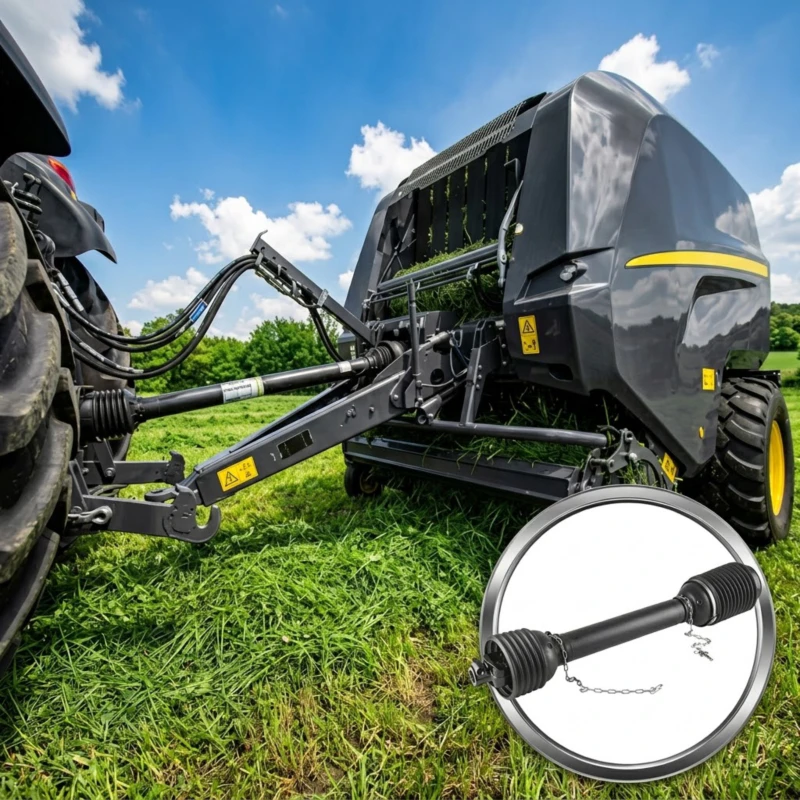
Silage baling requires consistent PTO speed throughout the bale formation cycle — speed variation affects bale density and surface uniformity, both of which influence wrap film contact
PTO speed consistency and bale surface quality: A worn PTO shaft with yoke play or driveline imbalance causes the bale chamber rollers to vary speed during bale formation. This produces bales with uneven surface profiles — ridges, flat spots, or loose outer layers — that create voids under the wrap film where oxygen can migrate laterally from a puncture or film edge. Consistent bale density and surface shape are prerequisites for effective silage wrapping. Inspecting and replacing a worn PTO shaft for New Holland big balers or equivalent machines before silage season ensures the bale entering the wrapper has the density and surface uniformity that film performance depends on.
Bale Wrapper Operation: Settings That Directly Affect Fermentation Outcome
A correctly specified film applied with incorrect wrapper settings produces the same fermentation failures as a poor-quality film. The three wrapper settings that most directly affect silage quality are overlap percentage, table rotation speed relative to film arm speed, and bale position on the wrapper table.
Film overlap percentage
Each film pass around the bale should overlap the previous pass by 50 percent of the film width. A 750 mm wide film applied at 50 percent overlap moves 375 mm along the bale axis per revolution of the film arm. Overlap below 50 percent creates zones where only two or three layers of film cover parts of the bale surface while adjacent zones receive four or more. These thin zones are where fermentation failures originate. Most modern wrappers set this automatically, but worn drive chains or damaged table rollers can cause uneven table rotation that shifts actual overlap away from the set value.
Table and film arm speed ratio
The bale rotates on the table while the film arm orbits around it. The ratio of these two speeds determines how the film is applied across the bale surface. If the table speed is too fast relative to the film arm, the film is applied in a steep helical pattern that reduces effective layer count on the cylindrical bale body. If too slow, the ends of the bale receive more layers than the sides. Consult the wrapper manual for the correct speed ratio for your film width and bale diameter. Verify by counting film layers at both the bale center and the bale end from a cut cross-section after test wrapping.
Bale centering on the table
A bale that sits off-center on the wrapper table rotates unevenly, causing the film arm to be closer to the bale on one side than the other. This alters both the effective stretch (closer means less stretch, further means more) and the layer count distribution. Center the bale carefully before starting the wrap cycle. On automatic wrapper-conveyors where bale positioning is fixed, inspect the centering guides and rollers for wear that allows lateral bale movement during wrapping.
Crop Moisture Targets for Round Bale Silage: Getting the DM Right
The fermentation biology of round bale silage is strongly influenced by dry matter content at the time of baling. Unlike clamp silage where the entire mass ferments together, each wrapped bale ferments as a discrete sealed unit. The moisture content at baling therefore determines the fermentation characteristics of that specific bale independently of every other bale on the property.
| Crop DM at Baling | Fermentation Type | Quality Outcome | Key Risk |
|---|---|---|---|
| Below 25% DM | Clostridial dominant | Poor — butyric acid, protein breakdown | Effluent loss, reduced palatability |
| 30 – 45% DM | Lactic acid dominant | Good to excellent — rapid pH drop | Minimal at correct layer count |
| 45 – 55% DM | Restricted — low moisture limits bacterial activity | Moderate — slower pH drop | Sharp stems risk film puncture from inside |
| Above 55% DM | Preservation by desiccation, not fermentation | Acceptable if fully sealed — behaves like dry hay | Very high puncture risk — consider baling as dry hay instead |
Puncture Repair: The 20-Minute Investment That Saves the Entire Bale
A single unrepaired puncture in a freshly wrapped silage bale allows atmospheric oxygen to continuously diffuse inward through the hole. Within 24 to 48 hours of puncture, the oxygen front penetrates the bale mass adjacent to the hole, supporting aerobic mold and yeast growth that progressively expands the spoilage zone. A puncture detected and repaired within 24 hours typically results in only a localised surface spoilage zone of a few kilograms. A puncture discovered at feed-out four months later may have degraded 30 to 60 kg of feed from a single bale.
Silage repair tape is a purpose-made self-adhesive polyethylene tape that bonds to the stretch film surface, creates an airtight seal over the puncture, and resists UV degradation over the same storage period as the film. Ordinary adhesive tape, duct tape, or insulating tape are not suitable substitutes — they do not bond reliably to polyethylene film, peel off within days of outdoor exposure, and leave the hole open.
Establish a daily walk of the silage storage area for the first two weeks after wrapping, when the film is under maximum internal gas pressure from active fermentation and punctures are most likely to propagate. After fermentation is complete and internal gas pressure normalises, puncture propagation slows, but repairs should still be made as soon as any damage is discovered.
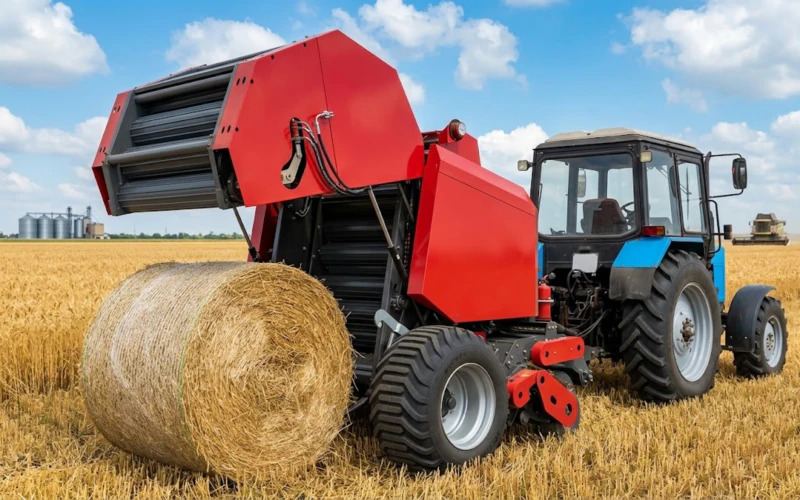
Field to storage — the chain from bale ejection to wrapped and sealed silage should be completed within two hours to minimise aerobic deterioration of the outer bale layer
Frequently Asked Questions
Conclusion: Film Quality and Application Discipline Together Determine Silage Outcome
Silage bale wrap film is not a commodity where buying the cheapest available roll is a rational cost decision. The OTR of the barrier layer, the UV stabilisation rating, and the tack compound concentration are engineering specifications that directly determine whether fermentation succeeds or fails over a storage period that may extend a year or more. A film that costs USD 0.50 less per bale but fails to maintain anaerobic conditions six months into storage destroys USD 30 to USD 80 of feed value in a single bale — a ratio that makes even significant film price premiums economically trivial.
Application discipline — correct layer count, correct stretch, correct overlap, wrapping within two hours of baling, and daily puncture inspection for the first two weeks — adds no material cost and determines a substantial fraction of the outcome independently of film quality. The combination of a correctly specified film and correct application practice produces consistent high-quality silage. Either factor in isolation leaves the operation exposed to preventable losses.
If you are selecting a round baler for silage production or evaluating baler models on the basis of bale density and surface quality — both of which affect wrap film performance — our team at balershay.com can provide specifications for our silage-configuration round baler models, including bale density range, chamber type, and net wrap compatibility.
Filed under: Silage Production | Bale Wrap Film | Round Bale Silage | Fermentation Management